Two of Swords in Yes / No
The Two of Swords in yes/no readings means 'maybe'—not because the outcome is uncertain, but because you haven't decided what you actually want the answer to be.
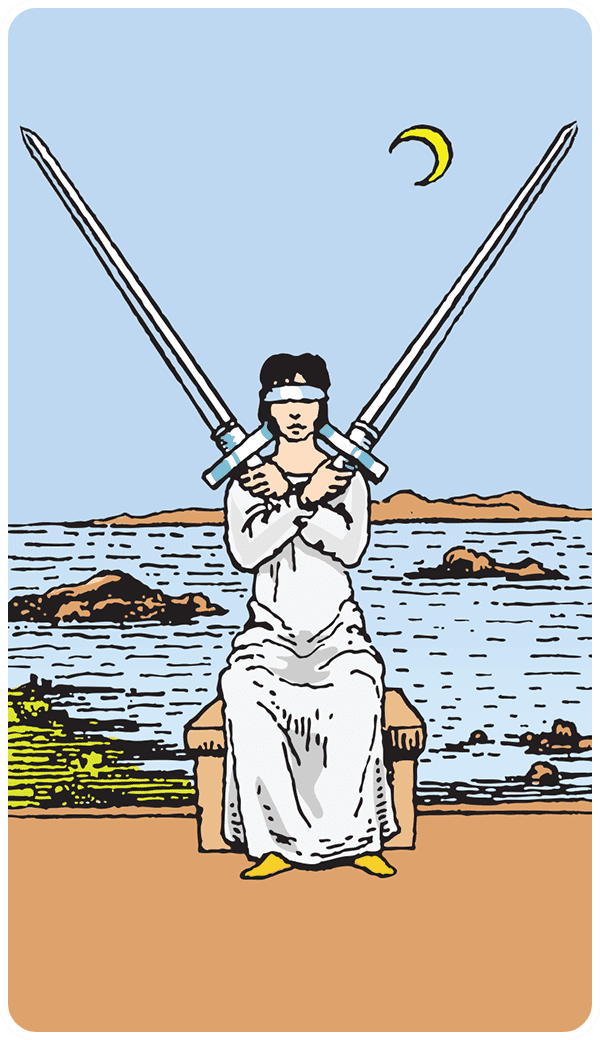
Two of Swords · plate 2
MAYBE
The Two of Swords in a yes/no reading is a maybe. Not because the outcome is uncertain, but because you are. The card doesn't name a future that hasn't landed yet—it names a present-tense stalemate you're maintaining right now. Most people read this card as "the universe hasn't decided," then sit back and wait for clarity to arrive from somewhere else. That's the misread. The universe decided already. You're the one holding two swords in perfect balance, eyes closed, refusing to let either one drop.
Why Two of Swords reads this way
What the suit, rank, and image are doing
Swords is the suit of thought, decision, and the mental frameworks you use to parse reality. It governs how you sort information, what you let yourself see, and what you decide counts as true. When Swords cards dominate a reading, the question is almost always about a choice the querent is pretending they don't have to make.
Twos in tarot describe balance, pairing, or a held tension between two forces. The Two of Cups is reciprocal affection. The Two of Pentacles is managed juggling. The Two of Swords is equilibrium achieved by refusal—you're holding two opposing thoughts at exactly the same weight so neither one wins.
Look at the image. A blindfolded figure sits with arms crossed, holding two swords upright in perfect symmetry. The posture is defensive. The blindfold isn't external—she put it on herself. Behind her, water and rocks suggest obstacles she's chosen not to look at. This is not indecision. This is active non-decision. She knows what the two options are. She's simply decided that choosing is worse than the discomfort of not choosing.
Why 'maybe' is the honest answer and when it flips
In a yes/no reading, the Two of Swords reads as 'maybe' because the outcome depends entirely on whether you're willing to drop one of the swords. If the question is "Should I take the job?" and this card appears, the answer is: you already know whether the job is right. You're just not ready to deal with what saying yes or saying no will cost you. The card won't resolve that for you.
The answer flips to 'no' when the question assumes someone else will make the choice. "Will he text me back?" with the Two of Swords means: you're waiting for him to resolve something you need to resolve about what you're actually willing to tolerate. The 'no' isn't about his behavior—it's about the fact that you're using his silence as an excuse not to decide what you want.
The answer flips to 'yes' when the question is "Am I avoiding something I need to face?" Then the card is a clean affirmative. Yes, you are. The swords are the two thoughts you're holding at equal weight so you don't have to act on either one.
The tell that you're misreading it
You're misreading the Two of Swords if you walk away from the reading and wait for more information. The card is not saying "wait for clarity." It's saying the clarity is already here and you've blindfolded yourself to it. If you find yourself checking your phone more, asking friends what they think, or pulling another card to "clarify," you're doing exactly what the figure on the card is doing—buying time, stalling, keeping both swords up.
The other tell: you feel relief when you see this card. Relief means you wanted permission to keep not choosing. The Two of Swords never gives that permission. It names the stalemate. What you do with that information is the next card.
A grounded observation
Go back through your last three major decisions and notice how long you knew the answer before you acted on it. That gap is what the Two of Swords measures. The card doesn't create the gap. It just makes you look at it.
Key themes to watch for
- № 01Theme
Affirmative current
- № 02Theme
Open door
- № 03Theme
Forward motion
What to do with this reading
Read the upright meaning first, even if you pulled the card reversed. The reversal is a commentary on the upright — not a separate card.
Notice what your body did when you saw Two of Swords. That reaction is usually closer to the truth than the interpretation.
Write down one sentence: What is this card asking me to stop avoiding? Let the answer be smaller than you expect.
Come back to this card in 48 hours. Most yes / no readings sharpen with a little distance.
Questions answered
Frequently asked
The Two of Swords in a yes/no reading is a maybe. Not because the outcome is uncertain, but because you are. The card doesn't name a future that hasn't landed yet—it names a present-tense stalemate you're maintaining right now. Most people read this card as "the universe hasn't decided," then sit back and wait for clarity to arrive from somewhere else. That's the misread. The universe decided already. You're the one holding two swords in perfect balance, eyes closed, refusing to let either one drop.
Reversed cards are rarely "bad." Two of Swords reversed asks you to look at where the same theme is blocked, postponed, or being avoided — usually with more compassion than the upright version.
Two of Swords colors the cards around it. Pay attention to where its themes — mental clarity, the truth being named, what the mind needs to release — show up in the next card. That is usually where the story is.
Tarot is observational, not predictive. Two of Swords describes the conditions in front of you right now and where they tend to lead if nothing changes — not a guarantee of timing.
Repeat cards are the deck underlining a theme. With Two of Swords, that usually means the question you are asking is the right one — but you have not yet acted on what the card is showing you.
Read next
Related readings
More Swords · Yes / No
- Ace of Swords — Yes / NoHow Ace of Swords reads in a yes / no context.
- Three of Swords — Yes / NoHow Three of Swords reads in a yes / no context.
- Four of Swords — Yes / NoHow Four of Swords reads in a yes / no context.
- Five of Swords — Yes / NoHow Five of Swords reads in a yes / no context.
- Six of Swords — Yes / NoHow Six of Swords reads in a yes / no context.
- Seven of Swords — Yes / NoHow Seven of Swords reads in a yes / no context.
Other Two of Swords readings
- General MeaningTwo of Swords read for general meaning.
- Love & RelationshipsTwo of Swords read for love & relationships.
- Career & WorkTwo of Swords read for career & work.
- Money & FinanceTwo of Swords read for money & finance.
- Health & WellbeingTwo of Swords read for health & wellbeing.
- SpiritualityTwo of Swords read for spirituality.