Six of Swords in Yes / No
The Six of Swords leans yes in yes/no readings, but only if you're willing to leave something behind. Here's what the card is actually measuring.
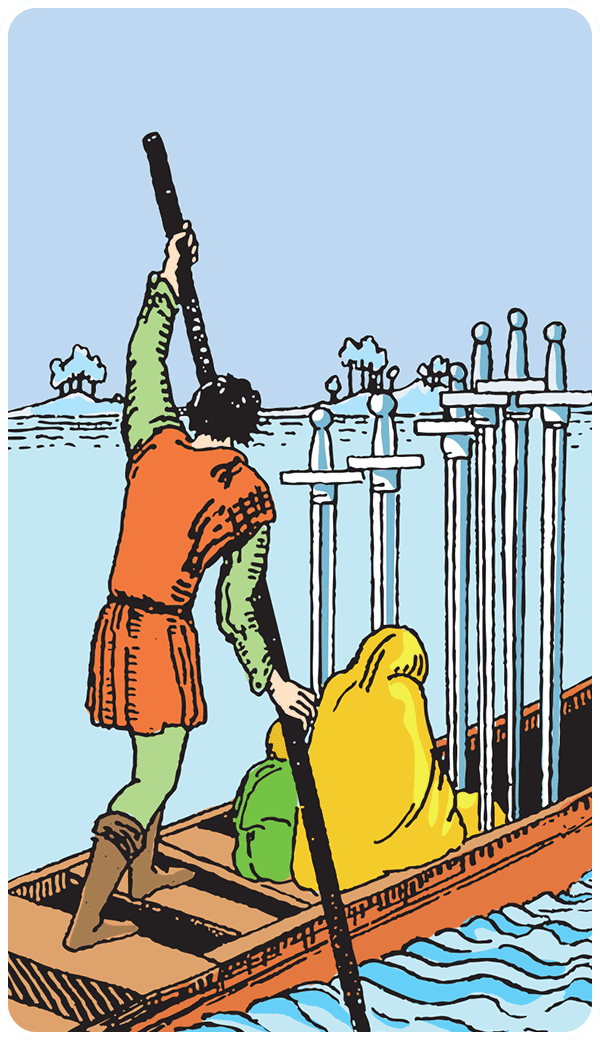
Six of Swords · plate 6
YES
The Six of Swords is a yes. But it is a yes that requires motion. If the question is 'Should I do this thing?' and doing the thing involves leaving a current situation, changing course, or walking away from what isn't working, the card reads as affirmative. If the question is 'Will this situation improve where it stands?' the answer flips to no — the card is naming the boat, not the shore. The most common misreading in yes/no contexts is treating the Six of Swords as gentle permission or a soft transition. It is neither. It is the card of necessary departure, and the yes it offers is conditional on your willingness to get in the boat.
Why Six of Swords reads this way
What the suit, the rank, and the image are doing
Swords is the suit of thought, decision, and the mental structures that either clarify or trap you. It governs how you think about a problem, what story you tell yourself about why you're stuck, and the moment you stop arguing with reality and act. When Swords cards dominate a reading, the question is almost always about whether the querent can think their way into a different position or whether they need to cut something and move.
Sixes in tarot describe temporary stability or a transitional state. They are not arrivals. The Six of Pentacles is the moment resources are moving but not yet settled. The Six of Cups is the pause where memory or nostalgia holds you before you move forward. Sixes mark the middle of a process — the part where you have left one thing but have not yet reached the next.
Now look at the image. A figure sits in a boat, head down, accompanied by a child. A ferryman poles them across water. The water is calmer on the far side than the near side. Six swords stand upright in the boat — they are traveling with the passengers, not abandoned. The card is not about escaping the problem. It is about carrying what you learned from the problem into the next place. The boat is moving. That is the entire point. In a yes/no reading, the Six of Swords is measuring whether the question involves forward motion. If it does, the answer is yes. If the question is asking whether you can stay where you are and have things improve, the card is telling you no.
How the card reads for two different querent situations
If the querent is asking 'Should I leave this job / relationship / city?' and they are already mentally halfway out the door, the Six of Swords reads as a clear yes. The card is confirming what they already know: the decision to move has been made, and the only question left is logistics. The swords in the boat are the lessons or skills or grief they are taking with them. The calmer water on the far side is not a promise of ease — it is the card saying the hardest part of the transition is the decision, not the aftermath.
If the querent is asking 'Will this situation get better?' and they are hoping the card will let them stay put, the Six of Swords reads as no. The card is not describing improvement in place. It is describing departure. The boat does not turn around. The ferryman does not stop mid-crossing. When someone pulls this card and tries to read it as 'things will improve if I wait,' they are misreading the direction of motion. The card is not about waiting. It is about leaving.
The tell that someone is misreading the card on themselves
The tell is when someone pulls the Six of Swords in a yes/no reading and immediately starts negotiating with the card. They say 'Maybe it means I should give it one more month' or 'Maybe it means things will get better slowly.' That is not what the card is saying. The Six of Swords does not describe slow improvement. It describes active transition. If you are trying to read the card as permission to stay, you are reading it backward. The yes the card offers is only available if you are willing to get in the boat. If you are not willing to get in the boat, the card is not answering your question — it is answering a different question you are not yet ready to ask.
A grounded observation
Go back through the last three times you stayed in something past the point where you knew it was over. The Six of Swords was the moment you finally let the ferryman take you across. The card does not describe the decision to leave — it describes the fact that you already left.
Key themes to watch for
- № 01Theme
Affirmative current
- № 02Theme
Open door
- № 03Theme
Forward motion
What to do with this reading
Read the upright meaning first, even if you pulled the card reversed. The reversal is a commentary on the upright — not a separate card.
Notice what your body did when you saw Six of Swords. That reaction is usually closer to the truth than the interpretation.
Write down one sentence: What is this card asking me to stop avoiding? Let the answer be smaller than you expect.
Come back to this card in 48 hours. Most yes / no readings sharpen with a little distance.
Questions answered
Frequently asked
The Six of Swords is a yes. But it is a yes that requires motion. If the question is 'Should I do this thing?' and doing the thing involves leaving a current situation, changing course, or walking away from what isn't working, the card reads as affirmative. If the question is 'Will this situation improve where it stands?' the answer flips to no — the card is naming the boat, not the shore. The most common misreading in yes/no contexts is treating the Six of Swords as gentle permission or a soft transition. It is neither. It is the card of necessary departure, and the yes it offers is conditional on your willingness to get in the boat.
Reversed cards are rarely "bad." Six of Swords reversed asks you to look at where the same theme is blocked, postponed, or being avoided — usually with more compassion than the upright version.
Six of Swords colors the cards around it. Pay attention to where its themes — mental clarity, the truth being named, what the mind needs to release — show up in the next card. That is usually where the story is.
Tarot is observational, not predictive. Six of Swords describes the conditions in front of you right now and where they tend to lead if nothing changes — not a guarantee of timing.
Repeat cards are the deck underlining a theme. With Six of Swords, that usually means the question you are asking is the right one — but you have not yet acted on what the card is showing you.
Read next
Related readings
More Swords · Yes / No
- Ace of Swords — Yes / NoHow Ace of Swords reads in a yes / no context.
- Two of Swords — Yes / NoHow Two of Swords reads in a yes / no context.
- Three of Swords — Yes / NoHow Three of Swords reads in a yes / no context.
- Four of Swords — Yes / NoHow Four of Swords reads in a yes / no context.
- Five of Swords — Yes / NoHow Five of Swords reads in a yes / no context.
- Seven of Swords — Yes / NoHow Seven of Swords reads in a yes / no context.
Other Six of Swords readings
- General MeaningSix of Swords read for general meaning.
- Love & RelationshipsSix of Swords read for love & relationships.
- Career & WorkSix of Swords read for career & work.
- Money & FinanceSix of Swords read for money & finance.
- Health & WellbeingSix of Swords read for health & wellbeing.
- SpiritualitySix of Swords read for spirituality.