Three of Swords in Yes / No
The Three of Swords reads as no in most yes/no questions — not because the outcome is doomed, but because the thing you're asking about carries a cost you haven't named yet.
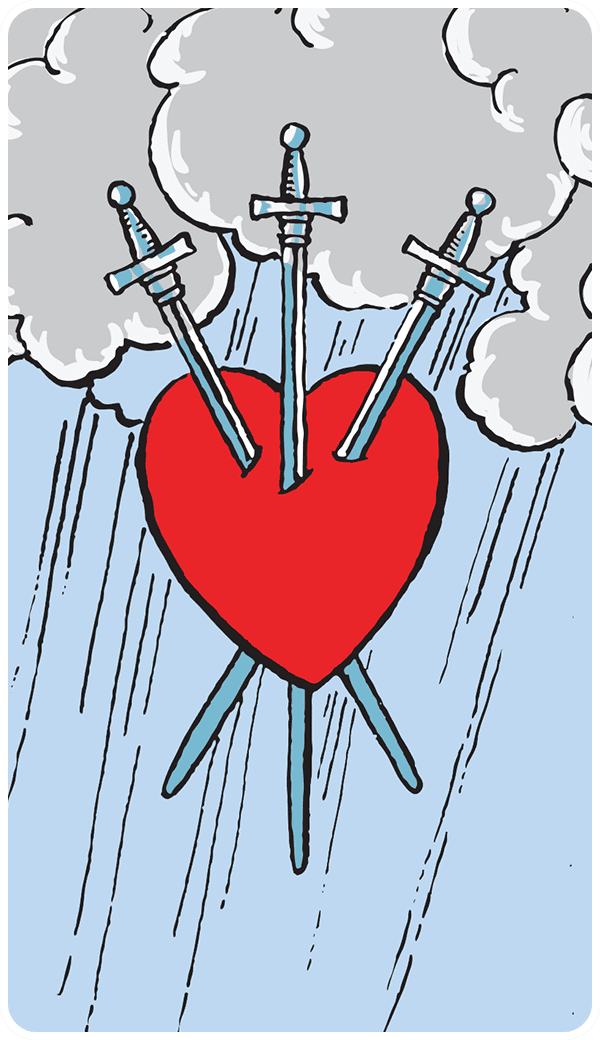
Three of Swords · plate 3
NO
The Three of Swords is a no. Not always, but in most yes/no readings, this card lands as a rejection or a loss or a thing that doesn't happen the way you want it to. The mistake people make is reading that no as punishment — as the universe blocking them, as evidence they're not meant to have what they want. That's not what the card is doing. The Three of Swords names the grief or betrayal or disappointment that is already present in the situation, whether you move forward or not. The no is protective. It's the part of you that knows the cost and is trying to stop you from paying it.
Why Three of Swords reads this way
What the suit, rank, and image are doing
Swords is the suit of thought, perception, and the stories you tell yourself about what is happening. It governs clarity and also distortion — the difference between seeing a thing accurately and seeing it through the lens of your own fear or hope. When Swords cards show up in a reading, the question being asked is almost always about whether something is true, whether you should believe someone, whether the risk is worth it.
Threes in tarot describe a point of tension or imbalance that has not yet resolved. The energy of a three is unstable. Something has been set in motion and the outcome is not yet determined, but the current trajectory is visible. The Three of Wands is expansion that hasn't landed yet. The Three of Pentacles is collaboration that hasn't been tested. The Three of Swords is heartbreak that is either happening now or is about to.
The image is blunt. Three swords pierce a heart. The heart is not defended. The swords are not decorative. This is the card of the thing that cuts through your reasoning and lands in the soft part. Betrayal. Rejection. The conversation where someone tells you the truth you didn't want to hear. The card does not describe ambiguity. It describes pain that has a shape.
Why it reads as no — and the one time it doesn't
In a yes/no reading, the Three of Swords almost always means the thing you're asking about will not go the way you want, or it will go that way and hurt more than you think it will. If you're asking "Will they come back?" and you pull this card, the answer is either no, or yes-but-it-will-be-worse. If you're asking "Should I take this job?" the answer is that the job comes with a betrayal or a disillusionment you're not seeing yet.
The card flips to a yes in exactly one situation: when the question is "Should I leave?" or "Is it time to cut this off?" In that case, the Three of Swords is a yes — not because leaving will feel good, but because the cut is necessary and you already know it. The swords are doing the work you've been avoiding.
Reversed, the card sometimes softens into "the worst has already happened" or "you're healing from the cut." In a yes/no context, reversed can mean the no has already been delivered and you're asking the question after the fact, looking for permission to stop hoping.
The tell that you're misreading it
The tell is when you pull the Three of Swords and immediately start negotiating with it. "Maybe it just means a small disappointment." "Maybe it's clearing out the old hurt so the new thing can come in." "Maybe if I do X differently, the swords won't land." If you're doing that, you're misreading the card on yourself.
The Three of Swords does not negotiate. It does not mean a small disappointment. It means the thing that makes you sit on the floor. The reason you're negotiating is because you already know the answer is no and you don't want it to be. The card is not predicting your future. It is naming the grief or the betrayal that is already present in the situation, waiting for you to see it. When you stop negotiating and let the no be a no, the card has done its job.
A grounded observation
Go back through your calendar and look for the last time you asked a yes/no question and got an answer you spent three days trying to reframe. That was this card, whether you pulled it or not.
Key themes to watch for
- № 01Theme
Affirmative current
- № 02Theme
Open door
- № 03Theme
Forward motion
What to do with this reading
Read the upright meaning first, even if you pulled the card reversed. The reversal is a commentary on the upright — not a separate card.
Notice what your body did when you saw Three of Swords. That reaction is usually closer to the truth than the interpretation.
Write down one sentence: What is this card asking me to stop avoiding? Let the answer be smaller than you expect.
Come back to this card in 48 hours. Most yes / no readings sharpen with a little distance.
Questions answered
Frequently asked
The Three of Swords is a no. Not always, but in most yes/no readings, this card lands as a rejection or a loss or a thing that doesn't happen the way you want it to. The mistake people make is reading that no as punishment — as the universe blocking them, as evidence they're not meant to have what they want. That's not what the card is doing. The Three of Swords names the grief or betrayal or disappointment that is already present in the situation, whether you move forward or not. The no is protective. It's the part of you that knows the cost and is trying to stop you from paying it.
Reversed cards are rarely "bad." Three of Swords reversed asks you to look at where the same theme is blocked, postponed, or being avoided — usually with more compassion than the upright version.
Three of Swords colors the cards around it. Pay attention to where its themes — mental clarity, the truth being named, what the mind needs to release — show up in the next card. That is usually where the story is.
Tarot is observational, not predictive. Three of Swords describes the conditions in front of you right now and where they tend to lead if nothing changes — not a guarantee of timing.
Repeat cards are the deck underlining a theme. With Three of Swords, that usually means the question you are asking is the right one — but you have not yet acted on what the card is showing you.
Read next
Related readings
More Swords · Yes / No
- Ace of Swords — Yes / NoHow Ace of Swords reads in a yes / no context.
- Two of Swords — Yes / NoHow Two of Swords reads in a yes / no context.
- Four of Swords — Yes / NoHow Four of Swords reads in a yes / no context.
- Five of Swords — Yes / NoHow Five of Swords reads in a yes / no context.
- Six of Swords — Yes / NoHow Six of Swords reads in a yes / no context.
- Seven of Swords — Yes / NoHow Seven of Swords reads in a yes / no context.
Other Three of Swords readings
- General MeaningThree of Swords read for general meaning.
- Love & RelationshipsThree of Swords read for love & relationships.
- Career & WorkThree of Swords read for career & work.
- Money & FinanceThree of Swords read for money & finance.
- Health & WellbeingThree of Swords read for health & wellbeing.
- SpiritualityThree of Swords read for spirituality.