Four of Swords in Yes / No
The Four of Swords in a yes/no reading almost always means not yet. Here's what the card is actually describing and why people misread stillness as refusal.
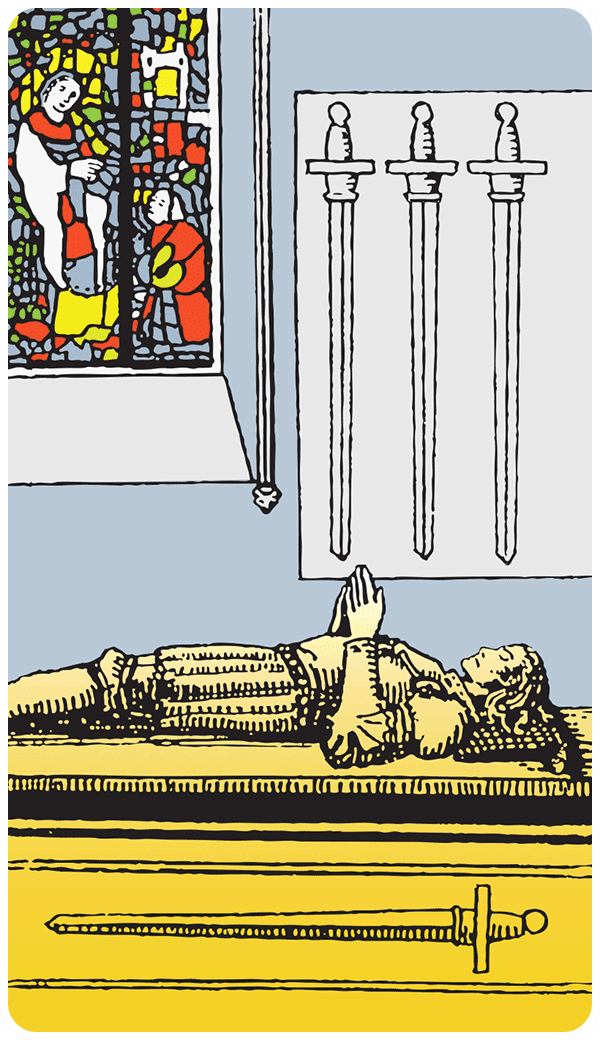
Four of Swords · plate 4
MAYBE
The Four of Swords in a yes/no reading is a maybe that leans toward not yet. The card describes a pause, not a verdict. Most querents read it as a no and feel dismissed. What the card is actually saying is that the conditions for a clean yes don't exist right now — something needs to settle, or you need to stop moving long enough to see what you actually want. The answer arrives after the rest, not during it.
Why Four of Swords reads this way
What the card is doing and why people read it as rejection
Swords is the suit of thought, conflict, and the mental structures you use to parse reality. It governs decision-making, clarity, and the way you cut through ambiguity to name what is true. When Swords cards dominate a reading, the question is almost always about whether something makes sense, not whether it feels right.
Fours in tarot describe stability, but it's the stability of a foundation or a container — something that holds still long enough for the next thing to build on top of it. The Four of Pentacles is resources held; the Four of Cups is emotional withdrawal. The Four of Swords is mental stillness. It is rest as a structural requirement, not rest as a luxury.
The image shows a figure lying on a stone slab, hands folded in prayer, three swords mounted on the wall above and one sword beneath the slab. It reads like a tomb. People see it and think death, or defeat, or the question being taken off the table entirely. That is not what is happening. The figure is not dead. The swords are sheathed. The posture is deliberate. This is someone who has stopped fighting long enough to let the dust settle. The card describes recuperation, not refusal.
Most people read the Four of Swords in a yes/no spread as a hard no because it doesn't give them forward motion. They wanted the question resolved and the card handed them a pause instead. But a pause is not a verdict. It is the condition that precedes a verdict you can trust.
How the card reads for two different querent situations
If the querent is asking a yes/no question while exhausted — burned out from a job search, wrung out from a relationship conflict, decision-fatigued from trying to force clarity — the Four of Swords is describing what is already true. You are too tired to see the answer clearly. The card is not saying no; it is saying you will not know until you stop trying to know. The yes or no reveals itself after rest, not during the push.
If the querent is asking a yes/no question as a way to avoid sitting with uncertainty — they want the cards to decide so they don't have to hold the discomfort of not knowing — the Four of Swords is describing what they are resisting. The mental thrash is the problem. The card is naming that the question does not need an answer right now, and the compulsion to force one is what is keeping the real answer from landing. The clarity they want is on the other side of letting the question sit.
Reversed, the Four of Swords often describes someone who refused the rest and is now operating from a depleted place. The yes/no question is being asked from a frame that cannot hold a real answer. The reversed card says: you are asking the wrong question, or you are asking it too soon, or you are asking it because you are too tired to trust yourself. The answer is still not yet, but now with more urgency about the rest.
The tell that someone is misreading the card on themselves
The tell is when someone sees the Four of Swords in a yes/no spread and immediately asks a follow-up question to try to get around it. They pull another card. They rephrase the question. They want to know when the yes will come, as if the card promised a yes and just delayed it. That is not what happened. The card described a state — you are too close to this question to see it clearly — and the querent tried to argue with the state instead of inhabiting it. If you find yourself negotiating with the Four of Swords, you have proven why it showed up.
A grounded observation
Go back through your calendar and look for the last time you got a clear answer to something without trying. It probably came during a walk, or in the shower, or the morning after you finally stopped thinking about it. That is what the Four of Swords is describing.
Key themes to watch for
- № 01Theme
Affirmative current
- № 02Theme
Open door
- № 03Theme
Forward motion
What to do with this reading
Read the upright meaning first, even if you pulled the card reversed. The reversal is a commentary on the upright — not a separate card.
Notice what your body did when you saw Four of Swords. That reaction is usually closer to the truth than the interpretation.
Write down one sentence: What is this card asking me to stop avoiding? Let the answer be smaller than you expect.
Come back to this card in 48 hours. Most yes / no readings sharpen with a little distance.
Questions answered
Frequently asked
The Four of Swords in a yes/no reading is a maybe that leans toward not yet. The card describes a pause, not a verdict. Most querents read it as a no and feel dismissed. What the card is actually saying is that the conditions for a clean yes don't exist right now — something needs to settle, or you need to stop moving long enough to see what you actually want. The answer arrives after the rest, not during it.
Reversed cards are rarely "bad." Four of Swords reversed asks you to look at where the same theme is blocked, postponed, or being avoided — usually with more compassion than the upright version.
Four of Swords colors the cards around it. Pay attention to where its themes — mental clarity, the truth being named, what the mind needs to release — show up in the next card. That is usually where the story is.
Tarot is observational, not predictive. Four of Swords describes the conditions in front of you right now and where they tend to lead if nothing changes — not a guarantee of timing.
Repeat cards are the deck underlining a theme. With Four of Swords, that usually means the question you are asking is the right one — but you have not yet acted on what the card is showing you.
Read next
Related readings
More Swords · Yes / No
- Ace of Swords — Yes / NoHow Ace of Swords reads in a yes / no context.
- Two of Swords — Yes / NoHow Two of Swords reads in a yes / no context.
- Three of Swords — Yes / NoHow Three of Swords reads in a yes / no context.
- Five of Swords — Yes / NoHow Five of Swords reads in a yes / no context.
- Six of Swords — Yes / NoHow Six of Swords reads in a yes / no context.
- Seven of Swords — Yes / NoHow Seven of Swords reads in a yes / no context.
Other Four of Swords readings
- General MeaningFour of Swords read for general meaning.
- Love & RelationshipsFour of Swords read for love & relationships.
- Career & WorkFour of Swords read for career & work.
- Money & FinanceFour of Swords read for money & finance.
- Health & WellbeingFour of Swords read for health & wellbeing.
- SpiritualityFour of Swords read for spirituality.