Ace of Swords in Yes / No
The Ace of Swords leans yes in a yes/no reading, but only if you're willing to cut through what's keeping the question murky. Here's what the card is actually saying.
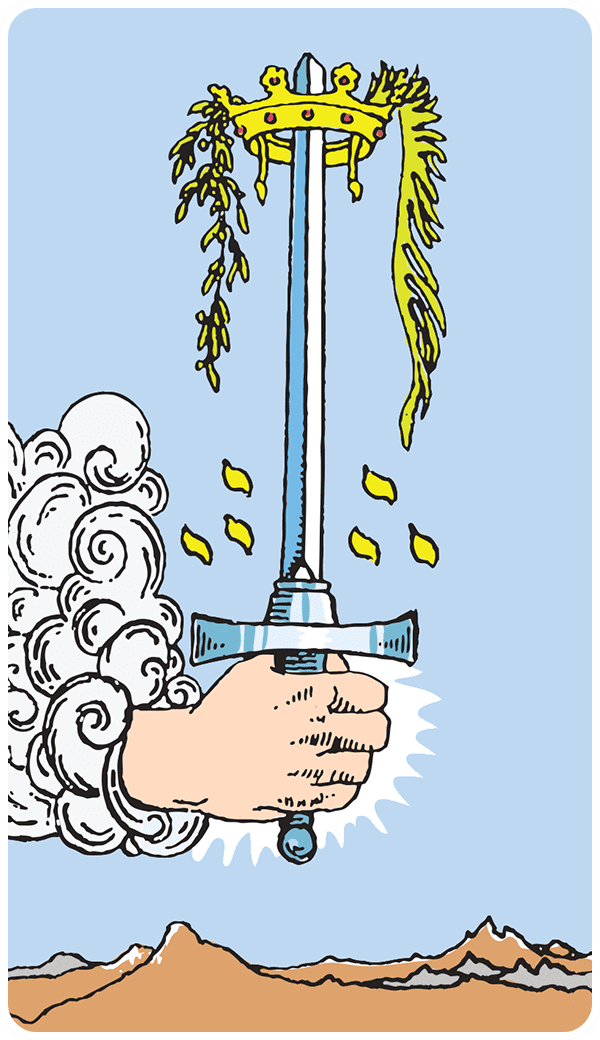
Ace of Swords · plate 1
YES
The Ace of Swords leans yes, but it's a yes with a condition attached. The card doesn't promise the thing will happen on its own. It says the clarity required to make it happen is now available — if you're willing to use it. Most people read the Ace of Swords as a clean affirmative and then wonder why the situation stayed stuck. The card wasn't lying. They just didn't pick up the sword.
Why Ace of Swords reads this way
What the suit, the rank, and the image are doing
Swords is the suit of thought, discernment, and the cut that separates signal from noise. It governs clarity, decision-making, and the part of you that can see a situation plainly even when your heart wants to blur it. Swords cards show up when the question is tangled in confusion, wishful thinking, or a story you've been telling yourself that no longer matches the facts.
Aces are thresholds. They describe the moment a new capacity becomes available, not the moment that capacity gets used. The Ace of Swords is not the decision made — it's the sudden ability to see what the decision should be. The mental fog lifts. The right question finally clarifies. You can now think your way through something that was previously opaque.
Look at the image: a hand emerging from a cloud, holding a sword upright. The blade is sharp, double-edged, unsheathed. A crown sits at the tip, wreathed in laurel and palm. The sword is being offered to you. It has not been swung. It has not cut anything yet. The card describes the availability of clarity, not the action that follows clarity. Whether you take the sword and use it is a separate question.
The most common misreading in a yes/no context is treating the Ace of Swords like a green light. The querent pulls it, reads "new beginning in the mental realm," and concludes the answer is yes and the thing will now unfold on its own. Three weeks later, nothing has moved. They feel confused. The card seemed so clear. What they missed is that the Ace of Swords doesn't do the work for you. It hands you the tool. If you don't pick it up and make the cut — end the conversation, send the email, stop pretending you don't already know — the situation stays exactly where it was.
How the answer changes depending on what you're asking
If the question is "Will this opportunity come through?" and the Ace of Swords appears, the answer is yes — but only if you stop waiting and start clarifying. Call and ask for the terms. Write the proposal. Name the thing that's been left vague. The opportunity exists, but it will not materialize while everyone is still talking around it.
If the question is "Should I stay in this relationship?" and the Ace of Swords shows up, the answer is not yes or no — it's that you already know, and the card is pointing at the fact that you've been avoiding the knowing. Go back through the last six months and notice how many times you've had the same realization and then talked yourself out of it. That's the pattern the Ace of Swords is naming. The clarity is not new. Your willingness to act on it is what's being offered.
Reversed, the Ace of Swords reads as clarity that arrived and then got ignored, or a decision that's being delayed because the querent is hoping the situation will resolve itself without them having to do the hard thing. The sword is still in reach. It's just face-down on the table while they pretend they don't see it.
The tell that you're misreading the card
You're misreading the Ace of Swords if you feel relieved when you pull it. Relief means you think the card is taking responsibility off your plate. The Ace of Swords does the opposite — it puts the next move back on you. If you pull this card and your first thought is "good, so it's handled," you've missed what it's saying. The correct feeling when the Ace of Swords shows up in a yes/no reading is not relief. It's recognition.
A grounded observation
Go back through your calendar and find the moment in the last two weeks when you suddenly saw the situation clearly, had the thought you'd been avoiding, and then did nothing with it. That was the Ace of Swords. The question is whether you're going to pick it up.
Key themes to watch for
- № 01Theme
Affirmative current
- № 02Theme
Open door
- № 03Theme
Forward motion
What to do with this reading
Read the upright meaning first, even if you pulled the card reversed. The reversal is a commentary on the upright — not a separate card.
Notice what your body did when you saw Ace of Swords. That reaction is usually closer to the truth than the interpretation.
Write down one sentence: What is this card asking me to stop avoiding? Let the answer be smaller than you expect.
Come back to this card in 48 hours. Most yes / no readings sharpen with a little distance.
Questions answered
Frequently asked
The Ace of Swords leans yes, but it's a yes with a condition attached. The card doesn't promise the thing will happen on its own. It says the clarity required to make it happen is now available — if you're willing to use it. Most people read the Ace of Swords as a clean affirmative and then wonder why the situation stayed stuck. The card wasn't lying. They just didn't pick up the sword.
Reversed cards are rarely "bad." Ace of Swords reversed asks you to look at where the same theme is blocked, postponed, or being avoided — usually with more compassion than the upright version.
Ace of Swords colors the cards around it. Pay attention to where its themes — mental clarity, the truth being named, what the mind needs to release — show up in the next card. That is usually where the story is.
Tarot is observational, not predictive. Ace of Swords describes the conditions in front of you right now and where they tend to lead if nothing changes — not a guarantee of timing.
Repeat cards are the deck underlining a theme. With Ace of Swords, that usually means the question you are asking is the right one — but you have not yet acted on what the card is showing you.
Read next
Related readings
More Swords · Yes / No
- Two of Swords — Yes / NoHow Two of Swords reads in a yes / no context.
- Three of Swords — Yes / NoHow Three of Swords reads in a yes / no context.
- Four of Swords — Yes / NoHow Four of Swords reads in a yes / no context.
- Five of Swords — Yes / NoHow Five of Swords reads in a yes / no context.
- Six of Swords — Yes / NoHow Six of Swords reads in a yes / no context.
- Seven of Swords — Yes / NoHow Seven of Swords reads in a yes / no context.
Other Ace of Swords readings
- General MeaningAce of Swords read for general meaning.
- Love & RelationshipsAce of Swords read for love & relationships.
- Career & WorkAce of Swords read for career & work.
- Money & FinanceAce of Swords read for money & finance.
- Health & WellbeingAce of Swords read for health & wellbeing.
- SpiritualityAce of Swords read for spirituality.