Five of Swords in Yes / No
The Five of Swords in yes/no readings leans no — not because you can't win, but because the win will leave you isolated. Here's what the card actually tracks.
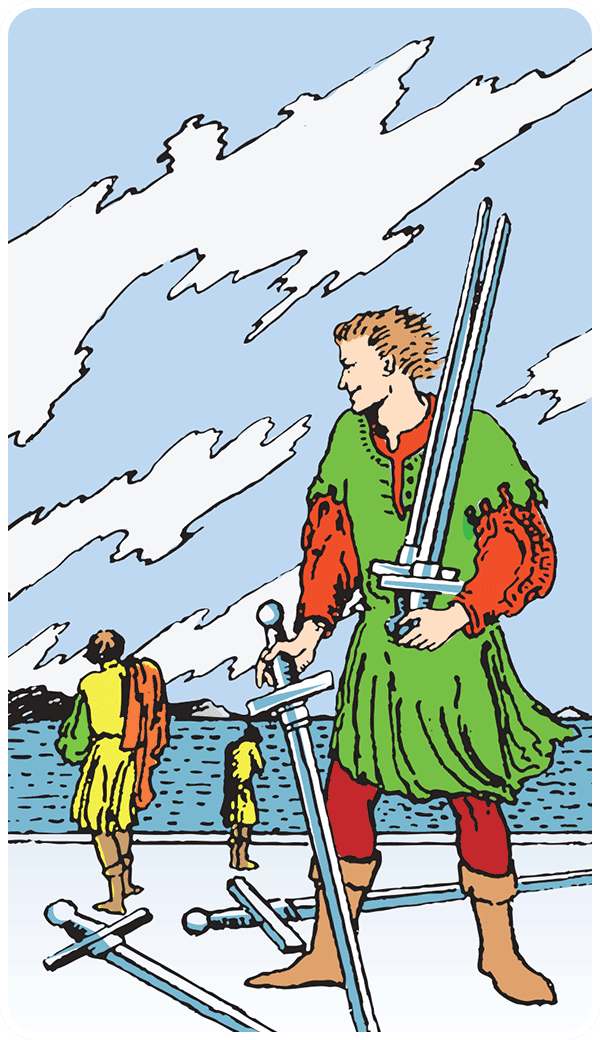
Five of Swords · plate 5
NO
The Five of Swords in a yes/no reading is a no. Not because the thing you want is impossible, but because getting it will cost you more than you think you're willing to pay. The card doesn't describe defeat. It describes the moment after a win when you look around and realize everyone else has walked off the field. Most people read the Five of Swords as "conflict" and stop there. They think the card is warning them about a fight, so they brace for opposition or prepare a defense. That's not what the image is tracking. The fight is over. Someone is holding the swords. The question the card is actually asking is whether you want to be that person.
Why Five of Swords reads this way
What the suit, rank, and image are doing
Swords governs thought, argument, and the social contract — the agreements and disagreements that structure how people move around each other. It is the suit of what gets said, what gets withheld, and what gets used as leverage. When Swords cards show up, the question is almost always about a relational or intellectual position someone is trying to hold or advance.
Fives in tarot name instability. They are the number of imbalance, of something that cannot hold its current form. The Four was stable; the Six will resolve; the Five is the wobble in between. Fives describe a situation where the structure is off and someone is scrambling to manage it.
Now look at the image. A figure holds three swords. Two swords lie on the ground. Two other figures walk away in the background, heads down. The sky is turbulent. The figure holding the swords is looking at the ones walking away. This is not a person mid-battle. This is a person who has won an argument or taken a position and is now standing alone with the spoils. The card names the moment you realize that being right, or being first, or getting your way has separated you from the people you thought you'd be celebrating with.
Why the answer is almost always no
The Five of Swords does not say the thing you want is unavailable. It says the method required to get it — the argument you'll have to win, the position you'll have to take, the person you'll have to outmaneuver — will damage the relationship or the context in a way that makes the win feel hollow. If the question is "Should I push for this promotion?" and the Five of Swords shows up, the card is not saying you won't get the promotion. It is saying that getting it will require you to undercut a colleague or break an alliance, and six months later you will be sitting in the new office wondering why no one is returning your calls.
The answer flips to yes in exactly one scenario: when the querent has already decided the relationship or the context is not worth preserving. If you are asking "Should I leave this job?" and you genuinely do not care about burning the bridge on your way out, the Five of Swords reads as yes — you will get out, and the fact that you're leaving scorched earth behind you is not a cost you're counting.
The tell that someone is misreading the card
The most common misread is treating the Five of Swords as a card about external opposition — "someone is going to fight me" or "there will be conflict I have to navigate." That is not what the card describes. The conflict has already happened or is about to resolve. The card is describing what you will feel after you win it. If someone pulls the Five of Swords in a yes/no reading and their first move is to start planning their argument or shoring up their defenses, they are not reading the card. They are reading their own anxiety and using the card as confirmation.
The other version: someone reads the card as "no, because I'll lose the fight." That is also wrong. The card assumes you can win. The no is about what winning will cost you relationally, not whether victory is possible.
A grounded observation
Go back through your last six months and find the argument you won. Notice who stopped calling after. That is what the Five of Swords is naming before it happens.
Key themes to watch for
- № 01Theme
Affirmative current
- № 02Theme
Open door
- № 03Theme
Forward motion
What to do with this reading
Read the upright meaning first, even if you pulled the card reversed. The reversal is a commentary on the upright — not a separate card.
Notice what your body did when you saw Five of Swords. That reaction is usually closer to the truth than the interpretation.
Write down one sentence: What is this card asking me to stop avoiding? Let the answer be smaller than you expect.
Come back to this card in 48 hours. Most yes / no readings sharpen with a little distance.
Questions answered
Frequently asked
The Five of Swords in a yes/no reading is a no. Not because the thing you want is impossible, but because getting it will cost you more than you think you're willing to pay. The card doesn't describe defeat. It describes the moment after a win when you look around and realize everyone else has walked off the field. Most people read the Five of Swords as "conflict" and stop there. They think the card is warning them about a fight, so they brace for opposition or prepare a defense. That's not what the image is tracking. The fight is over. Someone is holding the swords. The question the card is actually asking is whether you want to be that person.
Reversed cards are rarely "bad." Five of Swords reversed asks you to look at where the same theme is blocked, postponed, or being avoided — usually with more compassion than the upright version.
Five of Swords colors the cards around it. Pay attention to where its themes — mental clarity, the truth being named, what the mind needs to release — show up in the next card. That is usually where the story is.
Tarot is observational, not predictive. Five of Swords describes the conditions in front of you right now and where they tend to lead if nothing changes — not a guarantee of timing.
Repeat cards are the deck underlining a theme. With Five of Swords, that usually means the question you are asking is the right one — but you have not yet acted on what the card is showing you.
Read next
Related readings
More Swords · Yes / No
- Ace of Swords — Yes / NoHow Ace of Swords reads in a yes / no context.
- Two of Swords — Yes / NoHow Two of Swords reads in a yes / no context.
- Three of Swords — Yes / NoHow Three of Swords reads in a yes / no context.
- Four of Swords — Yes / NoHow Four of Swords reads in a yes / no context.
- Six of Swords — Yes / NoHow Six of Swords reads in a yes / no context.
- Seven of Swords — Yes / NoHow Seven of Swords reads in a yes / no context.
Other Five of Swords readings
- General MeaningFive of Swords read for general meaning.
- Love & RelationshipsFive of Swords read for love & relationships.
- Career & WorkFive of Swords read for career & work.
- Money & FinanceFive of Swords read for money & finance.
- Health & WellbeingFive of Swords read for health & wellbeing.
- SpiritualityFive of Swords read for spirituality.