Two of Swords in Love
The Two of Swords in love readings gets read as indecision. It's not. It's the active choice to stay suspended when both options feel like losses.
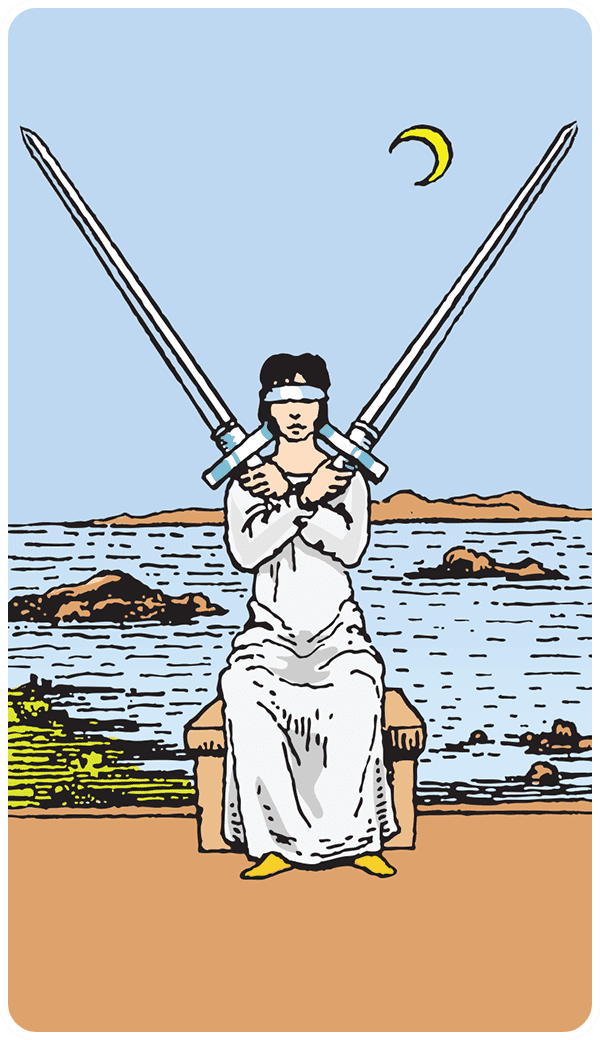
Two of Swords · plate 2
What the card is actually doing
The Two of Swords shows up in a love reading and the querent immediately says they're stuck. They can't decide. They don't know what they want. They're waiting for clarity. That is not what the card is describing. The Two of Swords is not about lacking information or waiting for a sign. It's about the moment you realize that choosing means losing something, so you choose suspension instead. The stalemate is not passive. It is the thing you are actively maintaining.
Reading Two of Swords in love
What the suit, the rank, and the image are doing
Swords is the suit of thought, discernment, and the part of the mind that names what is true even when the truth is uncomfortable. It governs the cuts you make in conversation, the arguments you have with yourself at 3am, and the moment you stop pretending something is working when it isn't. When Swords cards dominate a reading, the querent is thinking their way through a problem that may not have a thinking solution.
Twos in tarot describe a holding pattern between two forces. The Two of Pentacles is juggling resources. The Two of Wands is standing between a known path and an unknown one. The Two of Swords is the mind holding two incompatible truths at the same time without resolving them. It is not confusion. It is the refusal to choose because both choices require grief.
Look at the image. A figure sits blindfolded, arms crossed over the chest, holding two swords in perfect balance. The water behind them is still. They are not moving. They are not looking. The blindfold is not something that happened to them — they are wearing it. The stalemate is self-imposed. The card is describing the moment you decide that not-choosing is safer than choosing wrong.
How it reads for two different situations
If the querent is in a relationship that has gone cold, the Two of Swords names the part of them that knows it's over but will not say it out loud. They are holding the relationship and the exit in equal suspension. Every conversation stops one inch before the real question. They are waiting for the other person to end it, or for some external event to make the choice for them, because naming it themselves means they are the one who killed it. The card is not advising patience. It is naming the cost of the wait.
If the querent is choosing between two people, the Two of Swords describes the fantasy that if they stay suspended long enough, one option will become obviously right and the other obviously wrong. It won't. What tends to happen is that the suspension itself becomes the third option, and they stay there until one or both people leave. The card is pointing to the part of them that believes that not-choosing means they don't have to be responsible for the outcome. That is not how responsibility works.
The tell that someone is misreading it
The querent says they need more time. They say they need more information. They say they're waiting to feel sure. If you ask them what specific piece of information would resolve the question, they cannot name it. The Two of Swords shows up when the information is already in. The choice is not unclear. The choice is painful, and the pain is being mistaken for uncertainty. The misreading is treating the stalemate as a neutral holding space instead of an active decision to avoid loss. The longer the suspension lasts, the more the querent's life arranges itself around not-choosing, and the harder it becomes to move.
From the practice
“A card never tells you what to do. It tells you what you're already deciding — and gives you the words to name it.”
A grounded observation
Go back through your calendar and look for the moment you first knew what the choice was. The Two of Swords does not show up at the beginning of confusion. It shows up after.
Key themes to watch for
- № 01Theme
Vulnerability
- № 02Theme
New chapters
- № 03Theme
Emotional truth
What to do with this reading
Read the upright meaning first, even if you pulled the card reversed. The reversal is a commentary on the upright — not a separate card.
Notice what your body did when you saw Two of Swords. That reaction is usually closer to the truth than the interpretation.
Write down one sentence: What is this card asking me to stop avoiding? Let the answer be smaller than you expect.
Come back to this card in 48 hours. Most love readings sharpen with a little distance.
Questions answered
Frequently asked
In relationships, the Two of Swords brings a moment of impasse. You or your partner may be avoiding a difficult conversation, preferring silence over conflict. This card reflects the need for honesty, even if it feels uncomfortable. Are there truths you're keeping at bay to maintain harmony? Take stock of what silence costs you. A thoughtful dialogue might release the tension, even if the path forward is still unclear. Consider whether peace or truth is more valuable to you at this moment.
Reversed, this card in love signals a breaking point. The avoidance of issues may have led to a rupture, forcing an overdue confrontation. The silence is broken, but that can lead to growth. It might be uncomfortable, but it's a necessary storm that clears the air. Notice how the release of tension affects your connection. What new understanding can emerge from this? Acknowledge that resolution often follows disruption, even if it feels messy right now.
Two of Swords colors the cards around it. Pay attention to where its themes — mental clarity, the truth being named, what the mind needs to release — show up in the next card. That is usually where the story is.
Tarot is observational, not predictive. Two of Swords describes the conditions in front of you right now and where they tend to lead if nothing changes — not a guarantee of timing.
Repeat cards are the deck underlining a theme. With Two of Swords, that usually means the question you are asking is the right one — but you have not yet acted on what the card is showing you.
Read next
Related readings
More Swords · Love
- Ace of Swords — LoveHow Ace of Swords reads in a love context.
- Three of Swords — LoveHow Three of Swords reads in a love context.
- Four of Swords — LoveHow Four of Swords reads in a love context.
- Five of Swords — LoveHow Five of Swords reads in a love context.
- Six of Swords — LoveHow Six of Swords reads in a love context.
- Seven of Swords — LoveHow Seven of Swords reads in a love context.
Other Two of Swords readings
- General MeaningTwo of Swords read for general meaning.
- Career & WorkTwo of Swords read for career & work.
- Money & FinanceTwo of Swords read for money & finance.
- Health & WellbeingTwo of Swords read for health & wellbeing.
- SpiritualityTwo of Swords read for spirituality.
- Yes / No AnswerTwo of Swords read for yes / no answer.