Seven of Swords in Love
The Seven of Swords in love readings gets read as 'they're cheating' when the card is actually naming the strategy you're using to avoid being seen.
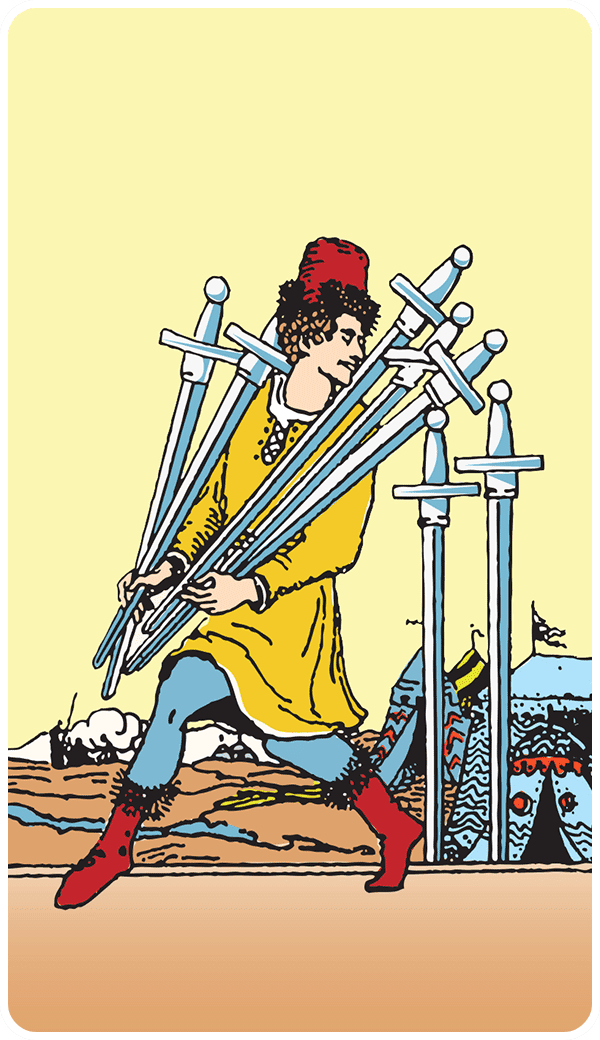
Seven of Swords · plate 7
What the card is actually doing
The Seven of Swords shows up in a love reading and the first question out of the querent's mouth is always some version of 'are they lying to me.' They want to know if their partner is cheating, if the person they're dating is still on the apps, if the ex who keeps texting has a hidden agenda. The card gets flattened into a simple betrayal marker — someone is being dishonest, someone is sneaking around, someone cannot be trusted.
That is not what the card is doing. The Seven of Swords does not report on someone else's behavior. It names the part of you that has decided not to show up fully, and the strategy you are using to protect yourself from being known.
Reading Seven of Swords in love
What the suit, the rank, and the image are actually describing
Swords is the suit of thought, communication, and the stories you tell yourself about what is happening. It governs how you frame a situation, what you decide it means, and how you use language — internal or spoken — to manage threat. When Swords dominate a reading, the real question is almost always about what narrative the querent has locked into and whether that narrative is load-bearing or just familiar.
Sevens in tarot describe strategy under pressure. They are not victories and they are not disasters. They are the moment you make a calculated move because staying still feels more dangerous. The Seven of Wands is the decision to fight. The Seven of Cups is the decision to fantasize instead of choose. The Seven of Swords is the decision to take what you need without asking for it directly.
Look at the image. A figure is sneaking away from a camp, carrying five swords, leaving two behind. The posture is furtive. The figure is on tiptoes. This is not someone storming out. This is someone who has decided that exit-without-conflict is the only safe play. The card describes the moment you stop negotiating and start maneuvering.
How the card reads for two different querent situations
If the querent is anxious about being lied to, the Seven of Swords is almost never confirming the lie. It is naming the part of them that has already decided trust is too expensive. They are pre-emptively withholding. They are checking their partner's location. They are reading texts over shoulders. They are running surveillance because they have decided that being caught off-guard is worse than being wrong. The strategy is the problem the card is pointing to, not the evidence of betrayal.
If the querent is the one pulling back, the Seven of Swords reads differently but the mechanism is the same. They are not showing their partner the full version of what they feel. They are editing their needs down to the version they think will be tolerated. They are saying 'I'm fine' when they are not fine. They are taking emotional distance in small increments because asking for what they actually want feels like handing someone a weapon. The card is naming the cost of that strategy — the intimacy you are not building because you have decided that being safe is more important than being seen.
The tell that someone is misreading the card on themselves
The tell is always the same. The querent reads the Seven of Swords and immediately starts building a case about the other person. They list evidence. They recall small moments that now feel suspicious. They want the card to be proof that their vigilance was justified. But if you ask them what they have actually said out loud to their partner about what they need or what they are afraid of, the answer is almost always nothing. The card is not about what the other person is hiding. It is about what you are not willing to risk saying directly.
From the practice
“A card never tells you what to do. It tells you what you're already deciding — and gives you the words to name it.”
A grounded observation
Go back through the last three conversations you had with the person this reading is about. Count how many times you edited what you were going to say before you said it. That number is what the card is measuring.
Key themes to watch for
- № 01Theme
Vulnerability
- № 02Theme
New chapters
- № 03Theme
Emotional truth
What to do with this reading
Read the upright meaning first, even if you pulled the card reversed. The reversal is a commentary on the upright — not a separate card.
Notice what your body did when you saw Seven of Swords. That reaction is usually closer to the truth than the interpretation.
Write down one sentence: What is this card asking me to stop avoiding? Let the answer be smaller than you expect.
Come back to this card in 48 hours. Most love readings sharpen with a little distance.
Questions answered
Frequently asked
In love, the Seven of Swords might indicate a hidden element in your relationship. There could be unspoken words or actions that aren't fully transparent. Perhaps one of you feels the need to be secretive, whether out of self-protection or fear of conflict. This card invites you to ponder the dynamics of openness and trust. What are you keeping under wraps, and why? There's a chance to explore the reasons behind any evasive behavior and what it means for the connection you share.
When reversed in a love context, the Seven of Swords can suggest that deceit or misunderstandings are being uncovered. It's a time when hidden feelings or motives might surface, for better or worse. This revelation could lead to clarity and a chance to address lingering issues. Consider what truths are emerging and what they mean for your relationship's future. Could this be a chance to rebuild trust and foster honest communication between you and your partner?
Seven of Swords colors the cards around it. Pay attention to where its themes — mental clarity, the truth being named, what the mind needs to release — show up in the next card. That is usually where the story is.
Tarot is observational, not predictive. Seven of Swords describes the conditions in front of you right now and where they tend to lead if nothing changes — not a guarantee of timing.
Repeat cards are the deck underlining a theme. With Seven of Swords, that usually means the question you are asking is the right one — but you have not yet acted on what the card is showing you.
Read next
Related readings
More Swords · Love
- Ace of Swords — LoveHow Ace of Swords reads in a love context.
- Two of Swords — LoveHow Two of Swords reads in a love context.
- Three of Swords — LoveHow Three of Swords reads in a love context.
- Four of Swords — LoveHow Four of Swords reads in a love context.
- Five of Swords — LoveHow Five of Swords reads in a love context.
- Six of Swords — LoveHow Six of Swords reads in a love context.
Other Seven of Swords readings
- General MeaningSeven of Swords read for general meaning.
- Career & WorkSeven of Swords read for career & work.
- Money & FinanceSeven of Swords read for money & finance.
- Health & WellbeingSeven of Swords read for health & wellbeing.
- SpiritualitySeven of Swords read for spirituality.
- Yes / No AnswerSeven of Swords read for yes / no answer.