Four of Swords in Love
The Four of Swords in love readings gets misread as 'take a break from dating.' What it actually describes is the pause you're already in and why you're holding it.
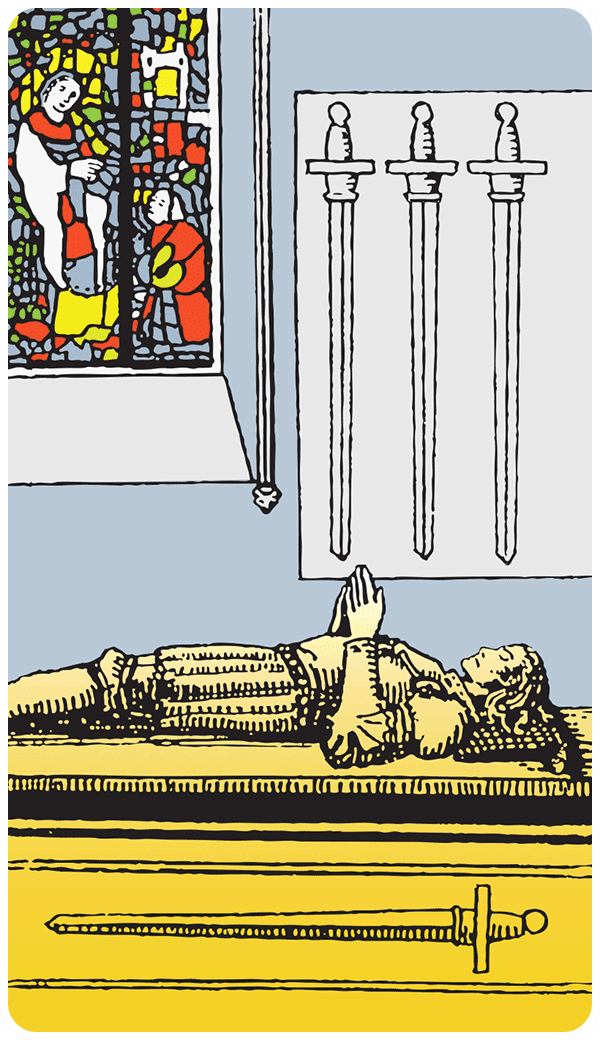
Four of Swords · plate 4
What the card is actually doing
The Four of Swords shows up in a love reading and the querent nods knowingly. They say: I need to take a break. I need to focus on myself. I need space. They think the card is giving them permission. It isn't. The card is describing what they are already doing — and more importantly, it is naming the reason they are doing it. The Four of Swords is not advice to rest. It is a portrait of someone who has gone still because moving felt dangerous.
Reading Four of Swords in love
What the suit, the rank, and the image are doing
Swords governs thought, communication, and the stories you tell yourself about what is happening. It is the suit of interpretation — the layer between raw feeling and the narrative you build to explain the feeling. When Swords cards stack in a love reading, the question is almost never about what the other person did. It is about what you decided it meant.
Fours in tarot describe consolidation. They are the moment after the initial chaos of the threes, when you pull back and try to make sense of what just happened. Fours are stabilizing structures, but they are also holding patterns. The Four of Pentacles hoards. The Four of Cups refuses. The Four of Swords withdraws.
The image shows a figure lying flat on a stone slab, hands folded in prayer position, three swords mounted on the wall above them, one sword beneath the slab. The figure is not asleep. The posture is too formal. This is not rest; this is retreat. The swords are still present — the thoughts have not been resolved, they have been suspended. The figure has removed themselves from the field but the field has not changed.
The most common misreading in love contexts is that the card prescribes solitude. The querent thinks: I should take time off from dating, I should stop texting them, I should pull back and recharge. But the card does not tell you to do anything. It describes what you have already done. You have gone still because the last round of thinking — the last argument, the last rejection, the last pattern you noticed — convinced you that engaging again would only produce more of the same pain.
How the card reads for two different situations
For someone freshly out of a relationship, the Four of Swords reads as necessary withdrawal. You are not avoiding healing; you are in the middle of it. The thoughts are still mounted on the wall. You are lying flat because standing up and pretending you are fine would be a lie. The card says: this is where you are. It will not be where you are forever, but right now, stillness is the only honest position.
For someone who has been single for two years and keeps saying they are 'working on themselves,' the Four of Swords reads differently. The withdrawal has calcified. The rest has become a strategy to avoid the next round of vulnerability. You are not healing anymore; you are hiding. The swords on the wall are old thoughts — 'everyone leaves,' 'I am too much,' 'it never works' — and you have built a whole architecture of solitude to avoid testing whether those thoughts are still true.
The tell that someone is misreading the card
The tell is how long they have been in the position. If the Four of Swords shows up and the querent has been on the slab for six weeks, the card is accurate. If they have been there for eighteen months and are still calling it self-care, the card is not describing rest. It is describing fear that has learned to look like wisdom. The question is not whether you need space. The question is whether the space is still serving the original function or whether it has become the thing you do instead of risking being hurt again.
From the practice
“A card never tells you what to do. It tells you what you're already deciding — and gives you the words to name it.”
A grounded observation
Go back through your calendar and count how many months it has been since you last let someone get close enough to disappoint you. If the number surprises you, the Four of Swords is not about rest.
Key themes to watch for
- № 01Theme
Vulnerability
- № 02Theme
New chapters
- № 03Theme
Emotional truth
What to do with this reading
Read the upright meaning first, even if you pulled the card reversed. The reversal is a commentary on the upright — not a separate card.
Notice what your body did when you saw Four of Swords. That reaction is usually closer to the truth than the interpretation.
Write down one sentence: What is this card asking me to stop avoiding? Let the answer be smaller than you expect.
Come back to this card in 48 hours. Most love readings sharpen with a little distance.
Questions answered
Frequently asked
In love, the Four of Swords whispers of a pause, a period to reflect on your relationships. It's a gentle nudge to step back, perhaps to heal from past wounds or to gain perspective. This card doesn't suggest a breakup, but an introspective time where you and your partner might individually process feelings. Are there unresolved emotions that need airing? This space can help you understand what you truly need from each other. Consider how a little solitude can refresh your connection, offering new depth and understanding.
Reversed, the Four of Swords in love hints at an inability to find peace. Perhaps you're feeling overwhelmed by emotional demands or struggling with unresolved tensions. This card suggests that avoidance might be creating more distance than closeness. It's like trying to rest on a bed of thorns. Reflect on what might be preventing harmony in your relationship. Is there a conversation that needs to happen? This might be a time to address what's been left unsaid, even if it's uncomfortable.
Four of Swords colors the cards around it. Pay attention to where its themes — mental clarity, the truth being named, what the mind needs to release — show up in the next card. That is usually where the story is.
Tarot is observational, not predictive. Four of Swords describes the conditions in front of you right now and where they tend to lead if nothing changes — not a guarantee of timing.
Repeat cards are the deck underlining a theme. With Four of Swords, that usually means the question you are asking is the right one — but you have not yet acted on what the card is showing you.
Read next
Related readings
More Swords · Love
- Ace of Swords — LoveHow Ace of Swords reads in a love context.
- Two of Swords — LoveHow Two of Swords reads in a love context.
- Three of Swords — LoveHow Three of Swords reads in a love context.
- Five of Swords — LoveHow Five of Swords reads in a love context.
- Six of Swords — LoveHow Six of Swords reads in a love context.
- Seven of Swords — LoveHow Seven of Swords reads in a love context.
Other Four of Swords readings
- General MeaningFour of Swords read for general meaning.
- Career & WorkFour of Swords read for career & work.
- Money & FinanceFour of Swords read for money & finance.
- Health & WellbeingFour of Swords read for health & wellbeing.
- SpiritualityFour of Swords read for spirituality.
- Yes / No AnswerFour of Swords read for yes / no answer.