Six of Swords in Love
The Six of Swords in love readings gets read as 'moving on' when it's describing the mechanical act of leaving. Here's what the card is actually doing.
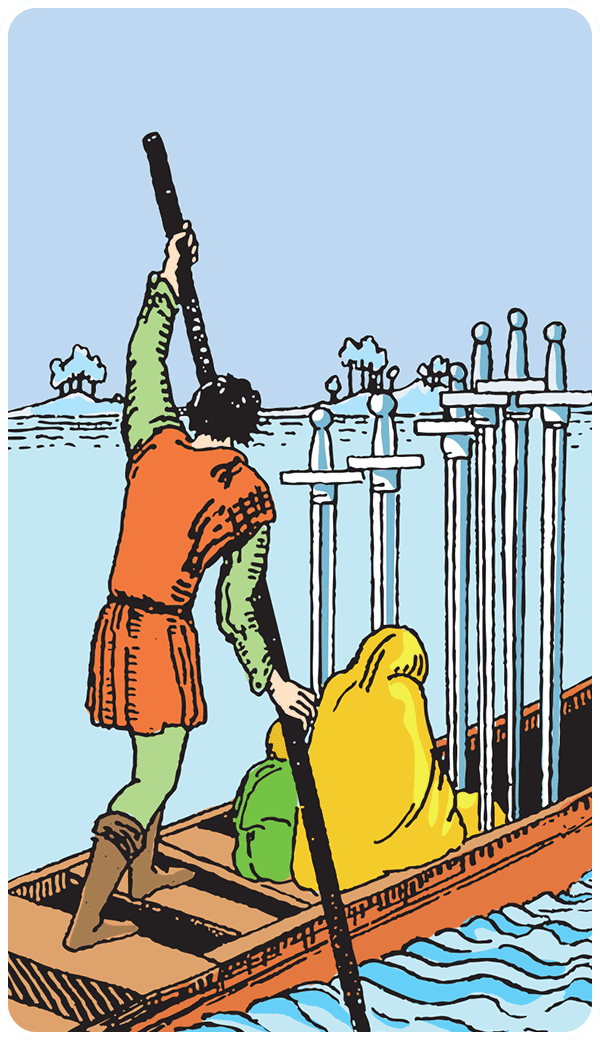
Six of Swords · plate 6
What the card is actually doing
The Six of Swords shows up in a love reading and the querent nods before I've said anything. They already know what it means: they're moving on. Healing is happening. They're leaving the past behind and heading toward calmer waters. That is the Instagram caption version of the card. It is not what the image shows. The card describes the act of leaving, not the state of having left. The difference matters more than any other distinction in the deck when you're asking about love.
Reading Six of Swords in love
What the suit, the rank, and the image are doing
Swords is the suit of thought, decision, and the stories you tell yourself about what happened. It governs the part of you that names things, draws lines, and decides what something meant. When Swords cards cluster in a reading, the question is almost always about how you're thinking about the situation, not what the situation objectively is.
Sixes in tarot describe transition states. They are the middle of a movement, not the resolution. The Six of Pentacles is resources moving between two people; the Six of Cups is memory actively shaping the present. Sixes are functional, not symbolic. They describe what is currently in motion.
Now look at the image. A figure in a boat, facing away. A ferryman poles the boat forward. Six swords stand upright in the boat. The water is choppy on one side, calmer ahead. The figure is in transit. They are not on the shore. They are not unpacking. They are still in the boat, still holding the swords, still moving. This is the mechanical answer: the Six of Swords is the act of leaving while still carrying what you're leaving. The swords are the thoughts, the grievances, the explanations you constructed to make leaving possible. You are not done with them yet.
How the card reads for two different situations
If the querent is the one who ended the relationship, the Six of Swords describes the story they are telling themselves to stay gone. "He never listened." "She was never going to change." "I gave it two years and nothing shifted." The card is not confirming that the story is true. It is naming that the story is the boat. Without it, they would swim back. The swords are the reasons, and the reasons are doing the work of distance right now.
If the querent is the one who got left, the Six of Swords describes the same transit from the other angle. They are the ones being ferried away from, and they are watching someone row toward a narrative that does not include them. The card tends to show up three to six weeks after the breakup, when the person who left has stopped answering texts with paragraphs and started answering with logistical sentences. The querent feels it as coldness. What the card is naming is that the other person is mid-passage and cannot turn the boat around without capsizing the story that made leaving survivable.
The tell that someone is misreading the card on themselves
The misread version sounds like this: "I'm finally moving on. I'm in a better place. I'm healing." If those sentences feel true when you pull the Six of Swords, you are not reading the card — you are performing the transit it describes. The card does not confirm that you have arrived. It confirms that you are still in the boat, still holding the swords, still using the story to stay in motion. The actual arrival is a different card. This one is the part where you're still explaining it to yourself.
From the practice
“A card never tells you what to do. It tells you what you're already deciding — and gives you the words to name it.”
A grounded observation
Go back through your texts from the last two weeks. If you are still explaining why you left, or why they left, or what it meant — you are still in the boat. That is not a failure. It is just where the card says you are.
Key themes to watch for
- № 01Theme
Vulnerability
- № 02Theme
New chapters
- № 03Theme
Emotional truth
What to do with this reading
Read the upright meaning first, even if you pulled the card reversed. The reversal is a commentary on the upright — not a separate card.
Notice what your body did when you saw Six of Swords. That reaction is usually closer to the truth than the interpretation.
Write down one sentence: What is this card asking me to stop avoiding? Let the answer be smaller than you expect.
Come back to this card in 48 hours. Most love readings sharpen with a little distance.
Questions answered
Frequently asked
In a love context, the Six of Swords speaks to moving away from past emotional turbulence. If you've been through a rough patch in your relationship, this card suggests a slow but steady path towards healing. It could also indicate leaving behind an unhealthy relationship to seek something more fulfilling. This isn't about sudden changes, but rather the gentle release of past hurts. How can you nurture this journey towards emotional clarity and connection?
Reversed, the Six of Swords in love may reveal difficulties in leaving behind a troubled relationship or emotional past. There might be unresolved issues lingering, preventing you from fully embracing new possibilities. It's a sign that emotional baggage could be holding you back from moving forward with someone new or healing an existing connection. Reflect on what's keeping you tethered to the past. Are there feelings that need to be addressed before progress can be made?
Six of Swords colors the cards around it. Pay attention to where its themes — mental clarity, the truth being named, what the mind needs to release — show up in the next card. That is usually where the story is.
Tarot is observational, not predictive. Six of Swords describes the conditions in front of you right now and where they tend to lead if nothing changes — not a guarantee of timing.
Repeat cards are the deck underlining a theme. With Six of Swords, that usually means the question you are asking is the right one — but you have not yet acted on what the card is showing you.
Read next
Related readings
More Swords · Love
- Ace of Swords — LoveHow Ace of Swords reads in a love context.
- Two of Swords — LoveHow Two of Swords reads in a love context.
- Three of Swords — LoveHow Three of Swords reads in a love context.
- Four of Swords — LoveHow Four of Swords reads in a love context.
- Five of Swords — LoveHow Five of Swords reads in a love context.
- Seven of Swords — LoveHow Seven of Swords reads in a love context.
Other Six of Swords readings
- General MeaningSix of Swords read for general meaning.
- Career & WorkSix of Swords read for career & work.
- Money & FinanceSix of Swords read for money & finance.
- Health & WellbeingSix of Swords read for health & wellbeing.
- SpiritualitySix of Swords read for spirituality.
- Yes / No AnswerSix of Swords read for yes / no answer.