Ace of Swords in Love
The Ace of Swords in love readings gets read as brutal clarity or a breakup card. What it actually describes is the moment a new thought cuts through old fog.
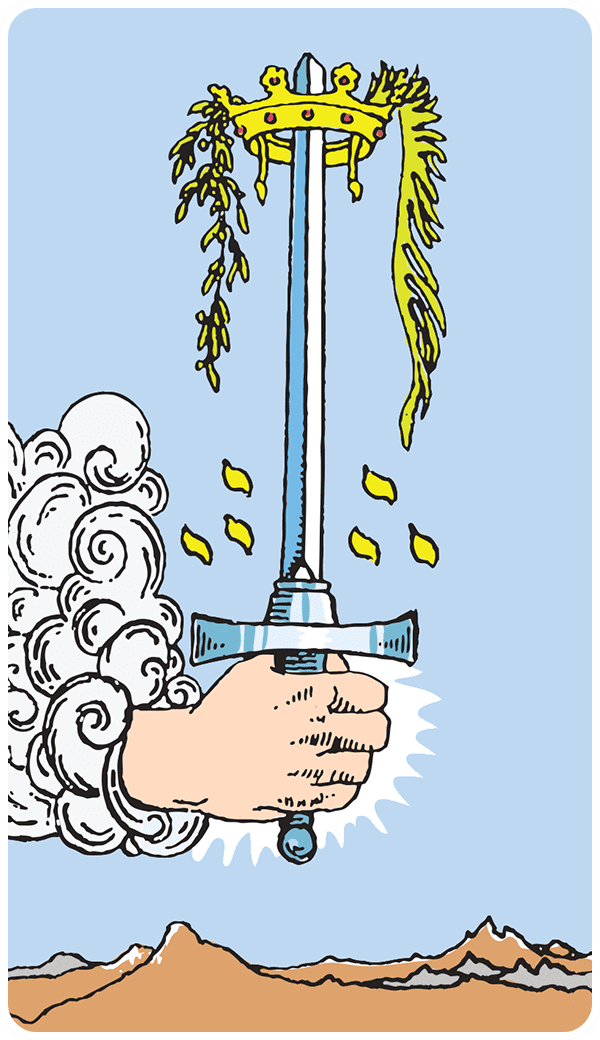
Ace of Swords · plate 1
What the card is actually doing
The Ace of Swords shows up in a love reading and the querent braces. They think it means the relationship is about to end, or that some hard truth is about to land, or that they're about to see something they've been avoiding. The card has a reputation for being cold, sharp, surgical — the opposite of what anyone wants when they're asking about love.
That reading misses what the card is. The Ace of Swords is not the truth itself. It is not the breakup. It is the moment a new thought becomes available — the cut that lets you think something you could not think before.
Reading Ace of Swords in love
What the suit, the rank, and the image are doing
Swords is the mental suit. It governs thought, language, perception, and the stories you tell yourself about what is happening. When Swords cards dominate a reading, the question is almost always about how the querent is thinking about the situation, not what is objectively true about it. Swords describes the lens, not the landscape.
Aces are thresholds. They are not outcomes. An Ace is the moment a door opens — the precondition for something, not the thing itself. The Ace of Swords is not clarity achieved. It is the arrival of a new thought that makes clarity possible if you follow it.
Look at the image. A hand emerges from a cloud, holding a sword upright. A crown sits at the tip. Branches — olive and palm — hang from the crown. The sword has not been swung. It has not cut anything yet. It is being offered, suspended, waiting.
The most common misreading in a love context is to treat this card as diagnostic — as if it is telling you what is true about the relationship. It is not. It is describing a shift in how you are able to think about the relationship. The thought that arrives might be "this person does not want what I want." It might be "I have been performing a version of myself that isn't me." It might be "the thing I thought was broken is actually just different." The card does not tell you which thought. It tells you a new one just became available.
How the card reads for two different querent situations
If the querent is stuck in confusion — if they have been asking the same question for months, if every conversation with the person loops back to the same unresolved knot — the Ace of Swords describes the moment the fog lifts enough to see one clear next move. It does not solve the whole problem. It cuts one clean line through the middle of it. The querent will know what it is when it happens. It will feel like relief, not devastation.
If the querent is in denial — if they are explaining away behavior, if they are holding two incompatible beliefs about the person at once — the Ace of Swords is the thought that breaks the suspension. It is not cruel. It is precise. The querent has been working very hard not to think something, and the card describes the moment that work stops being possible. What happens after that is a different card.
The tell that someone is misreading the card on themselves
The tell is when the querent treats the Ace of Swords as permission to deliver a monologue. They think the card means they finally get to say the thing they've been holding back, or that they are now entitled to "radical honesty," or that clarity equals confrontation. That is not what the card is doing. The sword has not been swung. The thought has arrived. What you do with the thought is your choice, and the card is neutral on whether speaking it aloud is the right move. Most of the time, the clarity is for you, not for the other person.
From the practice
“A card never tells you what to do. It tells you what you're already deciding — and gives you the words to name it.”
A grounded observation
Go back through your last three months of journal entries or texts. Find the moment you wrote a sentence you had never been able to write before. That was the Ace of Swords.
Key themes to watch for
- № 01Theme
Vulnerability
- № 02Theme
New chapters
- № 03Theme
Emotional truth
What to do with this reading
Read the upright meaning first, even if you pulled the card reversed. The reversal is a commentary on the upright — not a separate card.
Notice what your body did when you saw Ace of Swords. That reaction is usually closer to the truth than the interpretation.
Write down one sentence: What is this card asking me to stop avoiding? Let the answer be smaller than you expect.
Come back to this card in 48 hours. Most love readings sharpen with a little distance.
Questions answered
Frequently asked
In matters of the heart, the Ace of Swords brings a refreshing honesty. This is a time for clear communication and truth-telling. Whether single or in a relationship, you may find yourself expressing your feelings with newfound clarity or having conversations that cut to the heart of the matter. This card encourages you to embrace this moment of candor. What truths need to be spoken? Notice how honesty, even when difficult, can deepen connections and create space for growth.
Reversed, the Ace of Swords suggests confusion or miscommunication in your love life. Words may get tangled, leading to misunderstandings or unresolved conflicts. It's as if conversations are happening in parallel, rather than connecting. This might be a moment to pause and reconsider your approach to communication. Are you truly listening, or just waiting to respond? Reflect on how clarity and patience could bridge gaps more effectively than forceful words.
Ace of Swords colors the cards around it. Pay attention to where its themes — mental clarity, the truth being named, what the mind needs to release — show up in the next card. That is usually where the story is.
Tarot is observational, not predictive. Ace of Swords describes the conditions in front of you right now and where they tend to lead if nothing changes — not a guarantee of timing.
Repeat cards are the deck underlining a theme. With Ace of Swords, that usually means the question you are asking is the right one — but you have not yet acted on what the card is showing you.
Read next
Related readings
More Swords · Love
- Two of Swords — LoveHow Two of Swords reads in a love context.
- Three of Swords — LoveHow Three of Swords reads in a love context.
- Four of Swords — LoveHow Four of Swords reads in a love context.
- Five of Swords — LoveHow Five of Swords reads in a love context.
- Six of Swords — LoveHow Six of Swords reads in a love context.
- Seven of Swords — LoveHow Seven of Swords reads in a love context.
Other Ace of Swords readings
- General MeaningAce of Swords read for general meaning.
- Career & WorkAce of Swords read for career & work.
- Money & FinanceAce of Swords read for money & finance.
- Health & WellbeingAce of Swords read for health & wellbeing.
- SpiritualityAce of Swords read for spirituality.
- Yes / No AnswerAce of Swords read for yes / no answer.