Five of Swords in Love
The Five of Swords names the argument you already won. Most querents read it as relationship doom. Here's what the card is actually doing.
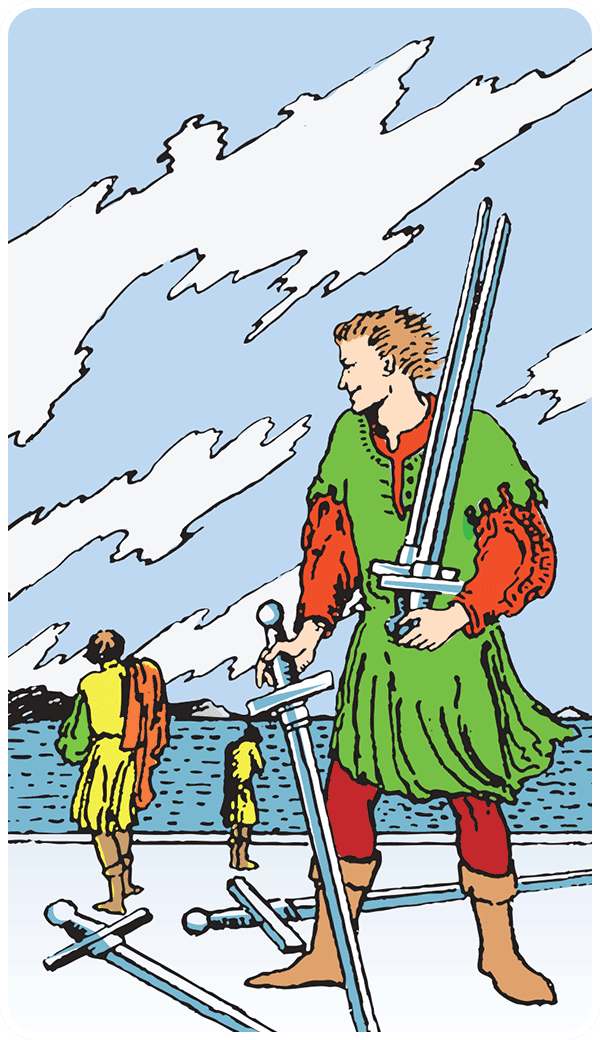
Five of Swords · plate 5
What the card is actually doing
The Five of Swords shows up in a love reading and the querent assumes the relationship is over. Someone cheated, someone lied, someone said the thing that can't be unsaid. The card looks like defeat — three figures walking away, two swords abandoned on the ground, one person holding all five blades with a smirk that reads as cruelty. But that's not what the card is naming. The Five of Swords describes the moment after you won an argument and realized winning didn't fix anything. The other person is still walking away. You're still holding all the swords. The card is about hollow victory, not betrayal.
Reading Five of Swords in love
What the suit, the rank, and the image are doing
Swords governs thought, language, and the stories you tell yourself about what just happened. It is the suit of interpretation — how you frame an event, what you decide it means, whether you replay it as evidence or release it as noise. When Swords cards dominate a love reading, the fight is almost always happening inside the querent's head, not in the room.
Fives in tarot describe instability that has already arrived. The structure wobbled. Something that was holding is no longer holding. Fives are not warnings; they are descriptions of a present-tense imbalance. The Five of Pentacles is not "you might lose money" — it is "you are standing outside the warm building right now." The Five of Swords is not "conflict is coming" — it is "you are standing in the wreckage of the conflict that just happened."
The image: one figure holds five swords, looking at two others who are walking away. The two departing figures have left their swords on the ground. The sky is clouded. The figure holding the swords looks satisfied, but no one else is still playing. This is the card's mechanical point: you can win the argument and lose the relationship. You can be right and be alone. The swords you're holding don't mean you won anything that matters.
How it reads when you were the one holding the swords vs. when you were the one walking away
If you were the person who pressed the point, who needed to be right, who turned a small disagreement into a referendum on the entire relationship — the Five of Swords is naming the moment you look up and realize the other person stopped arguing because they stopped caring. You won. They left. The card is not saying you were wrong to argue. It is saying the cost of being right was higher than you thought it would be.
If you were the person who walked away — if you were the one who decided the fight wasn't worth it, who dropped your sword and left mid-argument — the Five of Swords is naming the grief of disengagement. You didn't lose. You quit. The card describes the specific loneliness of choosing not to fight anymore because fighting started to feel like the entire relationship. You're walking away, but you're walking away from something you wanted to work.
The tell that you're misreading it
The misreading is: "This card means my partner is cruel / manipulative / out to hurt me." That reading turns the card into a villain origin story. It makes the other person the problem and you the victim, which is emotionally simpler but almost never accurate.
Here's the tell: if you pulled this card and immediately started cataloging everything the other person did wrong, you are the figure holding the swords. If you pulled this card and felt relief because now you have proof they're bad, you are the figure holding the swords. The card is not confirming your story. It is naming the story you keep telling yourself to avoid the real question, which is: what are you actually fighting for, and is it still there?
From the practice
“A card never tells you what to do. It tells you what you're already deciding — and gives you the words to name it.”
A grounded observation
Go back through your last three arguments with this person. Count how many times you were trying to win vs. how many times you were trying to be understood. The Five of Swords tends to show up when those two things stopped being the same.
Key themes to watch for
- № 01Theme
Vulnerability
- № 02Theme
New chapters
- № 03Theme
Emotional truth
What to do with this reading
Read the upright meaning first, even if you pulled the card reversed. The reversal is a commentary on the upright — not a separate card.
Notice what your body did when you saw Five of Swords. That reaction is usually closer to the truth than the interpretation.
Write down one sentence: What is this card asking me to stop avoiding? Let the answer be smaller than you expect.
Come back to this card in 48 hours. Most love readings sharpen with a little distance.
Questions answered
Frequently asked
In love, the Five of Swords points to a turbulent time. Arguments or unresolved issues may cast a shadow over your romantic connection. Words may have been exchanged that can't easily be taken back, leaving both parties feeling raw. This card invites you to consider what battles are worth fighting and what can be let go. Are these conflicts bringing you closer or driving a wedge? Reflect on the underlying causes and the future you envision for this relationship. Sometimes, understanding comes from listening more than speaking.
The reversed Five of Swords in a love reading suggests an easing of tensions. There may be a chance to mend what was broken, or at least to come to an understanding. This is a moment to allow vulnerability to surface, offering a path to genuine communication. Notice if there's a shift in how you both approach issues. Can this be a stepping stone toward a healthier relationship? The path to reconciliation often starts with a willingness to meet halfway.
Five of Swords colors the cards around it. Pay attention to where its themes — mental clarity, the truth being named, what the mind needs to release — show up in the next card. That is usually where the story is.
Tarot is observational, not predictive. Five of Swords describes the conditions in front of you right now and where they tend to lead if nothing changes — not a guarantee of timing.
Repeat cards are the deck underlining a theme. With Five of Swords, that usually means the question you are asking is the right one — but you have not yet acted on what the card is showing you.
Read next
Related readings
More Swords · Love
- Ace of Swords — LoveHow Ace of Swords reads in a love context.
- Two of Swords — LoveHow Two of Swords reads in a love context.
- Three of Swords — LoveHow Three of Swords reads in a love context.
- Four of Swords — LoveHow Four of Swords reads in a love context.
- Six of Swords — LoveHow Six of Swords reads in a love context.
- Seven of Swords — LoveHow Seven of Swords reads in a love context.
Other Five of Swords readings
- General MeaningFive of Swords read for general meaning.
- Career & WorkFive of Swords read for career & work.
- Money & FinanceFive of Swords read for money & finance.
- Health & WellbeingFive of Swords read for health & wellbeing.
- SpiritualityFive of Swords read for spirituality.
- Yes / No AnswerFive of Swords read for yes / no answer.