Three of Swords in Love
The Three of Swords names the betrayal that already happened. Most people think it predicts heartbreak. What it actually does is stop you from pretending.
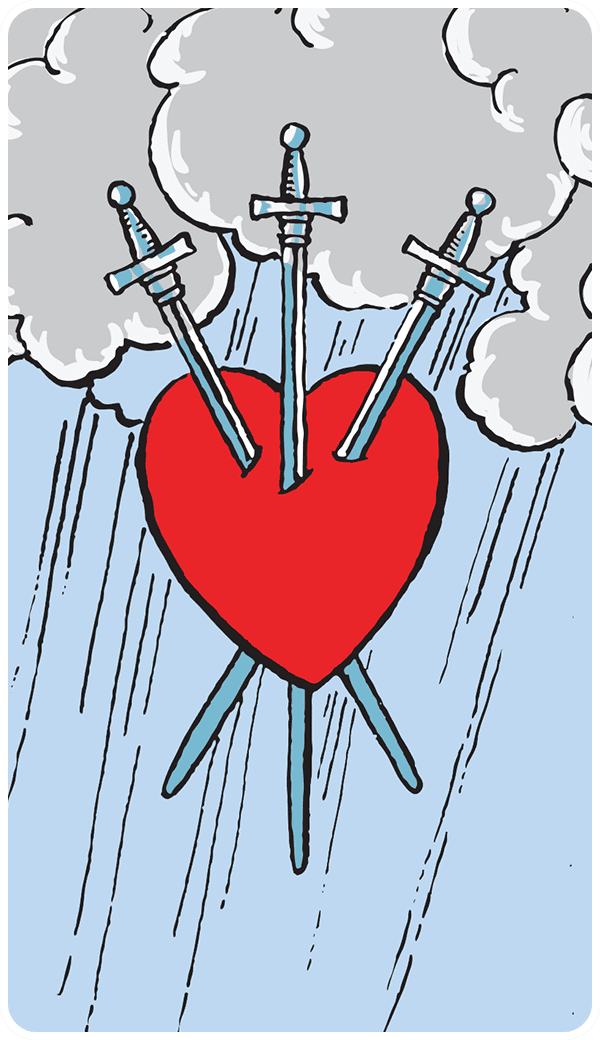
Three of Swords · plate 3
What the card is actually doing
The Three of Swords shows up in a love reading and the querent winces. They ask if it means the relationship is going to end. They ask if their partner is about to leave. They ask if heartbreak is coming. The card is not predictive. It is descriptive. The Three of Swords does not announce future pain. It names the pain that is already present in the room, the wound you have been working around, the thing you know but have not said out loud yet.
Reading Three of Swords in love
What the suit, rank, and image are doing
Swords is the suit of thought, language, and the cuts that happen when clarity arrives. It governs what you think about a situation, what you tell yourself about it, and the moment the story you were telling stops working. Swords cards do not create emotional events — they describe the mental reckoning that follows them.
Threes in tarot mark the first consequence of the pair. The Ace opened a channel, the Two held a tension, and the Three is what happens when that tension resolves into something you can no longer ignore. It is the card of realization, of the third point that makes the pattern visible.
The image: three swords pierce a heart suspended in rain. The heart is not bleeding. It is not torn apart. It is punctured, held in place, named. The swords are not moving. They have already landed. This is not the moment of betrayal. This is the moment after, when you are alone with what you now know.
The most common misreading in a love context is treating the card as a prediction of future heartbreak. People see it and brace for impact, as if the swords are still in the air. But the card describes a wound that has already occurred — a lie discovered, a boundary crossed, a truth finally spoken, the moment you understood your partner was not going to choose you the way you needed them to. The Three of Swords is the acknowledgment, not the event.
How it reads for two different situations
For someone still in the relationship: the card names the thing you have been trying not to think about. The conversation you keep avoiding. The pattern you pretend is temporary. The way they speak to you when no one else is listening. You already know what the swords are. The card is not warning you. It is asking why you are still pretending you don't see it.
For someone freshly out of the relationship: the card describes the clarity that comes after the shock wears off. The first few weeks, you bargained. You rewrote the story. You made excuses. Then one morning you woke up and the swords were just there, undeniable, and you stopped arguing with what happened. The Three of Swords is that morning.
The tell that someone is misreading the card
The tell is when they treat the card as something external that is being done to them. "The Three of Swords means I'm going to get hurt." No. You are already hurt. The card is naming the hurt you have been carrying. If you are asking the question, the swords have already landed. The only choice left is whether you keep walking around with them or whether you finally pull them out.
From the practice
“A card never tells you what to do. It tells you what you're already deciding — and gives you the words to name it.”
A grounded observation
Go back through your text messages from the last month. The thing the Three of Swords is naming is the conversation you keep starting and then deleting before you send it.
Key themes to watch for
- № 01Theme
Vulnerability
- № 02Theme
New chapters
- № 03Theme
Emotional truth
What to do with this reading
Read the upright meaning first, even if you pulled the card reversed. The reversal is a commentary on the upright — not a separate card.
Notice what your body did when you saw Three of Swords. That reaction is usually closer to the truth than the interpretation.
Write down one sentence: What is this card asking me to stop avoiding? Let the answer be smaller than you expect.
Come back to this card in 48 hours. Most love readings sharpen with a little distance.
Questions answered
Frequently asked
In love, the Three of Swords upright signals heartache or misunderstanding. It’s akin to an unfinished conversation where words hang heavy in the air. This card might point to betrayal or a breakdown in communication. It brings to light any emotional struggles in your relationships, urging you to face them honestly. While it might feel like a storm, it could also clear the air, making room for honest dialogue. Consider what truths need to be spoken or heard for healing to begin.
Reversed, this card suggests a period of mending in love. The healing process is underway, even if it feels slow. It's like the first glimmers of dawn after a long, dark night. Misunderstandings may start to resolve, or past hurts could be forgiven. This is a time to focus on rebuilding trust and finding common ground. The invitation here is to nurture the tender shoots of reconciliation and to let go of grudges holding you back.
Three of Swords colors the cards around it. Pay attention to where its themes — mental clarity, the truth being named, what the mind needs to release — show up in the next card. That is usually where the story is.
Tarot is observational, not predictive. Three of Swords describes the conditions in front of you right now and where they tend to lead if nothing changes — not a guarantee of timing.
Repeat cards are the deck underlining a theme. With Three of Swords, that usually means the question you are asking is the right one — but you have not yet acted on what the card is showing you.
Read next
Related readings
More Swords · Love
- Ace of Swords — LoveHow Ace of Swords reads in a love context.
- Two of Swords — LoveHow Two of Swords reads in a love context.
- Four of Swords — LoveHow Four of Swords reads in a love context.
- Five of Swords — LoveHow Five of Swords reads in a love context.
- Six of Swords — LoveHow Six of Swords reads in a love context.
- Seven of Swords — LoveHow Seven of Swords reads in a love context.
Other Three of Swords readings
- General MeaningThree of Swords read for general meaning.
- Career & WorkThree of Swords read for career & work.
- Money & FinanceThree of Swords read for money & finance.
- Health & WellbeingThree of Swords read for health & wellbeing.
- SpiritualityThree of Swords read for spirituality.
- Yes / No AnswerThree of Swords read for yes / no answer.