Ten of Swords in Yes / No
The Ten of Swords in a yes/no reading almost always means no — not because the outcome is cursed, but because the thing you're asking about is already over.
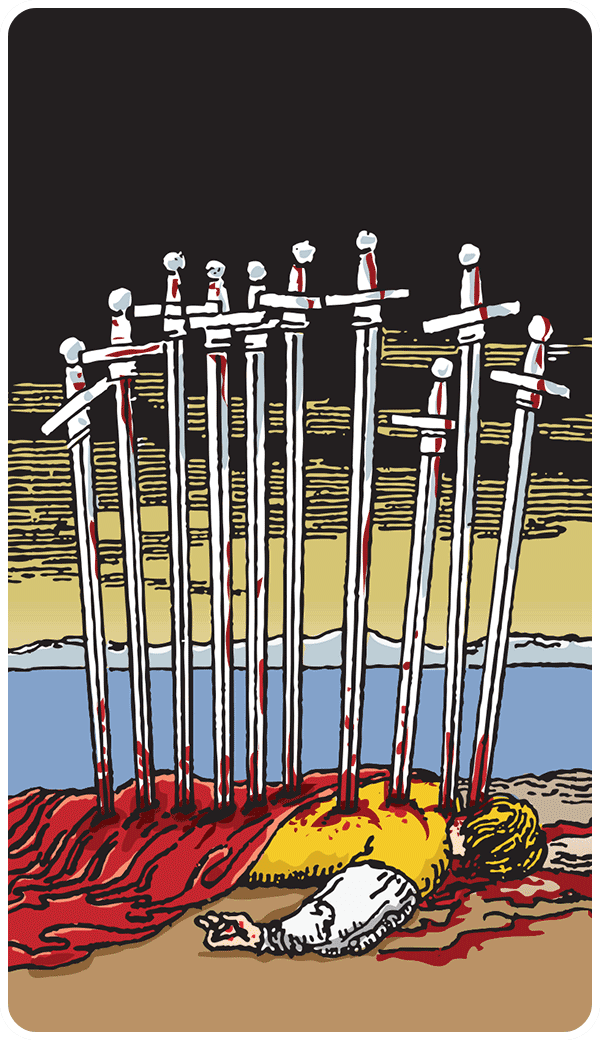
Ten of Swords · plate 10
NO
The Ten of Swords is a no. Not a soft no, not a 'wait and see' — a structural no. The card describes an ending that has already happened, even if you haven't admitted it yet. Most querents read the Ten of Swords as catastrophe incoming, which makes them think the answer is 'not yet' or 'only if I'm careful.' That misses what the card is actually showing you: the swords are already in your back. The question you're asking is about something that finished before you pulled the card.
Why Ten of Swords reads this way
What the rank, suit, and image are doing
Swords is the suit of thought, decision, and the stories you tell yourself about what's happening. It governs how you frame a situation, what narrative you're running, and whether that narrative matches the facts. Tens in tarot mark completion — the final card in the suit's arc, the point where the energy has run its course and cannot continue in its current form. The Ten of Swords is not the beginning of a bad outcome. It is the last moment of a cycle that was already dying.
Look at the image: a figure lies face-down with ten swords in their back. The sky is dark but the horizon is lightening. The figure is still. This is not a warning. It is a report. The thing has happened. The most common misreading in a yes/no context is treating this card as a threat — 'if you proceed, disaster will strike.' That reading assumes the swords are coming. They are not coming. They are already there. The Ten of Swords describes the moment you stop pretending the situation is salvageable and admit it ended three moves ago.
How the answer shifts depending on what you're asking
If you are asking 'should I try to save this relationship / job / project,' the answer is no, and the card is naming the fact that you already know it's over. You are asking for permission to stop fighting. The Ten of Swords is that permission. The swords in the back are the accumulated evidence you've been ignoring: the texts that don't get returned, the meetings that keep getting postponed, the project that loses funding every quarter. The card is not predicting failure. It is describing the failure you are currently standing in.
If you are asking 'will this new thing work out,' the answer is still no, but for a different reason. The Ten of Swords in that context suggests you are carrying the logic of the last ending into the new situation. You are asking a yes/no question about something you have already decided will go badly. The card is reflecting your own belief structure back at you. The thing you're asking about might be viable, but you are not asking from a place where you can actually build it. You are asking from the place where the swords are still in your back.
The tell that you're misreading it
The tell is this: you pulled the Ten of Swords, read it as disaster, and then asked the question again with a different deck or a clarifier card. You are trying to argue with the no. That impulse is the proof the card is correct. If the situation were actually open, you would not need to re-ask. You would take the no as useful information and adjust. When you keep pulling cards to try to get a different answer, you are demonstrating that you already know the thing is over and you are trying to use tarot to override your own knowing.
A grounded observation
Go back through your text history or your calendar. Find the moment you knew. The Ten of Swords is not the moment the thing ended. It is the moment you stop pretending it didn't.
Key themes to watch for
- № 01Theme
Affirmative current
- № 02Theme
Open door
- № 03Theme
Forward motion
What to do with this reading
Read the upright meaning first, even if you pulled the card reversed. The reversal is a commentary on the upright — not a separate card.
Notice what your body did when you saw Ten of Swords. That reaction is usually closer to the truth than the interpretation.
Write down one sentence: What is this card asking me to stop avoiding? Let the answer be smaller than you expect.
Come back to this card in 48 hours. Most yes / no readings sharpen with a little distance.
Questions answered
Frequently asked
The Ten of Swords is a no. Not a soft no, not a 'wait and see' — a structural no. The card describes an ending that has already happened, even if you haven't admitted it yet. Most querents read the Ten of Swords as catastrophe incoming, which makes them think the answer is 'not yet' or 'only if I'm careful.' That misses what the card is actually showing you: the swords are already in your back. The question you're asking is about something that finished before you pulled the card.
Reversed cards are rarely "bad." Ten of Swords reversed asks you to look at where the same theme is blocked, postponed, or being avoided — usually with more compassion than the upright version.
Ten of Swords colors the cards around it. Pay attention to where its themes — mental clarity, the truth being named, what the mind needs to release — show up in the next card. That is usually where the story is.
Tarot is observational, not predictive. Ten of Swords describes the conditions in front of you right now and where they tend to lead if nothing changes — not a guarantee of timing.
Repeat cards are the deck underlining a theme. With Ten of Swords, that usually means the question you are asking is the right one — but you have not yet acted on what the card is showing you.
Read next
Related readings
More Swords · Yes / No
- Ace of Swords — Yes / NoHow Ace of Swords reads in a yes / no context.
- Two of Swords — Yes / NoHow Two of Swords reads in a yes / no context.
- Three of Swords — Yes / NoHow Three of Swords reads in a yes / no context.
- Four of Swords — Yes / NoHow Four of Swords reads in a yes / no context.
- Five of Swords — Yes / NoHow Five of Swords reads in a yes / no context.
- Six of Swords — Yes / NoHow Six of Swords reads in a yes / no context.
Other Ten of Swords readings
- General MeaningTen of Swords read for general meaning.
- Love & RelationshipsTen of Swords read for love & relationships.
- Career & WorkTen of Swords read for career & work.
- Money & FinanceTen of Swords read for money & finance.
- Health & WellbeingTen of Swords read for health & wellbeing.
- SpiritualityTen of Swords read for spirituality.