Ten of Swords in Love
The Ten of Swords in love readings gets read as betrayal or ending. What it actually names is the moment you stop pretending the relationship still works.
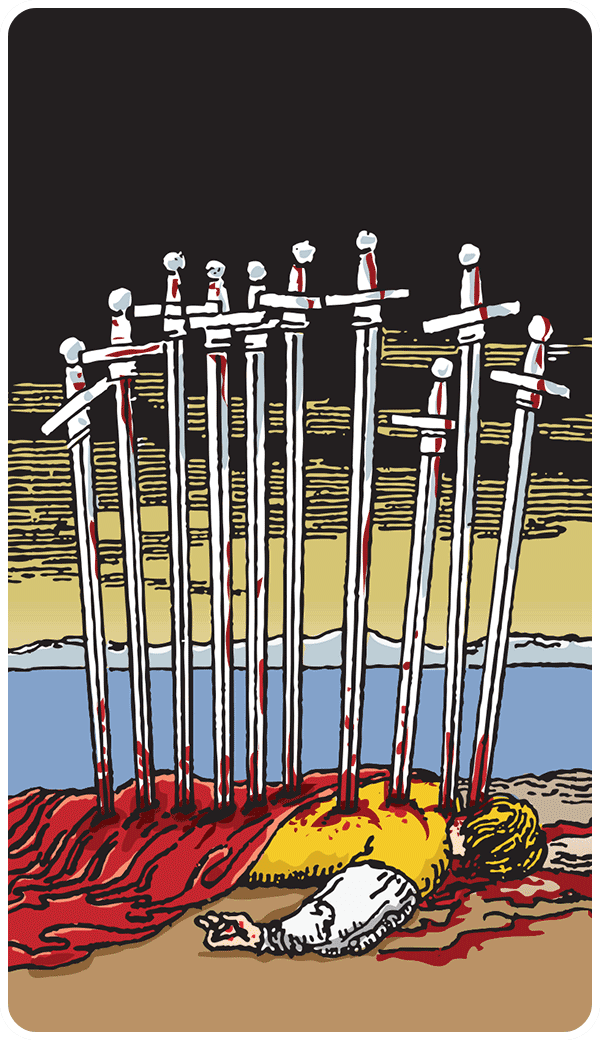
Ten of Swords · plate 10
What the card is actually doing
The Ten of Swords shows up in a love reading and the querent winces. They assume it means betrayal, or that the relationship is about to end badly, or that they're about to get hurt in some dramatic public way. That is not what the card is describing. The Ten of Swords is not predicting disaster. It is naming the disaster that already happened — the one you've been pretending didn't.
Reading Ten of Swords in love
What the suit, the rank, and the image are actually doing
Swords is the suit of thought, language, and the stories you tell yourself about what is happening. It governs how you frame a situation, what you permit yourself to see, and what mental structure you use to make sense of relational pain. When Swords cards dominate a reading, the question is almost always about narrative — whose version of events you're living inside, and whether that version is still accurate.
Tens in tarot are endpoints. They are the last card in the pip sequence, the place where the suit's energy has run its course and cannot continue in the same form. The Ten of Pentacles is material stability achieved. The Ten of Cups is emotional saturation. The Ten of Swords is the point where the mental framework collapses. You can no longer think your way into making it work.
Now look at the image. A figure lies face-down with ten swords in their back. The sky is dark. The body is still. Most people read this as murder, as betrayal, as violence done to them. But notice: the figure is not struggling. The swords are already placed. The scene is over. What the card is showing you is not the moment of impact. It is the moment after, when the pretending stops.
How it reads for someone still in the relationship versus someone already out
If you are still in the relationship and the Ten of Swords appears, it is naming the cognitive moment where you finally admit what you have known for months. The fight you keep having is not going to resolve. The apology you are waiting for is not coming. The person you fell in love with is not who is standing in front of you now. The card is not telling you to leave. It is telling you that you already know.
If you are already out of the relationship and the Ten of Swords appears, it is marking the end of the story you were telling yourself about why it ended. You have been running the same explanation on a loop — they were the problem, you were the problem, if only you had said the right thing at the right time. The card says: stop. The relationship is not a puzzle you failed to solve. It was a structure that could not hold, and now it is done.
The tell that you are misreading it on yourself
You are misreading the Ten of Swords if you are waiting for the other person to do something that will make the card make sense. If you are scanning for the betrayal, the revelation, the moment they finally show their true colors — you are looking for a future event. The card does not describe a future event. It describes the thing you already lived through and are still trying to narrate your way out of. Go back through your calendar. Find the week where you stopped sleeping well. That was the Ten of Swords. Everything since then has been the story you told yourself about it.
From the practice
“A card never tells you what to do. It tells you what you're already deciding — and gives you the words to name it.”
A grounded observation
The Ten of Swords does not arrive to warn you. It arrives when you are finally ready to stop performing optimism and name what already ended.
Key themes to watch for
- № 01Theme
Vulnerability
- № 02Theme
New chapters
- № 03Theme
Emotional truth
What to do with this reading
Read the upright meaning first, even if you pulled the card reversed. The reversal is a commentary on the upright — not a separate card.
Notice what your body did when you saw Ten of Swords. That reaction is usually closer to the truth than the interpretation.
Write down one sentence: What is this card asking me to stop avoiding? Let the answer be smaller than you expect.
Come back to this card in 48 hours. Most love readings sharpen with a little distance.
Questions answered
Frequently asked
In love, the Ten of Swords upright signals a painful ending or betrayal. This card might appear when a relationship reaches a breaking point, or when trust is shattered. It’s a rough patch that feels like an emotional freefall. Yet, this ending also clears the path for something new, even if it doesn’t feel like it now. It’s a moment to acknowledge the hurt and consider what this chapter has taught you about connections. How might you use this experience to inform future relationships?
Reversed in a love context, the Ten of Swords suggests the slow process of healing from heartache. The worst may be over, and there’s a glimmer of hope as you start to move on. It’s like the first sunny day after a stormy season. This reversal invites you to consider what closure looks like for you, and how you might open yourself to new possibilities in love. What have you learned about your needs and boundaries?
Ten of Swords colors the cards around it. Pay attention to where its themes — mental clarity, the truth being named, what the mind needs to release — show up in the next card. That is usually where the story is.
Tarot is observational, not predictive. Ten of Swords describes the conditions in front of you right now and where they tend to lead if nothing changes — not a guarantee of timing.
Repeat cards are the deck underlining a theme. With Ten of Swords, that usually means the question you are asking is the right one — but you have not yet acted on what the card is showing you.
Read next
Related readings
More Swords · Love
- Ace of Swords — LoveHow Ace of Swords reads in a love context.
- Two of Swords — LoveHow Two of Swords reads in a love context.
- Three of Swords — LoveHow Three of Swords reads in a love context.
- Four of Swords — LoveHow Four of Swords reads in a love context.
- Five of Swords — LoveHow Five of Swords reads in a love context.
- Six of Swords — LoveHow Six of Swords reads in a love context.
Other Ten of Swords readings
- General MeaningTen of Swords read for general meaning.
- Career & WorkTen of Swords read for career & work.
- Money & FinanceTen of Swords read for money & finance.
- Health & WellbeingTen of Swords read for health & wellbeing.
- SpiritualityTen of Swords read for spirituality.
- Yes / No AnswerTen of Swords read for yes / no answer.