Queen of Swords in Yes / No
The Queen of Swords in yes/no readings says maybe — not because she's uncertain, but because she's waiting for you to ask a clearer question.
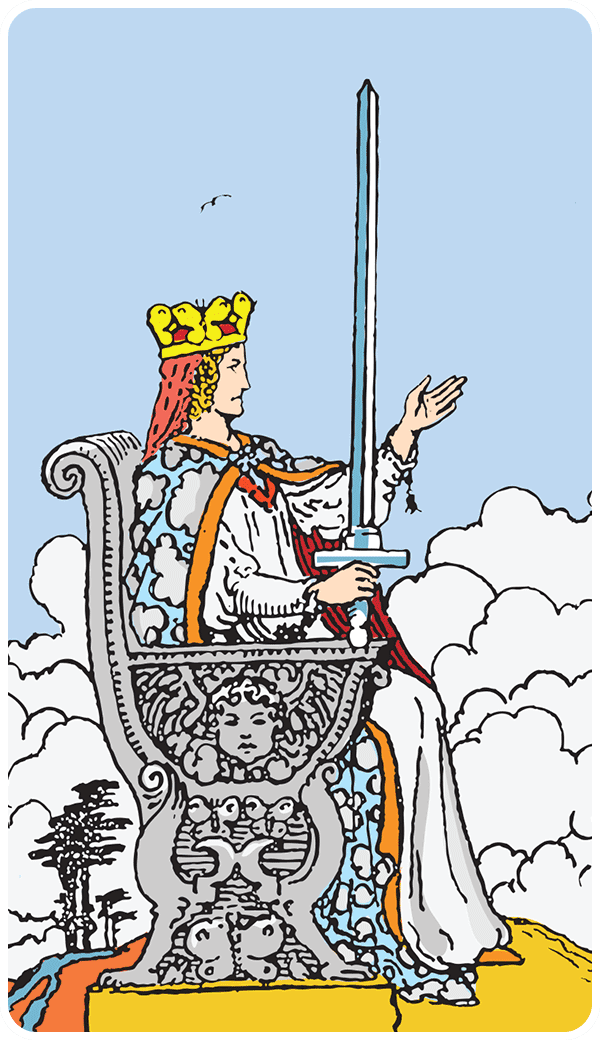
Queen of Swords · plate queen
MAYBE
The Queen of Swords in a yes/no reading is a maybe, and the maybe is deliberate. She is not hedging. She is not uncertain. She is telling you the question as phrased does not have enough information in it yet, or that the answer depends entirely on whether you are willing to cut through what you are not saying out loud. Most people read this card as a cold no — someone who will shut you down, someone who does not care about your feelings. That is the wrong read. The Queen of Swords cares about precision. If the question is sloppy, the answer will be conditional.
Why Queen of Swords reads this way
What the suit, rank, and image are doing
Swords is the suit of thought, discernment, and the capacity to separate signal from noise. It governs clarity, boundary-setting, and the ability to name what is actually happening without decoration. When Swords cards show up, the question being asked almost always has an emotional charge the querent is trying to think their way around.
Queens in tarot are the internalized, self-sustaining expression of their suit. They do not perform the suit's energy for an audience; they live it as a default setting. The Queen of Swords has done the work of cutting away what does not serve her so many times that she no longer needs to announce it. She simply does not engage with what is unclear, manipulative, or emotionally coercive.
The image: a woman sits on a throne, one hand raised, holding a sword upright. Her gaze is direct. The sky behind her is clear. There is no storm, no drama. She is not defending herself. She is not attacking. She is simply present, holding the blade as a tool of discernment, not a weapon. The sword is vertical — a line drawn, not a slash.
Why the answer is maybe, and when it flips
The Queen of Swords in a yes/no reading says maybe because she will not answer a question that has not been fully asked. If you are asking "Should I leave this job?" and what you actually mean is "Will leaving this job hurt someone's feelings?", she will not give you the answer to the question you did not ask. The maybe is an instruction: go back and name what you are actually asking.
The card flips to yes when the question is clean and the querent is prepared to act on clarity without needing external validation. If you are asking "Is this boundary necessary?" and you already know the answer is yes but are hoping the cards will let you off the hook, the Queen of Swords confirms it. Yes. Hold the line.
The card flips to no when the question is being used as a way to avoid responsibility. If you are asking "Will this work out if I just wait?" and waiting is another word for avoiding a conversation you know you need to have, the answer is no. The Queen of Swords does not reward passivity dressed up as patience.
The tell that you are misreading the card
You are misreading the Queen of Swords if you feel criticized by her. She is not criticizing you. She is asking you to be more honest with yourself. If the card lands and your first reaction is defensiveness — "I am being clear, the situation is just complicated" — that is the tell. The situation is not complicated. You are avoiding naming the part that hurts.
Another tell: if you pull this card and immediately want to pull another card to clarify it, you are trying to out-think the instruction. The Queen of Swords does not need clarification. She needs you to sit with the question long enough to notice what you left out of it.
A grounded observation
Go back through your journal or your text threads and look for the last time you asked someone a question and then, mid-conversation, realized you were asking the wrong question. That moment — the one where you had to stop and rephrase — is what the Queen of Swords is pointing to. She is already there.
Key themes to watch for
- № 01Theme
Affirmative current
- № 02Theme
Open door
- № 03Theme
Forward motion
What to do with this reading
Read the upright meaning first, even if you pulled the card reversed. The reversal is a commentary on the upright — not a separate card.
Notice what your body did when you saw Queen of Swords. That reaction is usually closer to the truth than the interpretation.
Write down one sentence: What is this card asking me to stop avoiding? Let the answer be smaller than you expect.
Come back to this card in 48 hours. Most yes / no readings sharpen with a little distance.
Questions answered
Frequently asked
The Queen of Swords in a yes/no reading is a maybe, and the maybe is deliberate. She is not hedging. She is not uncertain. She is telling you the question as phrased does not have enough information in it yet, or that the answer depends entirely on whether you are willing to cut through what you are not saying out loud. Most people read this card as a cold no — someone who will shut you down, someone who does not care about your feelings. That is the wrong read. The Queen of Swords cares about precision. If the question is sloppy, the answer will be conditional.
Reversed cards are rarely "bad." Queen of Swords reversed asks you to look at where the same theme is blocked, postponed, or being avoided — usually with more compassion than the upright version.
Queen of Swords colors the cards around it. Pay attention to where its themes — mental clarity, the truth being named, what the mind needs to release — show up in the next card. That is usually where the story is.
Tarot is observational, not predictive. Queen of Swords describes the conditions in front of you right now and where they tend to lead if nothing changes — not a guarantee of timing.
Repeat cards are the deck underlining a theme. With Queen of Swords, that usually means the question you are asking is the right one — but you have not yet acted on what the card is showing you.
Read next
Related readings
More Swords · Yes / No
- Ace of Swords — Yes / NoHow Ace of Swords reads in a yes / no context.
- Two of Swords — Yes / NoHow Two of Swords reads in a yes / no context.
- Three of Swords — Yes / NoHow Three of Swords reads in a yes / no context.
- Four of Swords — Yes / NoHow Four of Swords reads in a yes / no context.
- Five of Swords — Yes / NoHow Five of Swords reads in a yes / no context.
- Six of Swords — Yes / NoHow Six of Swords reads in a yes / no context.
Other Queen of Swords readings
- General MeaningQueen of Swords read for general meaning.
- Love & RelationshipsQueen of Swords read for love & relationships.
- Career & WorkQueen of Swords read for career & work.
- Money & FinanceQueen of Swords read for money & finance.
- Health & WellbeingQueen of Swords read for health & wellbeing.
- SpiritualityQueen of Swords read for spirituality.