Page of Swords in Yes / No
The Page of Swords in a yes/no reading leans 'no' — not because the outcome is blocked, but because the information isn't complete yet.
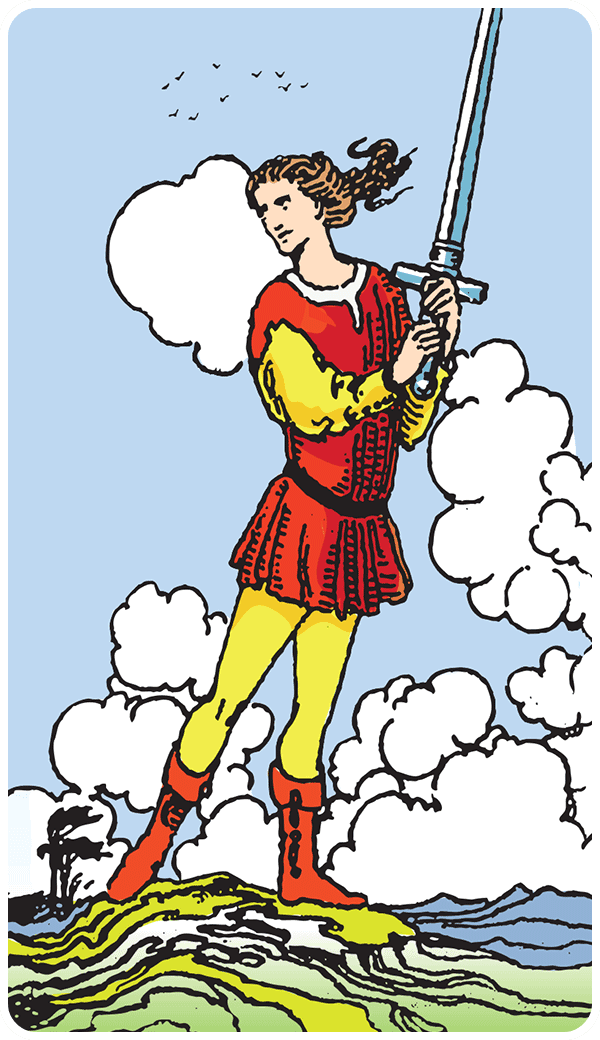
Page of Swords · plate page
NO
The Page of Swords in a yes/no reading leans 'no.' Not a hard no — a 'not yet' no. The card names incomplete information. Something hasn't been said, hasn't been checked, hasn't been thought through all the way. Most people read this as 'the answer is coming soon,' which is close but wrong. The card isn't describing a timeline. It's describing a gap in what you know right now, and that gap matters more than you think it does.
Why Page of Swords reads this way
What the rank, suit, and image are doing
Pages in tarot are messengers and students. They represent early-stage energy — the beginning of a process, the first draft, the question before the answer. Pages are not outcomes. They are the part that comes before the outcome, when something is still forming. When a Page shows up in a yes/no reading, the question itself is premature. You're asking for a binary when the situation is still in motion.
Swords is the suit of thought, communication, and information. It governs what gets said, what gets withheld, what gets misunderstood, and what gets clarified. Swords cards track the movement of truth — not emotional truth, intellectual truth. When Swords dominates a reading, the real question is almost always 'what do I actually know here, and what am I assuming.'
The image: a young figure stands alone, holding a sword upright, wind blowing. The ground is uneven. The stance is alert but not defensive. The figure is watching, listening, ready to move but not moving yet. This is someone gathering information, not someone who has already decided. The sword is a tool for cutting through confusion, but it hasn't been used yet. The card describes readiness, not action.
Why people misread it as 'yes, but with obstacles'
The most common misreading is treating the Page of Swords as a qualified yes — 'yes, but you'll have to be strategic,' or 'yes, but there will be challenges.' That reading imports the Swords suit's association with difficulty and applies it to the outcome. But the Page isn't describing difficulty in the outcome. It's describing incompleteness in the present moment.
Here's what tends to happen when someone gets the Page of Swords and reads it as yes. They move forward. Two weeks later, a piece of information surfaces that they didn't have before — a clause in the contract they didn't read, a conversation the other person had that they didn't know about, a assumption they made that turned out to be wrong. The outcome doesn't fail because of bad luck. It fails because the decision was made too early.
The card reads differently depending on whether you're the one withholding information or the one missing it. If you're the querent and you haven't told the full truth yet — to yourself or to someone else — the Page of Swords is naming that gap. The answer is no until you say the thing. If you're waiting on someone else to clarify, the Page of Swords says they haven't clarified yet, and you don't have enough to decide.
The tell that you're misreading it
The tell is this: you're asking the yes/no question, but you haven't actually asked the clarifying question in real life yet. You haven't sent the email. You haven't checked the terms. You haven't said 'wait, what did you mean by that.' You're trying to skip the information-gathering step and jump straight to the outcome. The Page of Swords will not let you do that. The card doesn't block the yes. It says the yes isn't available yet because you don't know what you're saying yes to.
A grounded observation
Go back through your last three days of communication. Find the question you didn't ask because you were afraid it would sound paranoid or because you assumed you already knew the answer. That's the question the Page of Swords is pointing at.
Key themes to watch for
- № 01Theme
Affirmative current
- № 02Theme
Open door
- № 03Theme
Forward motion
What to do with this reading
Read the upright meaning first, even if you pulled the card reversed. The reversal is a commentary on the upright — not a separate card.
Notice what your body did when you saw Page of Swords. That reaction is usually closer to the truth than the interpretation.
Write down one sentence: What is this card asking me to stop avoiding? Let the answer be smaller than you expect.
Come back to this card in 48 hours. Most yes / no readings sharpen with a little distance.
Questions answered
Frequently asked
The Page of Swords in a yes/no reading leans 'no.' Not a hard no — a 'not yet' no. The card names incomplete information. Something hasn't been said, hasn't been checked, hasn't been thought through all the way. Most people read this as 'the answer is coming soon,' which is close but wrong. The card isn't describing a timeline. It's describing a gap in what you know right now, and that gap matters more than you think it does.
Reversed cards are rarely "bad." Page of Swords reversed asks you to look at where the same theme is blocked, postponed, or being avoided — usually with more compassion than the upright version.
Page of Swords colors the cards around it. Pay attention to where its themes — mental clarity, the truth being named, what the mind needs to release — show up in the next card. That is usually where the story is.
Tarot is observational, not predictive. Page of Swords describes the conditions in front of you right now and where they tend to lead if nothing changes — not a guarantee of timing.
Repeat cards are the deck underlining a theme. With Page of Swords, that usually means the question you are asking is the right one — but you have not yet acted on what the card is showing you.
Read next
Related readings
More Swords · Yes / No
- Ace of Swords — Yes / NoHow Ace of Swords reads in a yes / no context.
- Two of Swords — Yes / NoHow Two of Swords reads in a yes / no context.
- Three of Swords — Yes / NoHow Three of Swords reads in a yes / no context.
- Four of Swords — Yes / NoHow Four of Swords reads in a yes / no context.
- Five of Swords — Yes / NoHow Five of Swords reads in a yes / no context.
- Six of Swords — Yes / NoHow Six of Swords reads in a yes / no context.
Other Page of Swords readings
- General MeaningPage of Swords read for general meaning.
- Love & RelationshipsPage of Swords read for love & relationships.
- Career & WorkPage of Swords read for career & work.
- Money & FinancePage of Swords read for money & finance.
- Health & WellbeingPage of Swords read for health & wellbeing.
- SpiritualityPage of Swords read for spirituality.