Page of Swords in Love
The Page of Swords in love gets read as communication problems. What it actually describes is the moment you start watching the relationship instead of being in it.
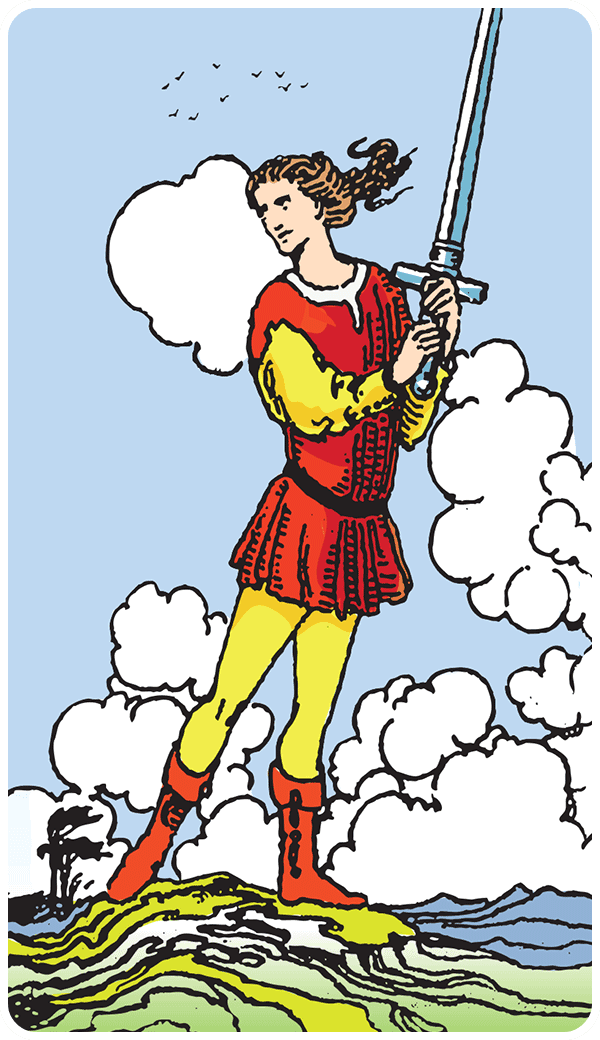
Page of Swords · plate page
What the card is actually doing
The Page of Swords shows up in a love reading and the querent nods knowingly. They think the card is telling them there's a communication issue. Someone isn't being honest. Someone needs to speak up. The relationship needs more transparency, more talking, more clarity.
That is almost never what the card is describing. The Page of Swords is not about what needs to be said. It is about the moment you start treating the relationship as a puzzle to solve instead of an experience to live inside.
Reading Page of Swords in love
What the suit, the rank, and the image are doing
Swords is the mental suit. It governs thought, language, perception, and the stories you tell yourself about what is happening. When Swords cards dominate a reading, the question is being processed through the intellect, not the body. The querent is thinking about the relationship more than they are feeling it.
Pages in tarot are observers and messengers. They are not actors. They are not authorities. A Page is the figure who stands at the edge of the scene, watching, collecting information, forming hypotheses. Pages describe a learning posture — curious, alert, sometimes nervous. The Page of Swords specifically describes the mind in reconnaissance mode.
Look at the image. A young figure holds a sword upright, standing on uneven ground. The sky is turbulent. The posture is vigilant, not combative. This is someone scanning the horizon, testing the wind, gathering data. The sword is a tool for cutting through to clarity, but it has not been swung yet. The Page is still deciding what the information means.
The card describes the moment you start watching your partner's behavior for clues. You replay conversations. You notice patterns. You start building a case in your head about what is actually going on beneath what is being said. The mind is active, alert, and slightly suspicious. You are no longer inside the intimacy — you are outside it, studying it.
How the card reads for two different situations
If the querent is early in a relationship or dating someone new, the Page of Swords describes healthy discernment. You are paying attention. You are noticing how this person behaves when they are stressed, how they talk about their ex, whether their actions match their words. This is appropriate vigilance. The card is not a warning; it is a description of what your mind is already doing.
If the querent is in an established relationship, the Page of Swords describes a shift. Something has changed the felt sense of safety, and the mind has stepped in to protect you. You are no longer assuming good intent. You are scanning for inconsistencies. You are building a narrative about what your partner is really thinking or feeling or planning. The card does not tell you whether your suspicion is justified — it only names that the suspicion is now running the show.
The tell that you are misreading the card on yourself
The most common misreading is to treat the Page of Swords as a prescription. The querent decides the card is telling them to communicate more, to ask the hard questions, to demand transparency. They think the card is instructing them to use their sword.
But the Page does not swing the sword. The Page holds it and watches. If you are already in observer mode — already analyzing, already building the case — the card is not telling you to do more of that. It is naming that you have already left the intimacy and entered the investigation. The question the card is actually asking is: what made you stop trusting what you feel and start needing to prove what you think?
From the practice
“A card never tells you what to do. It tells you what you're already deciding — and gives you the words to name it.”
A grounded observation
Go back through the last two weeks and notice when you stopped feeling the relationship and started narrating it to yourself. That is when the Page of Swords walked in.
Key themes to watch for
- № 01Theme
Vulnerability
- № 02Theme
New chapters
- № 03Theme
Emotional truth
What to do with this reading
Read the upright meaning first, even if you pulled the card reversed. The reversal is a commentary on the upright — not a separate card.
Notice what your body did when you saw Page of Swords. That reaction is usually closer to the truth than the interpretation.
Write down one sentence: What is this card asking me to stop avoiding? Let the answer be smaller than you expect.
Come back to this card in 48 hours. Most love readings sharpen with a little distance.
Questions answered
Frequently asked
In love, the Page of Swords brings a spark of curiosity and playful communication. Picture a relationship where questions are met with laughter and conversations flow freely. This card might signal the beginning stages of romance where everything feels new and exciting, or it could suggest a need for open dialogue in a current relationship. Pay attention to the way words are exchanged and the joy of discovering more about each other. What new things are you learning about your partner, and how do they shape your connection?
Reversed, the Page of Swords in love might hint at misunderstandings or communication that feels off-kilter. There could be a sense of words left unsaid or mixed signals creating confusion. It's a time to be mindful of how you express yourself and to seek clarity if things feel muddled. Imagine two people trying to have a conversation over a noisy crowd; consider what might help bring the conversation back into focus. How can you ensure both voices are heard and understood?
Page of Swords colors the cards around it. Pay attention to where its themes — mental clarity, the truth being named, what the mind needs to release — show up in the next card. That is usually where the story is.
Tarot is observational, not predictive. Page of Swords describes the conditions in front of you right now and where they tend to lead if nothing changes — not a guarantee of timing.
Repeat cards are the deck underlining a theme. With Page of Swords, that usually means the question you are asking is the right one — but you have not yet acted on what the card is showing you.
Read next
Related readings
More Swords · Love
- Ace of Swords — LoveHow Ace of Swords reads in a love context.
- Two of Swords — LoveHow Two of Swords reads in a love context.
- Three of Swords — LoveHow Three of Swords reads in a love context.
- Four of Swords — LoveHow Four of Swords reads in a love context.
- Five of Swords — LoveHow Five of Swords reads in a love context.
- Six of Swords — LoveHow Six of Swords reads in a love context.
Other Page of Swords readings
- General MeaningPage of Swords read for general meaning.
- Career & WorkPage of Swords read for career & work.
- Money & FinancePage of Swords read for money & finance.
- Health & WellbeingPage of Swords read for health & wellbeing.
- SpiritualityPage of Swords read for spirituality.
- Yes / No AnswerPage of Swords read for yes / no answer.