Nine of Swords in Yes / No
The Nine of Swords in a yes/no reading usually means no — but the card isn't answering your question. It's naming the mental loop that's asking it.
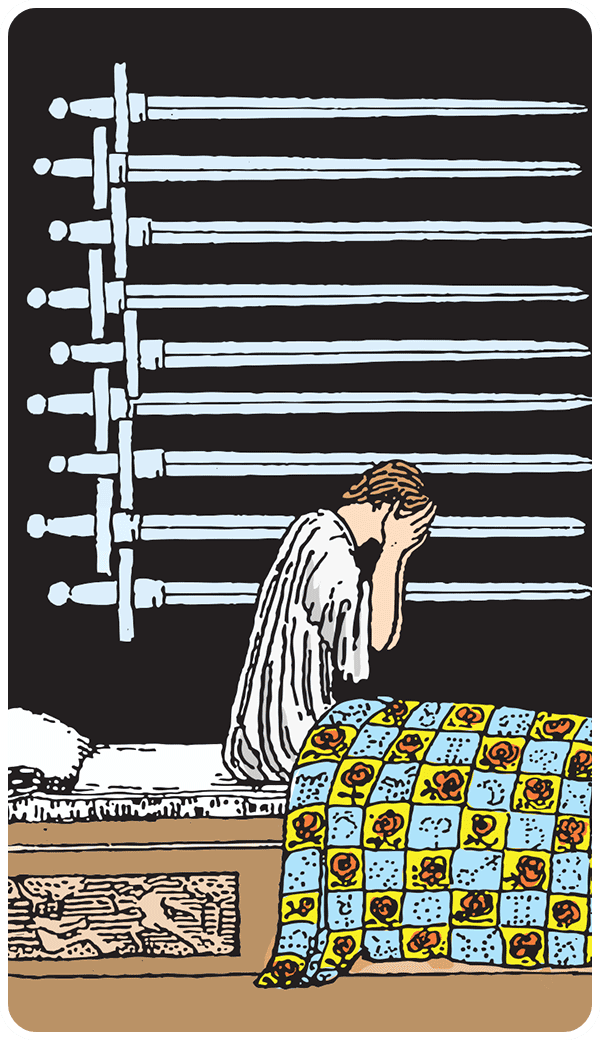
Nine of Swords · plate 9
NO
The Nine of Swords in a yes/no reading leans no. Not because the outcome is doomed, but because the question is being asked from a place of catastrophic thinking. The card describes a mind that has already written the worst version of the story and is now asking for permission to believe it. Most querents read this as confirmation that their fears are correct. That is the misread. The card is not validating the fear. It is pointing to the fact that fear is the only voice in the room right now, and fear does not produce reliable answers.
Why Nine of Swords reads this way
What the suit, rank, and image are doing
Swords is the suit of thought, language, and the structures the mind builds to make sense of the world. When Swords cards dominate a reading, the question is being processed intellectually, not emotionally or intuitively. The Nine is late in the suit's sequence — past the initial cut of clarity, past the stalemate, deep into the part where thinking has turned against itself.
Nines in tarot represent culmination before completion. They are the last full expression of the suit's energy before the Ten closes the cycle. The Nine of Swords is the point where mental activity reaches its most punishing intensity. Look at the image: a figure sits upright in bed, head in hands, surrounded by nine swords hung on the wall behind them. It is the middle of the night. They are alone. They are not in danger. They are imagining danger so vividly that the body responds as if the danger is real.
This is what the card describes: recursive worry. The mind spinning the same scenario over and over, each time finding a new reason it will go wrong. The nine swords are not external threats. They are thoughts. The querent is not being attacked. They are attacking themselves with their own projections, and the attack feels so real that they cannot tell the difference between the thought and the fact.
Why the answer is usually no, and when it isn't
The Nine of Swords answers no because the question is being asked from a state of panic, and panic does not produce good data. If you ask "Will this work out?" while your nervous system is convinced it won't, the card is not predicting failure — it is naming the fact that you are not currently capable of seeing the situation clearly. The no is procedural. It means: not like this. Not from this mental state. Not while you are rehearsing catastrophe.
The answer flips to maybe when the querent can name the specific fear and separate it from the question. If someone asks "Should I take this job?" and the Nine of Swords appears, the card is not saying the job is bad. It is saying: you are asking this question at 3am after scrolling worst-case scenarios for two hours. Go back and ask again when you are not in fight-or-flight.
Reversed, the card sometimes describes the moment the mental loop breaks. The querent has hit the point where the anxiety is so exhausting that they stop feeding it. The answer in that case edges toward yes — not because the outcome has changed, but because the querent has stopped pre-emptively destroying it in their head.
The tell that you are misreading the card on yourself
If you pull the Nine of Swords in a yes/no reading and your immediate reaction is relief — "See, I knew it wouldn't work" — you are misreading it. The card is not agreeing with you. It is showing you that you have been asking the same question in six different ways, hoping for a different answer, and the only thing that has changed is how tired you are. The Nine of Swords does not confirm your fears. It confirms that your fears are the loudest thing in the room, and that is not the same as being correct.
A grounded observation
Go back through your search history or your text threads and count how many times you have asked a version of this question in the last 48 hours. If the number is higher than three, the card is not answering the question. It is answering the asking.
Key themes to watch for
- № 01Theme
Affirmative current
- № 02Theme
Open door
- № 03Theme
Forward motion
What to do with this reading
Read the upright meaning first, even if you pulled the card reversed. The reversal is a commentary on the upright — not a separate card.
Notice what your body did when you saw Nine of Swords. That reaction is usually closer to the truth than the interpretation.
Write down one sentence: What is this card asking me to stop avoiding? Let the answer be smaller than you expect.
Come back to this card in 48 hours. Most yes / no readings sharpen with a little distance.
Questions answered
Frequently asked
The Nine of Swords in a yes/no reading leans no. Not because the outcome is doomed, but because the question is being asked from a place of catastrophic thinking. The card describes a mind that has already written the worst version of the story and is now asking for permission to believe it. Most querents read this as confirmation that their fears are correct. That is the misread. The card is not validating the fear. It is pointing to the fact that fear is the only voice in the room right now, and fear does not produce reliable answers.
Reversed cards are rarely "bad." Nine of Swords reversed asks you to look at where the same theme is blocked, postponed, or being avoided — usually with more compassion than the upright version.
Nine of Swords colors the cards around it. Pay attention to where its themes — mental clarity, the truth being named, what the mind needs to release — show up in the next card. That is usually where the story is.
Tarot is observational, not predictive. Nine of Swords describes the conditions in front of you right now and where they tend to lead if nothing changes — not a guarantee of timing.
Repeat cards are the deck underlining a theme. With Nine of Swords, that usually means the question you are asking is the right one — but you have not yet acted on what the card is showing you.
Read next
Related readings
More Swords · Yes / No
- Ace of Swords — Yes / NoHow Ace of Swords reads in a yes / no context.
- Two of Swords — Yes / NoHow Two of Swords reads in a yes / no context.
- Three of Swords — Yes / NoHow Three of Swords reads in a yes / no context.
- Four of Swords — Yes / NoHow Four of Swords reads in a yes / no context.
- Five of Swords — Yes / NoHow Five of Swords reads in a yes / no context.
- Six of Swords — Yes / NoHow Six of Swords reads in a yes / no context.
Other Nine of Swords readings
- General MeaningNine of Swords read for general meaning.
- Love & RelationshipsNine of Swords read for love & relationships.
- Career & WorkNine of Swords read for career & work.
- Money & FinanceNine of Swords read for money & finance.
- Health & WellbeingNine of Swords read for health & wellbeing.
- SpiritualityNine of Swords read for spirituality.