Nine of Swords in Love
The Nine of Swords in love readings describes the anxiety loop, not the relationship problem. Here's what the card is actually naming.
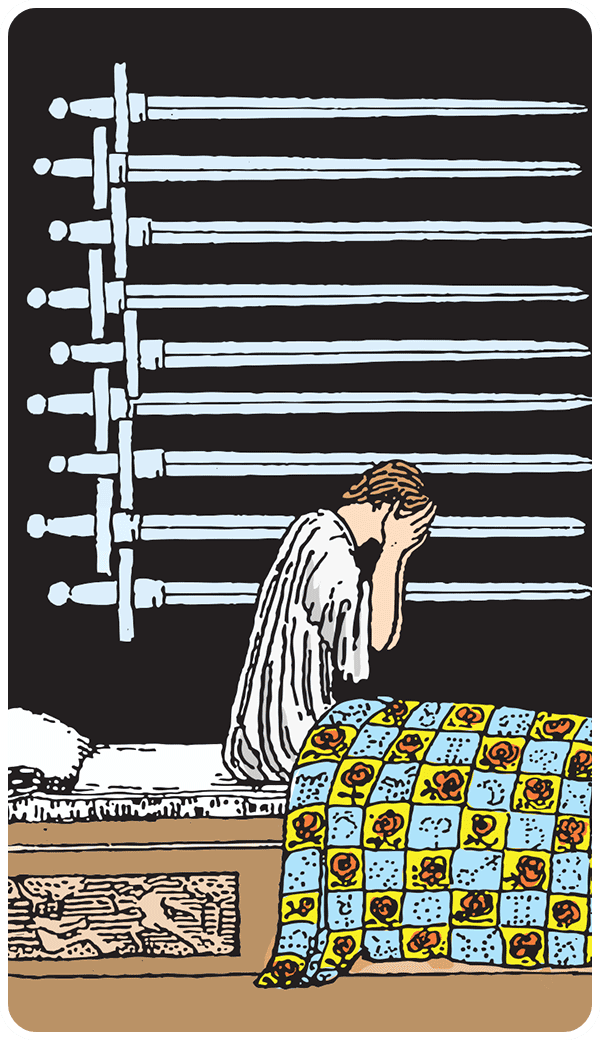
Nine of Swords · plate 9
What the card is actually doing
The Nine of Swords shows up in a love reading and the querent assumes the relationship is doomed. They read the card as confirmation that something terrible is happening or about to happen — that their partner is lying, that the connection is dying, that they are about to be left. That is not what the card describes. The Nine of Swords does not report on the relationship. It reports on the querent's nervous system at 3am.
Reading Nine of Swords in love
What the suit, the rank, and the image are doing
Swords is the suit of thought, language, and the stories you tell yourself about what is happening. It governs how you interpret experience, how you argue with yourself, and how meaning gets constructed or dismantled in your head. When Swords dominates a love reading, the question is almost always about interpretation — not about what the other person is doing, but about what you have decided it means.
Nines in tarot describe accumulation at the edge of completion. The Nine of Pentacles is material self-sufficiency before partnership. The Nine of Cups is emotional satisfaction that doesn't require outside validation. The Nine of Swords is the accumulation of every worst-case thought you have had about this situation, stacked and replaying.
Look at the image. A figure sits upright in bed, head in hands. Nine swords hang on the wall behind them. They are not being attacked. The swords are not moving. The figure is alone with their own mind. This is the mechanical answer: the Nine of Swords describes the anxiety loop, not the thing being worried about.
How the card reads for two different querents
For the querent whose partner has actually pulled back — stopped texting as much, canceled plans twice, seems distant — the Nine of Swords says: you are now in the story about what this means, and the story is worse than the data. You have written the ending. You are rehearsing the breakup conversation. You are no longer responding to what is happening; you are responding to the narrative you built around what is happening. The card does not say the relationship is fine. It says you cannot see the relationship clearly right now because you are inside the fear.
For the querent whose partner has done nothing observably different — texts back, shows up, says they love you — but who feels convinced something is wrong, the Nine of Swords is more direct. It names catastrophic thinking as the primary event. The relationship has not changed. Your tolerance for uncertainty has collapsed. You are scanning for proof of the disaster you have already decided is coming. The card is not warning you. It is describing what you are doing to yourself.
The tell that someone is misreading this card on themselves
The tell is when the querent treats the Nine of Swords as evidence. "The cards are saying he's going to leave." "This proves I'm right to be worried." No. The card confirms that worry is present. It does not confirm that the worry is accurate. If you pull the Nine of Swords and your first move is to text your partner a question designed to extract reassurance, you are misreading it. The card is not asking you to investigate the relationship. It is asking you to notice that you are in a loop.
From the practice
“A card never tells you what to do. It tells you what you're already deciding — and gives you the words to name it.”
A grounded observation
Go back through your texts from the last three days. If you have asked the same question in three different ways, you are in the Nine of Swords. The question is not the problem. The asking is.
Key themes to watch for
- № 01Theme
Vulnerability
- № 02Theme
New chapters
- № 03Theme
Emotional truth
What to do with this reading
Read the upright meaning first, even if you pulled the card reversed. The reversal is a commentary on the upright — not a separate card.
Notice what your body did when you saw Nine of Swords. That reaction is usually closer to the truth than the interpretation.
Write down one sentence: What is this card asking me to stop avoiding? Let the answer be smaller than you expect.
Come back to this card in 48 hours. Most love readings sharpen with a little distance.
Questions answered
Frequently asked
In love, the Nine of Swords can feel like the doubts and insecurities that creep in during quiet moments. It might be worries about the future of a relationship or past mistakes that haunt the present. This card suggests that these fears, while intense, might be more about your own inner dialogue than reality. Are you projecting past hurts onto current situations? It’s worth exploring whether these fears are shared or solely internal. The card invites you to open a conversation, not just with your partner but also with yourself, about what truly matters.
Reversed, the Nine of Swords in love signals a release from anxiety. Perhaps you have found new ways to communicate with your partner or have had a cathartic realization. This card suggests a turning point where the shadows of doubt begin to lighten. However, it's crucial to recognize the journey it took to get here and the emotional growth that has occurred. What can you carry forward from this experience to nurture future intimacy? The card invites you to embrace the peace that comes from addressing and understanding your fears.
Nine of Swords colors the cards around it. Pay attention to where its themes — mental clarity, the truth being named, what the mind needs to release — show up in the next card. That is usually where the story is.
Tarot is observational, not predictive. Nine of Swords describes the conditions in front of you right now and where they tend to lead if nothing changes — not a guarantee of timing.
Repeat cards are the deck underlining a theme. With Nine of Swords, that usually means the question you are asking is the right one — but you have not yet acted on what the card is showing you.
Read next
Related readings
More Swords · Love
- Ace of Swords — LoveHow Ace of Swords reads in a love context.
- Two of Swords — LoveHow Two of Swords reads in a love context.
- Three of Swords — LoveHow Three of Swords reads in a love context.
- Four of Swords — LoveHow Four of Swords reads in a love context.
- Five of Swords — LoveHow Five of Swords reads in a love context.
- Six of Swords — LoveHow Six of Swords reads in a love context.
Other Nine of Swords readings
- General MeaningNine of Swords read for general meaning.
- Career & WorkNine of Swords read for career & work.
- Money & FinanceNine of Swords read for money & finance.
- Health & WellbeingNine of Swords read for health & wellbeing.
- SpiritualityNine of Swords read for spirituality.
- Yes / No AnswerNine of Swords read for yes / no answer.