Knight of Swords in Yes / No
The Knight of Swords leans yes — but only if you're asking about action you can take immediately. Here's what the card is actually measuring.
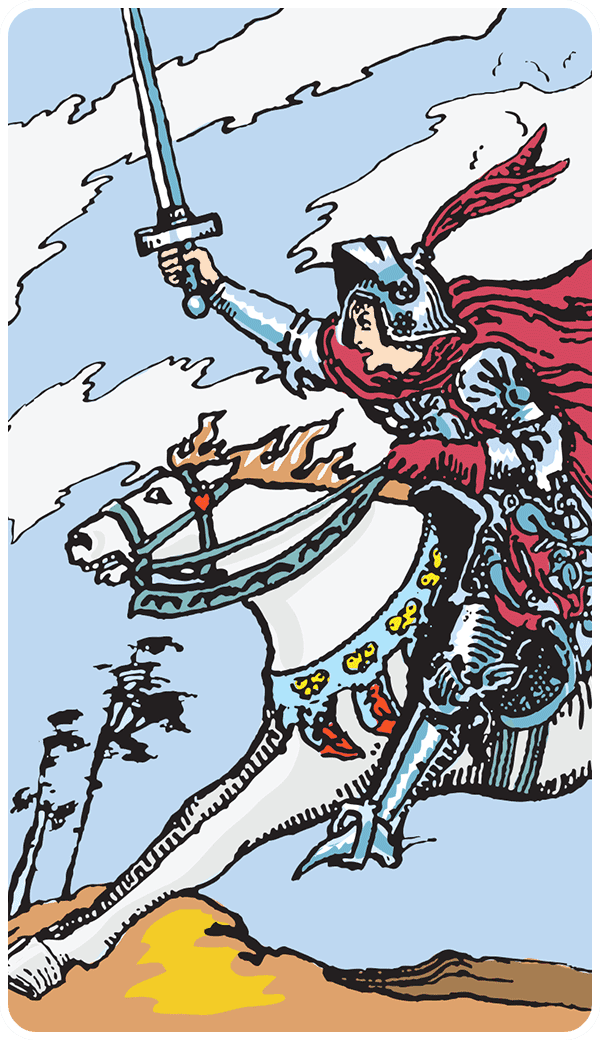
Knight of Swords · plate knight
YES
The Knight of Swords in a yes/no reading leans yes, but with a tight condition: the yes holds only if you can act on it immediately and the question involves something you personally control. The card does not predict outcomes. It describes momentum. Most people misread it as "things will happen fast" when what it actually says is "you are already moving, and the question is whether that momentum serves the goal." If you're asking about someone else's choice or waiting for external timing to shift, the card stops meaning yes and starts meaning you're about to waste energy on a question the other person hasn't even registered yet.
Why Knight of Swords reads this way
What the suit, the rank, and the image are doing
Swords is the suit of thought, decision, and the cut of clarity that lets you move through a problem instead of circling it. It governs what you think is true, what argument you're running in your head, and whether that argument is sharp enough to land. When Swords cards dominate a reading, the question is almost always about whether the querent has enough information or whether they're stuck in analysis.
Knights in tarot are momentum cards. They are not arrivals. They are not completions. A Knight describes energy already in motion — the part of the process where you've committed to a direction and are now moving through it at speed. The Knight of Cups is emotional pursuit. The Knight of Pentacles is methodical, grinding progress. The Knight of Swords is mental velocity: the decision has been made, the argument has been sharpened, and now you're moving.
Look at the image. A figure on horseback charges forward, sword raised, leaning into the wind. The horse's front legs are off the ground. There is no hesitation in the posture. This is not someone weighing options. This is someone who has already chosen and is now executing. The card describes the state of being mid-action, not the state of wondering whether to act.
Why the yes/no answer depends on whether you're the one moving
The Knight of Swords reads as yes when the question is about something you can do — "Should I send the email?" "Should I book the ticket?" "Should I say the thing I've been avoiding saying?" The card is confirming that you already have enough information and the delay is not serving you. The momentum is available. The yes is permission to stop deliberating.
The card reads as no — or more accurately, as irrelevant — when the question is about someone else's timeline or an external condition. "Will they text me back?" is not a question the Knight of Swords can answer, because the card is not describing their movement. It's describing yours. If you pull this card on that question, what it's actually saying is: you are spending mental energy on something you cannot control, and that energy is not generating the outcome. The no is structural. You are asking the wrong question.
The reversed Knight of Swords flips the meaning in a specific way. Upright, the card says the momentum is aligned and you should move. Reversed, it says the momentum exists but it's not aimed at the goal. You are moving fast in a direction that does not solve the problem. The yes becomes: yes, you will act, but no, it will not produce what you think it will produce.
The tell that you're misreading the card
The tell is when someone pulls the Knight of Swords, reads it as yes, and then spends three days waiting for the thing to happen. If you are waiting, you have misread the card. The Knight of Swords does not describe things happening to you. It describes you happening to things. If the question was "Will this resolve?" and you're now passively monitoring for resolution, the card was not giving you a prediction. It was naming the action you're avoiding. Go back through the question and find the verb. If the verb is something you can do today, the card is a yes. If the verb belongs to someone else or to timing, the card is off-topic.
A grounded observation
When the Knight of Swords shows up in a yes/no reading and you feel relieved, check whether the relief is because you now have permission to act or because you think you no longer have to. If it's the second one, you misread it.
Key themes to watch for
- № 01Theme
Affirmative current
- № 02Theme
Open door
- № 03Theme
Forward motion
What to do with this reading
Read the upright meaning first, even if you pulled the card reversed. The reversal is a commentary on the upright — not a separate card.
Notice what your body did when you saw Knight of Swords. That reaction is usually closer to the truth than the interpretation.
Write down one sentence: What is this card asking me to stop avoiding? Let the answer be smaller than you expect.
Come back to this card in 48 hours. Most yes / no readings sharpen with a little distance.
Questions answered
Frequently asked
The Knight of Swords in a yes/no reading leans yes, but with a tight condition: the yes holds only if you can act on it immediately and the question involves something you personally control. The card does not predict outcomes. It describes momentum. Most people misread it as "things will happen fast" when what it actually says is "you are already moving, and the question is whether that momentum serves the goal." If you're asking about someone else's choice or waiting for external timing to shift, the card stops meaning yes and starts meaning you're about to waste energy on a question the other person hasn't even registered yet.
Reversed cards are rarely "bad." Knight of Swords reversed asks you to look at where the same theme is blocked, postponed, or being avoided — usually with more compassion than the upright version.
Knight of Swords colors the cards around it. Pay attention to where its themes — mental clarity, the truth being named, what the mind needs to release — show up in the next card. That is usually where the story is.
Tarot is observational, not predictive. Knight of Swords describes the conditions in front of you right now and where they tend to lead if nothing changes — not a guarantee of timing.
Repeat cards are the deck underlining a theme. With Knight of Swords, that usually means the question you are asking is the right one — but you have not yet acted on what the card is showing you.
Read next
Related readings
More Swords · Yes / No
- Ace of Swords — Yes / NoHow Ace of Swords reads in a yes / no context.
- Two of Swords — Yes / NoHow Two of Swords reads in a yes / no context.
- Three of Swords — Yes / NoHow Three of Swords reads in a yes / no context.
- Four of Swords — Yes / NoHow Four of Swords reads in a yes / no context.
- Five of Swords — Yes / NoHow Five of Swords reads in a yes / no context.
- Six of Swords — Yes / NoHow Six of Swords reads in a yes / no context.
Other Knight of Swords readings
- General MeaningKnight of Swords read for general meaning.
- Love & RelationshipsKnight of Swords read for love & relationships.
- Career & WorkKnight of Swords read for career & work.
- Money & FinanceKnight of Swords read for money & finance.
- Health & WellbeingKnight of Swords read for health & wellbeing.
- SpiritualityKnight of Swords read for spirituality.