King of Swords in Yes / No
The King of Swords leans yes in binary readings — but only if you're asking from clarity, not control. Here's what the card is actually measuring.
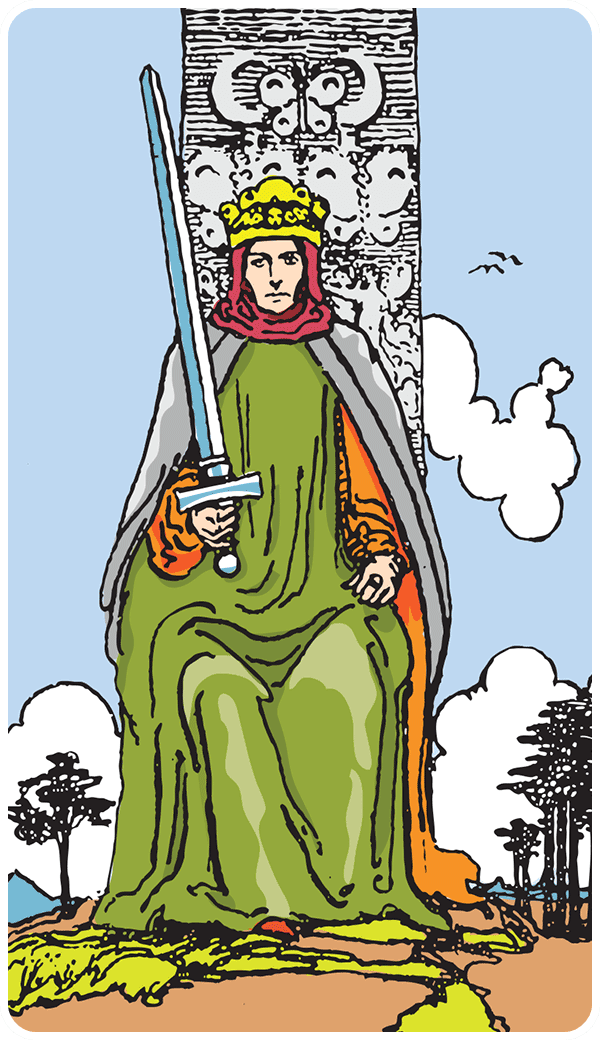
King of Swords · plate king
YES
The King of Swords leans yes. But the yes is conditional, and most people miss the condition. They read the card as permission to proceed and stop there. What the card is actually doing is asking whether you are asking the question from the right part of yourself. If you are asking from clarity — if you have already done the analysis, weighed the variables, and know what the smart move is — the King confirms it. If you are asking because you want the cards to override your doubt or justify a decision you've already made for emotional reasons, the answer flips to no.
Why King of Swords reads this way
What the suit, rank, and image are doing
Swords is the suit of thought, discernment, and the part of the psyche that cuts through fog to name what is true. It governs how you think, what standards you apply, and whether you can hold a position without needing it to feel good. Swords readings are almost never about what you feel; they are about what you know and whether you are willing to act on it.
Kings in tarot are mastery cards. They represent the suit's energy fully realized, wielded with competence and consistency. The King of Swords is not someone learning to think clearly — he already does. He is the part of you that can look at a situation, strip away the sentiment, and name the correct answer even when the correct answer is hard. The image shows a figure seated on a throne, sword upright, gaze forward. He is not deliberating. He has already decided. The question is whether you have.
In a yes/no reading, the King of Swords says yes when the question is being asked from that same place — from the part of you that has already done the work, knows the answer, and is checking in with the cards as a final sanity test, not as a way to avoid responsibility. The most common misreading is treating the King as a green light when you are actually asking the cards to make the decision for you. That is not what the card does. It reflects whether you are in the King's seat or not.
How the answer changes depending on who is asking
If you are asking a question and you already know the logical answer — you have run the numbers, you have checked your assumptions, you have named the risks and decided they are acceptable — the King of Swords is a clean yes. The card is confirming that you are operating from clarity, not wishful thinking. Proceed.
If you are asking because you are hoping the cards will override your hesitation, the King reads as no. Not because the action itself is wrong, but because you are not in the right relationship to the decision. You are asking the cards to be the authority so you do not have to be. The King of Swords does not do that job. He hands the sword back to you.
Reversed, the King of Swords in a yes/no reading almost always means no, but the no is about method, not outcome. It signals that you are either overthinking to the point of paralysis or underthinking and calling it intuition. The reversed King is the tell that you are using logic as a defense — sharpening the blade but not cutting anything, or cutting without checking whether you are aiming at the right thing.
The tell that you are misreading the card
You drew the King of Swords, read it as yes, and felt relief. That relief is the tell. The King of Swords does not produce relief. It produces recognition. If the card feels like permission, you were not asking from clarity — you were asking from doubt and hoping the cards would resolve it for you. Go back to the question. Ask yourself what you actually know, not what you want to be true. The King will still be there when you are ready to hold the sword yourself.
A grounded observation
If you need to ask the question three times, the answer is no. Not because the outcome is wrong, but because you are not the King yet. The card is naming that gap.
Key themes to watch for
- № 01Theme
Affirmative current
- № 02Theme
Open door
- № 03Theme
Forward motion
What to do with this reading
Read the upright meaning first, even if you pulled the card reversed. The reversal is a commentary on the upright — not a separate card.
Notice what your body did when you saw King of Swords. That reaction is usually closer to the truth than the interpretation.
Write down one sentence: What is this card asking me to stop avoiding? Let the answer be smaller than you expect.
Come back to this card in 48 hours. Most yes / no readings sharpen with a little distance.
Questions answered
Frequently asked
The King of Swords leans yes. But the yes is conditional, and most people miss the condition. They read the card as permission to proceed and stop there. What the card is actually doing is asking whether you are asking the question from the right part of yourself. If you are asking from clarity — if you have already done the analysis, weighed the variables, and know what the smart move is — the King confirms it. If you are asking because you want the cards to override your doubt or justify a decision you've already made for emotional reasons, the answer flips to no.
Reversed cards are rarely "bad." King of Swords reversed asks you to look at where the same theme is blocked, postponed, or being avoided — usually with more compassion than the upright version.
King of Swords colors the cards around it. Pay attention to where its themes — mental clarity, the truth being named, what the mind needs to release — show up in the next card. That is usually where the story is.
Tarot is observational, not predictive. King of Swords describes the conditions in front of you right now and where they tend to lead if nothing changes — not a guarantee of timing.
Repeat cards are the deck underlining a theme. With King of Swords, that usually means the question you are asking is the right one — but you have not yet acted on what the card is showing you.
Read next
Related readings
More Swords · Yes / No
- Ace of Swords — Yes / NoHow Ace of Swords reads in a yes / no context.
- Two of Swords — Yes / NoHow Two of Swords reads in a yes / no context.
- Three of Swords — Yes / NoHow Three of Swords reads in a yes / no context.
- Four of Swords — Yes / NoHow Four of Swords reads in a yes / no context.
- Five of Swords — Yes / NoHow Five of Swords reads in a yes / no context.
- Six of Swords — Yes / NoHow Six of Swords reads in a yes / no context.
Other King of Swords readings
- General MeaningKing of Swords read for general meaning.
- Love & RelationshipsKing of Swords read for love & relationships.
- Career & WorkKing of Swords read for career & work.
- Money & FinanceKing of Swords read for money & finance.
- Health & WellbeingKing of Swords read for health & wellbeing.
- SpiritualityKing of Swords read for spirituality.