Eight of Swords in Yes / No
The Eight of Swords leans 'no' in yes/no readings — not because the answer is no, but because the question assumes options you don't actually see yet.
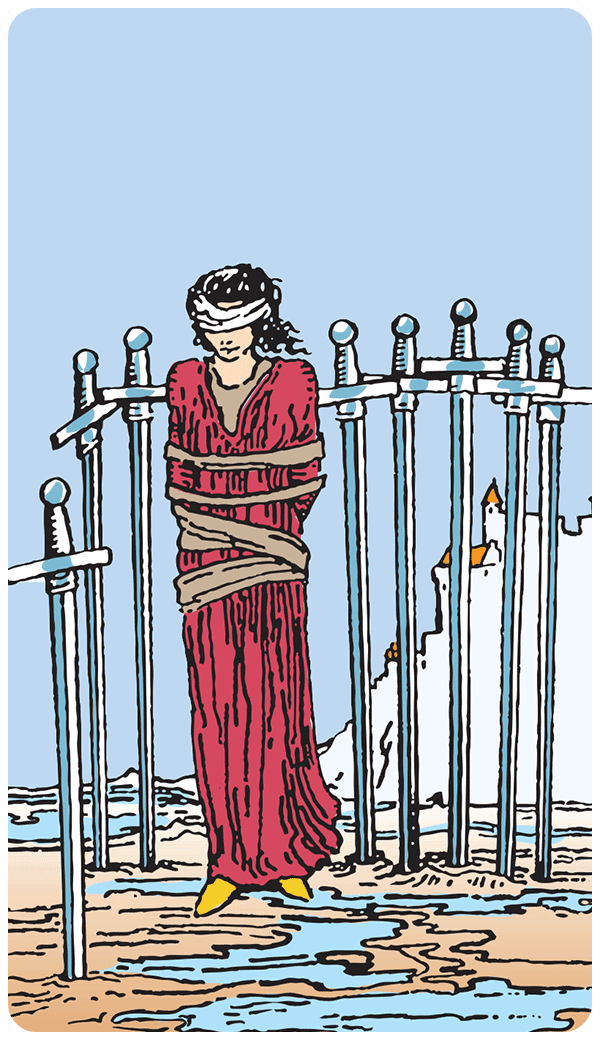
Eight of Swords · plate 8
NO
The Eight of Swords is a 'no.' Not because the thing you're asking about can't happen, but because you're asking the wrong question. The card doesn't describe an external block. It describes the moment you've talked yourself into believing there are only two choices, and both feel like traps. When this card shows up in a yes/no reading, the honest answer is: you won't move forward until you see the third option you're currently refusing to look at.
Why Eight of Swords reads this way
What the suit, rank, and image are doing — and why people read it as 'trapped by circumstances'
Swords governs thought, belief, and the stories you tell yourself about what's possible. It's the suit of mental frameworks — the lens through which you interpret what's happening. When Swords cards dominate, the question isn't about what's real; it's about what you think is real, and whether that thought is load-bearing or just familiar.
Eights in tarot describe constraint. Not the hard no of a Five (active conflict) or the ending of a Ten (collapse), but the tighter, more specific experience of operating inside boundaries that feel non-negotiable. The Eight of Pentacles is constraint as craft. The Eight of Cups is constraint as the thing you finally walk away from. The Eight of Swords is constraint as the box you're standing in, built entirely out of thoughts you haven't questioned yet.
Now look at the image. A figure stands blindfolded, surrounded by eight swords planted in the ground. Their hands are bound loosely — sometimes not bound at all, depending on the deck. The swords form a loose perimeter. There is space between them. The figure is not pinned. They are not imprisoned. They are standing very still in the middle of an open field, convinced they cannot move. This is the card. The block is cognitive, not material.
People read the Eight of Swords as 'trapped by circumstances' because the figure looks trapped. But circumstances are the swords — and the swords are not touching them. The trap is the belief that this is all there is. When someone asks a yes/no question and pulls this card, they are almost always asking a question that assumes only two roads exist, and they've already decided both roads are bad. The card is naming that assumption, not confirming it.
How the card reads differently depending on what the querent is actually asking
If the question is 'Should I stay in this job?' and the Eight of Swords appears, the answer is not 'no, quit' and it is not 'yes, stay.' The answer is: you are asking the wrong binary. You think the options are 'stay and be miserable' or 'quit and risk everything,' and you have not yet let yourself consider the third thing — renegotiate your role, go part-time, take the job in the other department, admit you're staying for the health insurance and stop pretending it's a passion question. The card is a 'no' to forward motion because forward motion requires seeing an option you're currently filtering out.
If the question is 'Will this person text me back?' and the Eight of Swords shows up, the card is not commenting on whether they will text. It is commenting on the fact that you have made 'they text or they don't' the entire frame of your emotional life for the past seventy-two hours. You are standing in a field of options — text someone else, go to the event anyway, admit you're not that interested and are just fixated because you're bored — and you have decided that this one binary is the only one that matters. The 'no' is to the premise of the question.
The tell that someone is misreading the card on themselves
The tell is: they describe the Eight of Swords as though it's the Tower. 'Everything is falling apart.' 'I have no options.' 'I'm completely stuck.' If you hear someone use the word 'completely,' they are misreading the card. The Eight of Swords never describes total blockage. It describes the very specific experience of standing in front of a door you are convinced is locked, without checking the handle. The card is gentler than people think, and more insulting. It is not saying you're trapped. It is saying you're choosing to stand still, and the choice is so invisible to you that it feels like fate.
A grounded observation
Go back through your last three 'impossible situation' moments and check: what option were you not letting yourself see? What question were you not letting yourself ask? The swords aren't touching you.
Key themes to watch for
- № 01Theme
Affirmative current
- № 02Theme
Open door
- № 03Theme
Forward motion
What to do with this reading
Read the upright meaning first, even if you pulled the card reversed. The reversal is a commentary on the upright — not a separate card.
Notice what your body did when you saw Eight of Swords. That reaction is usually closer to the truth than the interpretation.
Write down one sentence: What is this card asking me to stop avoiding? Let the answer be smaller than you expect.
Come back to this card in 48 hours. Most yes / no readings sharpen with a little distance.
Questions answered
Frequently asked
The Eight of Swords is a 'no.' Not because the thing you're asking about can't happen, but because you're asking the wrong question. The card doesn't describe an external block. It describes the moment you've talked yourself into believing there are only two choices, and both feel like traps. When this card shows up in a yes/no reading, the honest answer is: you won't move forward until you see the third option you're currently refusing to look at.
Reversed cards are rarely "bad." Eight of Swords reversed asks you to look at where the same theme is blocked, postponed, or being avoided — usually with more compassion than the upright version.
Eight of Swords colors the cards around it. Pay attention to where its themes — mental clarity, the truth being named, what the mind needs to release — show up in the next card. That is usually where the story is.
Tarot is observational, not predictive. Eight of Swords describes the conditions in front of you right now and where they tend to lead if nothing changes — not a guarantee of timing.
Repeat cards are the deck underlining a theme. With Eight of Swords, that usually means the question you are asking is the right one — but you have not yet acted on what the card is showing you.
Read next
Related readings
More Swords · Yes / No
- Ace of Swords — Yes / NoHow Ace of Swords reads in a yes / no context.
- Two of Swords — Yes / NoHow Two of Swords reads in a yes / no context.
- Three of Swords — Yes / NoHow Three of Swords reads in a yes / no context.
- Four of Swords — Yes / NoHow Four of Swords reads in a yes / no context.
- Five of Swords — Yes / NoHow Five of Swords reads in a yes / no context.
- Six of Swords — Yes / NoHow Six of Swords reads in a yes / no context.
Other Eight of Swords readings
- General MeaningEight of Swords read for general meaning.
- Love & RelationshipsEight of Swords read for love & relationships.
- Career & WorkEight of Swords read for career & work.
- Money & FinanceEight of Swords read for money & finance.
- Health & WellbeingEight of Swords read for health & wellbeing.
- SpiritualityEight of Swords read for spirituality.