Eight of Swords in Love
The Eight of Swords in love readings gets read as external trap. It's not. It names the story you're telling yourself about why you can't move.
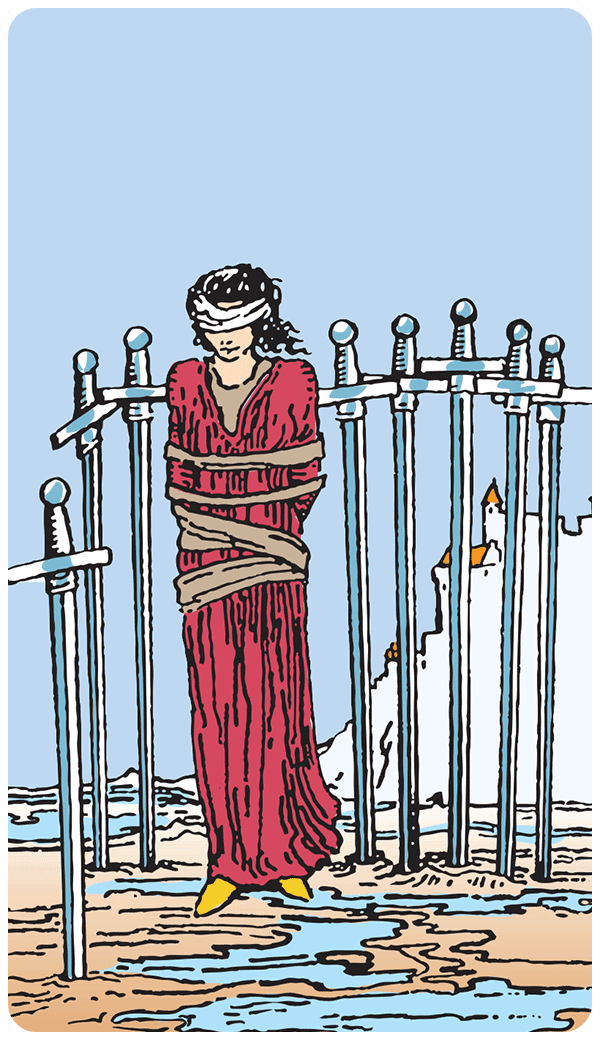
Eight of Swords · plate 8
What the card is actually doing
The Eight of Swords shows up in a love reading and the querent immediately starts listing reasons why they're stuck. Their ex won't give them closure. The other person is sending mixed signals. They live in different cities. They're too old, too broke, too damaged from the last relationship. The card gets read as confirmation that the situation has them trapped. That is the misreading. The Eight of Swords does not describe the situation. It describes what you are doing with your attention while standing in the situation.
Reading Eight of Swords in love
What the suit, the rank, and the image are each doing
Swords is the suit of thought, language, and the stories you tell yourself about what is happening. It governs perception, interpretation, and the specific angle from which you are viewing a situation. When Swords cards dominate a reading, the question is almost never about what is happening — it is about how the querent is thinking about what is happening, and whether that thinking is accurate.
Eights in tarot describe constraint, boundary, and the point where forward motion requires a different logic than the one that got you here. The Eight of Pentacles is the constraint of mastery — you cannot skip the repetitions. The Eight of Cups is the constraint of knowing you have to leave even though nothing is technically wrong. The Eight of Swords is the constraint of your own attention.
Now look at the image. A figure stands blindfolded, surrounded by eight swords planted in the ground. Their hands appear bound. The swords do not touch them. There is open space behind them. The bindings are loose. The blindfold is cloth, not iron. What looks like a prison is a perceptual frame. The card is not saying you are trapped. It is saying you are standing very still inside a story about being trapped, and the story is what has your attention.
How this reads differently depending on what the querent is actually doing
If the querent is in an active relationship and the Eight of Swords appears, it almost always points to a conversation they are not having because they have pre-decided how it will go. They want more commitment but they've told themselves the other person will say no. They're unhappy with the dynamic but they've decided that naming it will end the relationship. The card is naming the internal loop — the place where you are reasoning yourself out of speaking before you've tested whether the reasoning is true.
If the querent is single or post-breakup and the Eight of Swords appears, the pattern is slightly different but the mechanism is identical. They've built a story about why no one will want them, or why the last relationship ended, or why the person they want is unavailable, and they are now moving through the world as though the story is a fact. The card shows up to mark the moment where the story has replaced the territory. You are not seeing the situation. You are seeing your narrative about the situation, and you have forgotten there is a difference.
The tell that someone is misreading this card on themselves
The tell is always the same. The querent lists external facts — logistical problems, things the other person said, past evidence — and presents them as reasons they cannot act. If you ask what would happen if they did the thing anyway, they loop back to the same list. They are not problem-solving. They are defending the frame. The Eight of Swords does not appear because you are trapped. It appears because you are investing energy in explaining to yourself why you are trapped, and that investment is now the thing holding you in place.
From the practice
“A card never tells you what to do. It tells you what you're already deciding — and gives you the words to name it.”
A grounded observation
Go back through the last three months and look for the moment you stopped testing your assumptions and started defending them. That is usually when this card became true.
Key themes to watch for
- № 01Theme
Vulnerability
- № 02Theme
New chapters
- № 03Theme
Emotional truth
What to do with this reading
Read the upright meaning first, even if you pulled the card reversed. The reversal is a commentary on the upright — not a separate card.
Notice what your body did when you saw Eight of Swords. That reaction is usually closer to the truth than the interpretation.
Write down one sentence: What is this card asking me to stop avoiding? Let the answer be smaller than you expect.
Come back to this card in 48 hours. Most love readings sharpen with a little distance.
Questions answered
Frequently asked
In love, the Eight of Swords brings a sense of entrapment or stagnation. You might feel bound by circumstances or misunderstandings, unable to express your true feelings. This card suggests that fear of vulnerability could be keeping you isolated. Consider what assumptions you might be holding onto that prevent you from connecting more deeply. The card invites you to gently question whether these barriers are as solid as they seem, and how a change in mindset might open up new paths in your relationships.
Reversed, the Eight of Swords signals a potential for release and clearer communication in love. Perhaps old fears or doubts are beginning to dissolve, allowing you to see your partner and your relationship in a new light. This shift can bring a sense of relief and renewed intimacy. Take note of how this newfound clarity impacts your interactions. Are there conversations or connections that suddenly seem more possible than before? Let this moment of reprieve guide you toward more open-hearted exchanges.
Eight of Swords colors the cards around it. Pay attention to where its themes — mental clarity, the truth being named, what the mind needs to release — show up in the next card. That is usually where the story is.
Tarot is observational, not predictive. Eight of Swords describes the conditions in front of you right now and where they tend to lead if nothing changes — not a guarantee of timing.
Repeat cards are the deck underlining a theme. With Eight of Swords, that usually means the question you are asking is the right one — but you have not yet acted on what the card is showing you.
Read next
Related readings
More Swords · Love
- Ace of Swords — LoveHow Ace of Swords reads in a love context.
- Two of Swords — LoveHow Two of Swords reads in a love context.
- Three of Swords — LoveHow Three of Swords reads in a love context.
- Four of Swords — LoveHow Four of Swords reads in a love context.
- Five of Swords — LoveHow Five of Swords reads in a love context.
- Six of Swords — LoveHow Six of Swords reads in a love context.
Other Eight of Swords readings
- General MeaningEight of Swords read for general meaning.
- Career & WorkEight of Swords read for career & work.
- Money & FinanceEight of Swords read for money & finance.
- Health & WellbeingEight of Swords read for health & wellbeing.
- SpiritualityEight of Swords read for spirituality.
- Yes / No AnswerEight of Swords read for yes / no answer.