Three of Swords in Money
The Three of Swords in money readings gets read as financial disaster. What it actually describes is the moment you stop pretending the loss wasn't real.
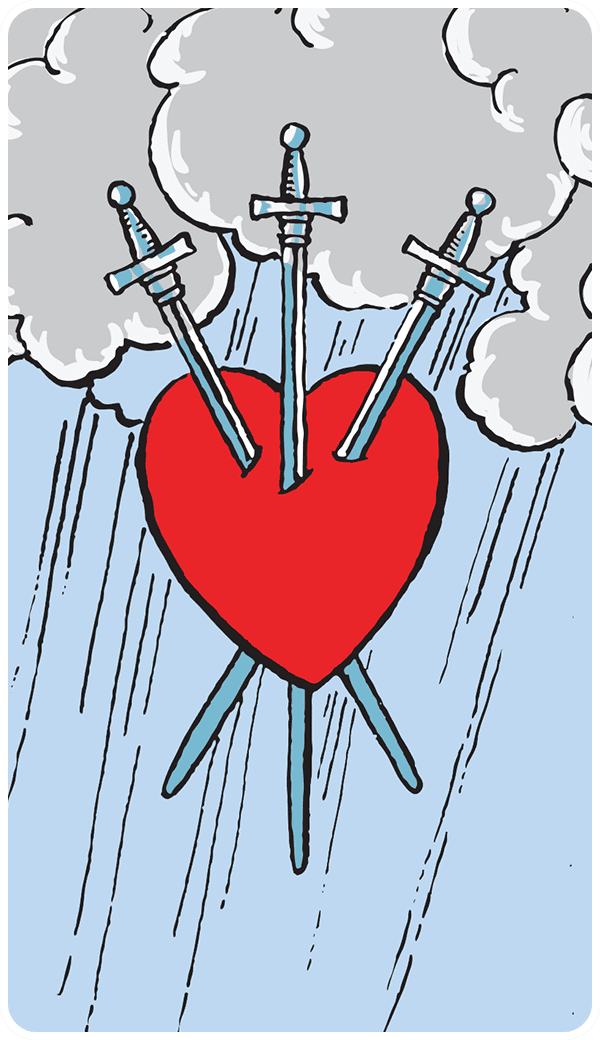
Three of Swords · plate 3
What the card is actually doing
The Three of Swords shows up in a finance reading and the querent braces. They assume it means bankruptcy, job loss, a market crash they can't recover from. The card becomes proof that their worst financial fear is confirmed and arriving. That reading misses what the card is actually doing. The Three of Swords doesn't predict disaster. It names the grief that follows a loss that already happened — and the specific, sharp moment when you finally admit the money isn't coming back.
Reading Three of Swords in money
What the suit, rank, and image are doing
Swords is the suit of thought, decision, and the stories you tell yourself about what's true. It governs how you process information, what narratives you construct when something goes wrong, and the mental loop you run when trying to make sense of a situation that hurts. When Swords cards cluster in a reading, the question isn't usually about what happened — it's about how the querent is thinking about what happened.
Threes in tarot describe the first consequence of a pairing. The Ace opens, the Two holds tension, and the Three shows what that tension produces when it breaks. Threes are points of clarification. Something that was ambiguous is now clear, and the clarity itself is the event.
The image: three swords pierce a heart suspended in a gray sky. Rain falls. The heart is not destroyed. It is punctured. The swords are already in. The damage is done. What the card describes is not the moment of impact — it's the moment after, when you're standing in the rain looking at what just happened and realizing you can't un-know it. In a finance context, this is the morning you check your account and see the number you were avoiding. It's the email that says the deal fell through. It's the conversation where someone tells you the money you lent them isn't coming back. The loss isn't theoretical anymore.
The most common misreading is treating this card as a warning about future financial disaster. Querents see the Three of Swords and think it means they're about to lose everything. But the card doesn't describe what's coming. It describes what you're finally admitting already came. The grief is present tense.
How it reads differently depending on the querent's situation
For someone who just took a financial hit — a bad investment, a job loss, a business that didn't work — the Three of Swords describes the emotional aftermath, not the event itself. The money is already gone. What the card is naming is the part where you stop refreshing your bank app hoping the number will change. It's the grief of acceptance, which is different from the shock of loss. The card says: you're in the rain now. You're allowed to feel it.
For someone who hasn't lost money yet but is terrified they will, the Three of Swords usually points to a loss that already happened and hasn't been processed. Go back six months. A deal that fell through. A loan you wrote off. A business expense you're still pretending was an investment. The card is naming the thing you're not letting yourself grieve because if you grieve it, you have to admit it's real.
The tell that someone is misreading this card
The tell is when someone reads the Three of Swords and immediately starts strategizing how to prevent the loss. They ask what they should do differently, what financial move will protect them, how to avoid the disaster the card is supposedly predicting. That response means they're treating the card as a future event they can outrun. What they're actually doing is using the card as permission to avoid the grief that's already sitting in the room. The Three of Swords doesn't give you a problem to solve. It gives you a loss to acknowledge.
From the practice
“A card never tells you what to do. It tells you what you're already deciding — and gives you the words to name it.”
A grounded observation
If this card showed up and your first thought was 'I need to fix this,' check your account history for the last six months. Look for the expense you're still calling temporary.
Key themes to watch for
- № 01Theme
Non-material wealth
- № 02Theme
Generosity
- № 03Theme
Values check
What to do with this reading
Read the upright meaning first, even if you pulled the card reversed. The reversal is a commentary on the upright — not a separate card.
Notice what your body did when you saw Three of Swords. That reaction is usually closer to the truth than the interpretation.
Write down one sentence: What is this card asking me to stop avoiding? Let the answer be smaller than you expect.
Come back to this card in 48 hours. Most money readings sharpen with a little distance.
Questions answered
Frequently asked
Financially, the Three of Swords can signify a period of loss or disappointment. Perhaps an investment didn’t pan out as hoped, or unexpected expenses cropped up. This card serves as a reminder to address financial wounds directly. It's an opportunity to look at what’s not working and to adjust your financial plans accordingly. Consider what changes are necessary to secure your financial footing.
In reverse, the Three of Swords suggests the easing of financial stress. It's a time of recovery from past monetary setbacks. You may find that a clearer perspective on your finances is emerging. The invitation is to continue moving forward with caution, but also with optimism, as you leave behind the shadows of past financial mishaps.
Three of Swords colors the cards around it. Pay attention to where its themes — mental clarity, the truth being named, what the mind needs to release — show up in the next card. That is usually where the story is.
Tarot is observational, not predictive. Three of Swords describes the conditions in front of you right now and where they tend to lead if nothing changes — not a guarantee of timing.
Repeat cards are the deck underlining a theme. With Three of Swords, that usually means the question you are asking is the right one — but you have not yet acted on what the card is showing you.
Read next
Related readings
More Swords · Money
- Ace of Swords — MoneyHow Ace of Swords reads in a money context.
- Two of Swords — MoneyHow Two of Swords reads in a money context.
- Four of Swords — MoneyHow Four of Swords reads in a money context.
- Five of Swords — MoneyHow Five of Swords reads in a money context.
- Six of Swords — MoneyHow Six of Swords reads in a money context.
- Seven of Swords — MoneyHow Seven of Swords reads in a money context.
Other Three of Swords readings
- General MeaningThree of Swords read for general meaning.
- Love & RelationshipsThree of Swords read for love & relationships.
- Career & WorkThree of Swords read for career & work.
- Health & WellbeingThree of Swords read for health & wellbeing.
- SpiritualityThree of Swords read for spirituality.
- Yes / No AnswerThree of Swords read for yes / no answer.