Five of Swords in Money
The Five of Swords in money readings gets read as 'you lost.' What the card actually describes is the cost structure of the win you just took.
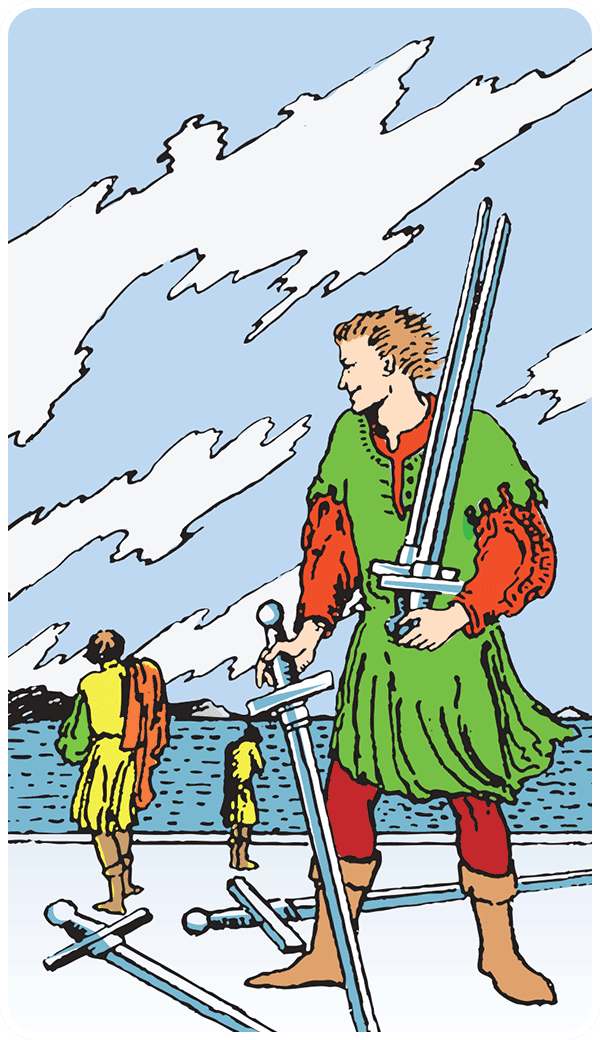
Five of Swords · plate 5
What the card is actually doing
The Five of Swords shows up in a finance reading and the querent assumes they're being warned. Someone is going to screw them over. A deal is going to fall through. They're about to lose money to a bad actor. That is not what the card is describing. The Five of Swords is not about being cheated. It is about the terms you accepted when you decided winning mattered more than the relationship. Most people read this card as external threat when it is actually describing an internal accounting problem they don't want to look at.
Reading Five of Swords in money
What the suit, the rank, and the image are each doing
Swords is the suit of thought, strategy, and the part of the mind that cuts through to what is true even when the truth is inconvenient. In finance readings, Swords cards describe your decision-making process — what you prioritized, what you ignored, and whether the logic you used to justify the choice is holding up under scrutiny. When Swords dominate a money spread, the financial question is actually a question about whether you can live with the reasoning you used.
Fives in tarot describe conflict and loss, but not the catastrophic kind. Fives are the card of something not working the way you thought it would. The structure is unstable. The agreement has a crack in it. You got what you wanted and it cost more than you expected. The Five of Swords specifically describes a win that required you to prioritize victory over fairness, and now you're holding the consequences.
Look at the image. A figure holds three swords and looks at two others walking away. Two swords lie on the ground. The figure won. The other people left. The swords on the ground are not the figure's swords — they belong to the people who are gone. The card is not describing theft. It is describing the moment after you took the terms you wanted and the other party decided the deal was no longer worth it to them.
How this reads for the aggressive negotiator versus the one who got out-negotiated
If you pushed hard in a business deal, undercut a competitor, or structured an agreement where you extracted maximum value and the other side got minimum flexibility, the Five of Swords is naming what you already know: you won, and the relationship is over. They are not coming back to the table. The card is not saying you were wrong to do it. It is saying the price of that win was the future collaboration, and you need to decide if that price was worth it. Most people who pull this card in this context want me to tell them the other party will come around. They will not.
If you are the one who walked away from a deal because the terms were unacceptable, the Five of Swords describes the moment you realized the other person was not negotiating in good faith. You left money on the table because staying in the deal would have cost you more in the long run. The card is confirming that you read the situation correctly. The loss you took by walking was smaller than the loss you would have taken by staying.
The tell that someone is misreading the card on themselves
The querent reads the Five of Swords and immediately starts scanning for external enemies. Who is the bad actor? Who is trying to cheat me? Where is the threat coming from? That framing misses the mechanical function of the card. The Five of Swords does not describe someone doing something to you. It describes a situation where someone prioritized winning over relationship, and now both parties are holding the cost of that choice. If you are scanning outward for the villain, go back and look at the last financial decision you made where you chose your advantage over someone else's trust. The card is naming that.
From the practice
“A card never tells you what to do. It tells you what you're already deciding — and gives you the words to name it.”
A grounded observation
Go back through your calendar and find the deal where you got the terms you wanted and the other person stopped returning your calls. That is the Five of Swords. The card does not say you were wrong. It says the bill came due.
Key themes to watch for
- № 01Theme
Non-material wealth
- № 02Theme
Generosity
- № 03Theme
Values check
What to do with this reading
Read the upright meaning first, even if you pulled the card reversed. The reversal is a commentary on the upright — not a separate card.
Notice what your body did when you saw Five of Swords. That reaction is usually closer to the truth than the interpretation.
Write down one sentence: What is this card asking me to stop avoiding? Let the answer be smaller than you expect.
Come back to this card in 48 hours. Most money readings sharpen with a little distance.
Questions answered
Frequently asked
Financially, the Five of Swords suggests disputes or disagreements about money. Perhaps there are conflicts over shared resources or tricky negotiations at play. This is a time to carefully consider the implications of financial decisions and the cost of winning a monetary argument. Reflect on your financial priorities and the impact of these conflicts on your peace of mind. What does financial success mean to you, and how does it align with your broader life goals?
Reversed, this card indicates potential resolution in financial matters. Past disagreements about money may begin to soften, leading to clearer communication and mutual understanding. This is a chance to reassess financial priorities and find common ground. Notice how these changes influence your financial landscape. Could this be a moment to redefine what financial stability means for you and those involved?
Five of Swords colors the cards around it. Pay attention to where its themes — mental clarity, the truth being named, what the mind needs to release — show up in the next card. That is usually where the story is.
Tarot is observational, not predictive. Five of Swords describes the conditions in front of you right now and where they tend to lead if nothing changes — not a guarantee of timing.
Repeat cards are the deck underlining a theme. With Five of Swords, that usually means the question you are asking is the right one — but you have not yet acted on what the card is showing you.
Read next
Related readings
More Swords · Money
- Ace of Swords — MoneyHow Ace of Swords reads in a money context.
- Two of Swords — MoneyHow Two of Swords reads in a money context.
- Three of Swords — MoneyHow Three of Swords reads in a money context.
- Four of Swords — MoneyHow Four of Swords reads in a money context.
- Six of Swords — MoneyHow Six of Swords reads in a money context.
- Seven of Swords — MoneyHow Seven of Swords reads in a money context.
Other Five of Swords readings
- General MeaningFive of Swords read for general meaning.
- Love & RelationshipsFive of Swords read for love & relationships.
- Career & WorkFive of Swords read for career & work.
- Health & WellbeingFive of Swords read for health & wellbeing.
- SpiritualityFive of Swords read for spirituality.
- Yes / No AnswerFive of Swords read for yes / no answer.