Seven of Swords in Money
The Seven of Swords in money questions gets read as theft or deception. What it actually describes is the strategy you're using when you don't trust the system.
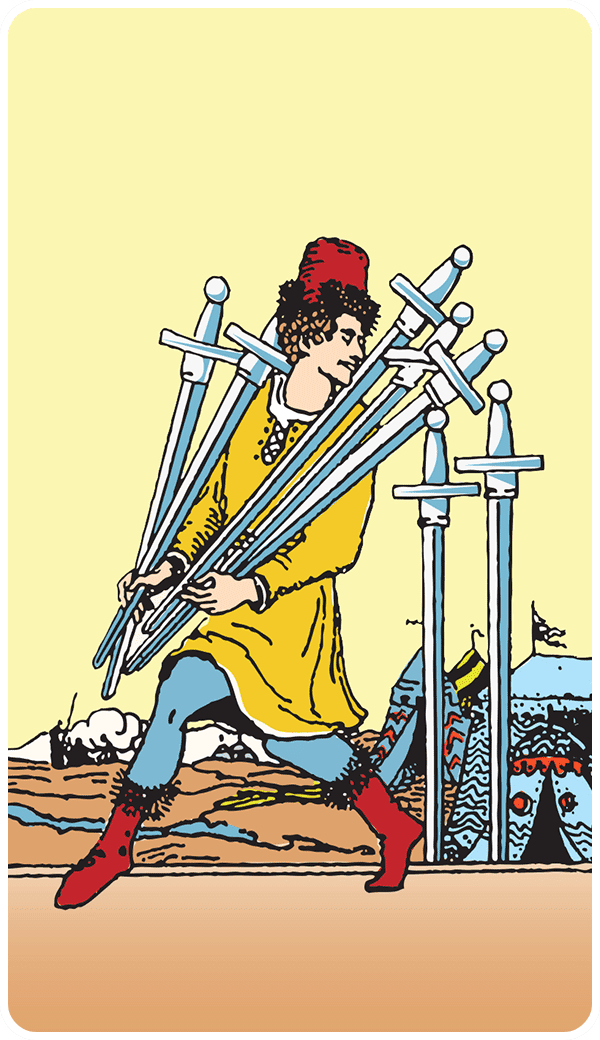
Seven of Swords · plate 7
What the card is actually doing
The Seven of Swords shows up in a finance reading and the querent immediately asks if someone is stealing from them. Is their business partner hiding money? Is their ex draining the joint account? Is their employer shorting their paycheck? The card gets read as external betrayal — someone else taking what's yours. That reading misses what the card is actually pointing at. The Seven of Swords describes the strategy you deploy when you believe the official channels won't work for you. It's the move you make when you've decided you can't win by the stated rules.
Reading Seven of Swords in money
What the suit, rank, and image are doing
Swords is the suit of thought, strategy, and the stories you tell yourself about how the world works. It governs planning, assessment, and the mental frameworks you use to navigate conflict or scarcity. When Swords cards dominate a money reading, the financial question is actually a question about belief — what you think is possible, what you think you deserve, what you think you have to do to get it.
Sevens in tarot describe partial success under difficult conditions. They are the card of "this is working, but barely" or "I'm holding it together, but the cost is high." The Seven of Wands is defending a position you can't fully secure. The Seven of Cups is sorting through options when none of them are clean wins. The Seven of Swords is executing a plan that requires you to operate outside the official structure.
Look at the image. A figure is walking away from a military camp, carrying five swords. Two swords remain planted in the ground behind him. He is moving carefully, glancing back. He is taking what he can carry and leaving the rest. This is not theft for profit. This is retrieval under conditions where asking permission would mean losing everything.
How the card reads for two different financial situations
If the querent is employed and asking about their job, the Seven of Swords often describes the quiet strategies people use when they've stopped trusting their employer. They're taking extra supplies home. They're using company time to interview elsewhere. They're not reporting all their freelance income because they've watched three rounds of layoffs and decided the company doesn't get full transparency anymore. The card is not saying this is morally correct. It is saying: this is what you are doing, and you are doing it because you have assessed the power differential and decided this is your best move.
If the querent is self-employed or asking about a business deal, the Seven of Swords describes operating in the grey areas of contracts or tax law. Not illegal, but not fully disclosed. Structuring payments to avoid a threshold. Using a personal card for business expenses and not tracking it cleanly. Telling a client one thing and a partner another thing because you've decided full transparency would cost you the deal. The card reads as strategic opacity — the choice to keep certain information compartmentalized because you believe clarity would work against you.
The tell that you're misreading it on yourself
The tell is when you read the Seven of Swords and immediately start scanning for the external thief. Who is lying to you? Who is taking from you? If that is your first move, you are not looking at what the card is actually showing. Go back through your financial behavior for the last three months. Look for the moment you decided not to ask for something directly. Look for the workaround you built because you assumed the official answer would be no. Look for the payment you didn't report, the expense you didn't submit, the boundary you didn't name because naming it felt too risky. That is where the Seven of Swords is operating.
From the practice
“A card never tells you what to do. It tells you what you're already deciding — and gives you the words to name it.”
A grounded observation
The card does not tell you whether the strategy is working. It tells you that you are using one, and that the need to use one is costing you something in transparency or ease or trust.
Key themes to watch for
- № 01Theme
Non-material wealth
- № 02Theme
Generosity
- № 03Theme
Values check
What to do with this reading
Read the upright meaning first, even if you pulled the card reversed. The reversal is a commentary on the upright — not a separate card.
Notice what your body did when you saw Seven of Swords. That reaction is usually closer to the truth than the interpretation.
Write down one sentence: What is this card asking me to stop avoiding? Let the answer be smaller than you expect.
Come back to this card in 48 hours. Most money readings sharpen with a little distance.
Questions answered
Frequently asked
The Seven of Swords in finance suggests a need for caution and perhaps some secretive maneuvering. You might be strategizing behind the scenes to improve your financial situation, which can be wise in certain contexts. However, consider if this approach is sustainable. Are there ethical considerations in your financial dealings? This card invites you to weigh the benefits of being discreet against the potential for greater transparency in your monetary life.
Reversed, the Seven of Swords in finance can indicate that hidden financial issues may come to light. This might involve uncovering past mistakes or deceit. Take this as a nudge to review your financial dealings with a critical eye. Is there a chance to rectify errors and establish clearer, more honest financial practices moving forward?
Seven of Swords colors the cards around it. Pay attention to where its themes — mental clarity, the truth being named, what the mind needs to release — show up in the next card. That is usually where the story is.
Tarot is observational, not predictive. Seven of Swords describes the conditions in front of you right now and where they tend to lead if nothing changes — not a guarantee of timing.
Repeat cards are the deck underlining a theme. With Seven of Swords, that usually means the question you are asking is the right one — but you have not yet acted on what the card is showing you.
Read next
Related readings
More Swords · Money
- Ace of Swords — MoneyHow Ace of Swords reads in a money context.
- Two of Swords — MoneyHow Two of Swords reads in a money context.
- Three of Swords — MoneyHow Three of Swords reads in a money context.
- Four of Swords — MoneyHow Four of Swords reads in a money context.
- Five of Swords — MoneyHow Five of Swords reads in a money context.
- Six of Swords — MoneyHow Six of Swords reads in a money context.
Other Seven of Swords readings
- General MeaningSeven of Swords read for general meaning.
- Love & RelationshipsSeven of Swords read for love & relationships.
- Career & WorkSeven of Swords read for career & work.
- Health & WellbeingSeven of Swords read for health & wellbeing.
- SpiritualitySeven of Swords read for spirituality.
- Yes / No AnswerSeven of Swords read for yes / no answer.