Four of Swords in Money
The Four of Swords in a money reading gets read as 'pause spending' when it's actually describing the mental exhaustion that precedes bad decisions.
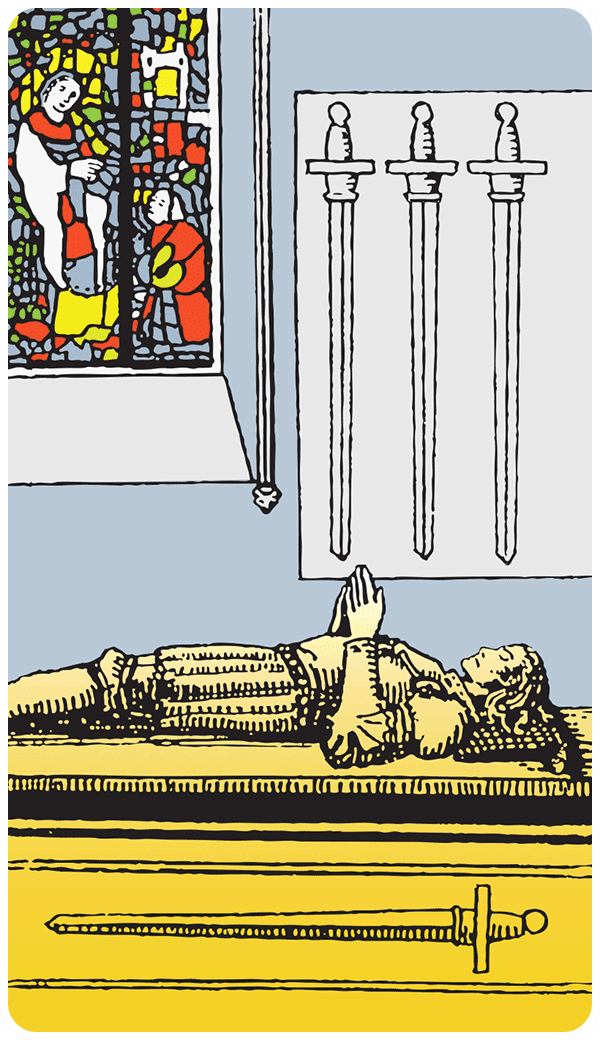
Four of Swords · plate 4
What the card is actually doing
The Four of Swords shows up in a finance reading and the querent nods like they already know what I'm going to say. They think the card is telling them to stop. Stop spending, stop investing, stop making moves. Take a break from money decisions. That's not what the card is describing. The Four of Swords names the state you're already in — the mental fatigue that makes you unable to think clearly about money — not a prescription to pause.
Reading Four of Swords in money
What the suit, rank, and image are each doing
Swords governs thought, analysis, and the part of your mind that makes decisions by cutting through competing options. It's the suit of mental clarity when it's working and mental exhaustion when it's not. Fours in tarot describe a temporary structure — a holding pattern, a plateau, a moment of enforced stillness before the next phase begins. The Four of Swords specifically describes rest after mental depletion.
Look at the image. A figure lies horizontal on a stone slab, hands folded in prayer position, three swords mounted on the wall above, one sword beneath the slab. The posture is a tomb effigy. The figure is not sleeping peacefully. They are flat-out, depleted, in the position of someone who has stopped because they had to stop, not because they chose rest as strategy.
In a finance context, this card describes the moment after you've been grinding on a money problem too long. You've run the budget scenarios seventeen times. You've researched investment options until the tabs blur together. You've had the same argument with yourself about whether to quit the job, sell the asset, take the loan. The Four of Swords is not advising rest. It's naming the fact that your decision-making apparatus is currently offline.
How it reads for two different situations
If you're asking about whether to make a financial move — buy, sell, invest, quit — and the Four of Swords appears, the card is saying you are too tired to make this decision right now. Not that the decision is wrong. Not that you should wait for some external sign. That you, specifically, in this moment, do not have the cognitive reserve to evaluate the choice clearly. The tell is that you keep reopening the spreadsheet and nothing new appears. You're running the same loop.
If you're asking about an ongoing financial situation — debt repayment, a business that's stalled, a salary negotiation that's dragging — the Four of Swords describes the current state of that situation. It has entered a holding pattern. No one is making moves. The energy has gone still. This is not inherently good or bad. It is a description. What matters is whether you're using the stillness to recover your capacity to think, or whether you're using it to avoid the next necessary cut.
The tell that someone is misreading it
The misreading sounds like this: "The card says I should take a break from thinking about money." No. The card says you already have taken a break, whether you meant to or not. Your mind has tapped out. The question is what you do when you notice that. Do you force a decision anyway and make it badly? Do you recognize the depletion and give yourself three days of actual rest before you reopen the question? The Four of Swords does not grant permission. It describes a condition. What you do with the condition is on you.
From the practice
“A card never tells you what to do. It tells you what you're already deciding — and gives you the words to name it.”
A grounded observation
Go back through your recent money decisions and notice which ones you made when you were genuinely rested versus which ones you made after the seventeenth loop through the same mental track. The difference in outcome is not subtle.
Key themes to watch for
- № 01Theme
Non-material wealth
- № 02Theme
Generosity
- № 03Theme
Values check
What to do with this reading
Read the upright meaning first, even if you pulled the card reversed. The reversal is a commentary on the upright — not a separate card.
Notice what your body did when you saw Four of Swords. That reaction is usually closer to the truth than the interpretation.
Write down one sentence: What is this card asking me to stop avoiding? Let the answer be smaller than you expect.
Come back to this card in 48 hours. Most money readings sharpen with a little distance.
Questions answered
Frequently asked
Financially, the Four of Swords suggests a period of calm and reflection. It's a moment to take stock of your financial situation without making any hasty moves. Consider it a timeout to review budgets or to plan your next financial steps. This is a good time to ensure that your resources are being managed wisely and that you are not overlooking any details. How might a little financial rest help you see your situation in a new light?
Reversed, the Four of Swords in finance indicates unrest or anxiety about money matters. It suggests you might be struggling to find peace with your current financial situation. This could be a sign that you're avoiding dealing with certain financial truths. Consider whether it's time to face these issues head-on rather than letting them fester. What small steps could you take to ease this tension?
Four of Swords colors the cards around it. Pay attention to where its themes — mental clarity, the truth being named, what the mind needs to release — show up in the next card. That is usually where the story is.
Tarot is observational, not predictive. Four of Swords describes the conditions in front of you right now and where they tend to lead if nothing changes — not a guarantee of timing.
Repeat cards are the deck underlining a theme. With Four of Swords, that usually means the question you are asking is the right one — but you have not yet acted on what the card is showing you.
Read next
Related readings
More Swords · Money
- Ace of Swords — MoneyHow Ace of Swords reads in a money context.
- Two of Swords — MoneyHow Two of Swords reads in a money context.
- Three of Swords — MoneyHow Three of Swords reads in a money context.
- Five of Swords — MoneyHow Five of Swords reads in a money context.
- Six of Swords — MoneyHow Six of Swords reads in a money context.
- Seven of Swords — MoneyHow Seven of Swords reads in a money context.
Other Four of Swords readings
- General MeaningFour of Swords read for general meaning.
- Love & RelationshipsFour of Swords read for love & relationships.
- Career & WorkFour of Swords read for career & work.
- Health & WellbeingFour of Swords read for health & wellbeing.
- SpiritualityFour of Swords read for spirituality.
- Yes / No AnswerFour of Swords read for yes / no answer.