Ten of Swords in Money
The Ten of Swords in a finance reading names the loss that already happened. Most querents read it as catastrophe incoming. Here's what it actually marks.
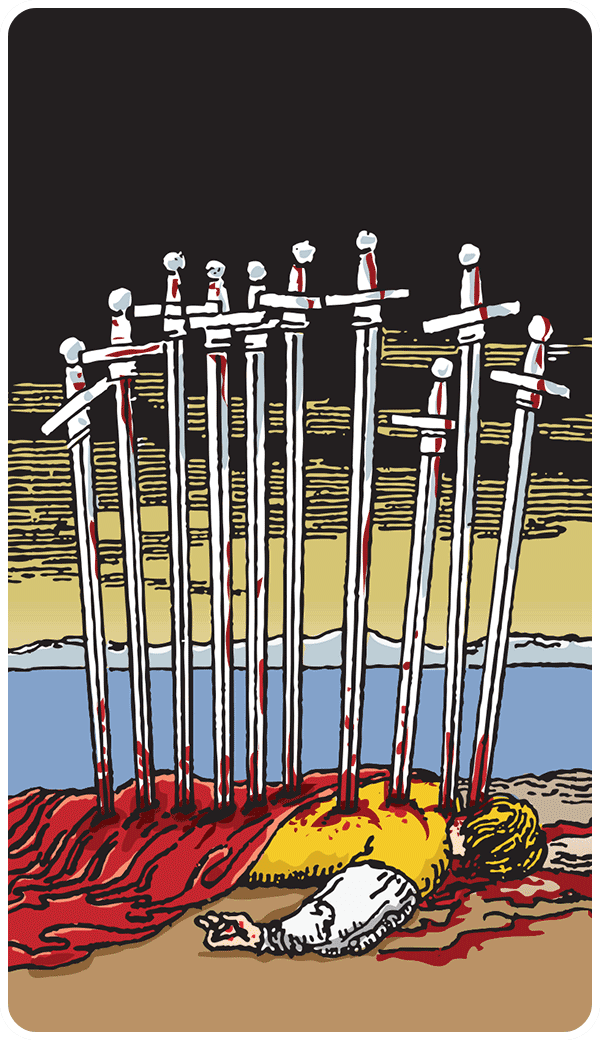
Ten of Swords · plate 10
What the card is actually doing
The Ten of Swords shows up in a money reading and the querent's shoulders drop. They read it as financial catastrophe — imminent collapse, total ruin, the end of everything. They want to know how to prevent it. That is the wrong question. The card is not describing something that is about to happen. It is naming something that already did.
Reading Ten of Swords in money
What the suit, the rank, and the image are doing
Swords is the suit of thought, narrative, and the stories you tell yourself about what is happening. It governs how you frame a situation, what meaning you assign to it, and whether that meaning keeps you stuck or lets you move. When Swords cards cluster in a finance reading, the money problem is almost always downstream of a thought problem — a story you keep running that prevents you from seeing what is actually available.
Tens in tarot mark completion. Not climax, not peak drama — completion. The cycle has run its course. The thing that was in motion has stopped moving. The Ten of Pentacles is wealth that has settled into structure. The Ten of Cups is emotional satisfaction that no longer requires chasing. The Ten of Swords is the moment the narrative you were running finally, definitively, does not work anymore.
Now look at the image. A figure lies face-down with ten swords in their back. The sky is dark but the horizon is beginning to lighten. The figure is not moving. The swords are already embedded. This is not a warning. It is a documentation. The loss has occurred. The story that kept you in motion — the one that said if you just worked harder, held on longer, believed more — that story is over. What the card is marking is the end of the denial.
How it reads for two different situations
If the querent is currently in financial freefall — missed payments, mounting debt, the account balance dropping every week — the Ten of Swords is not predicting worse. It is naming the moment they stop pretending the strategy was going to work. The business model that was never profitable. The job they stayed in because leaving felt too risky. The investment they kept averaging down on because admitting the loss felt like failure. The card reads as: the thing you were afraid would happen has happened. You are still here. The catastrophizing can stop now.
If the querent's finances are stable but they live in constant low-grade terror about money, the Ten of Swords is naming a different completion. It is the end of the story they inherited — the one that says security is always one mistake away from evaporating, that rest is irresponsible, that enough is never enough. The swords are not material losses. They are the exhausting mental narratives that have been running on repeat. The card is saying: you have been bracing for disaster for so long that you cannot tell the difference between caution and paralysis. That version of vigilance is done.
The tell that someone is misreading it
The querent reads the Ten of Swords and immediately starts contingency planning. They want to know what they should liquidate, what they should hoard, how to brace for impact. That response means they are reading the card as prediction instead of documentation. The correct question is not "what is coming" but "what story about money am I still running that stopped being true six months ago." If they cannot name a financial narrative they recently watched fail, they are not looking at the right loss yet.
From the practice
“A card never tells you what to do. It tells you what you're already deciding — and gives you the words to name it.”
A grounded observation
Go back through your bank statements for the last year. Find the month you kept telling yourself it was going to turn around. That is the month the Ten of Swords was describing.
Key themes to watch for
- № 01Theme
Non-material wealth
- № 02Theme
Generosity
- № 03Theme
Values check
What to do with this reading
Read the upright meaning first, even if you pulled the card reversed. The reversal is a commentary on the upright — not a separate card.
Notice what your body did when you saw Ten of Swords. That reaction is usually closer to the truth than the interpretation.
Write down one sentence: What is this card asking me to stop avoiding? Let the answer be smaller than you expect.
Come back to this card in 48 hours. Most money readings sharpen with a little distance.
Questions answered
Frequently asked
Financially, the Ten of Swords might indicate a significant setback or loss. It’s the kind of hit that forces you to reassess your situation and plans. This card speaks to the end of a financial cycle, perhaps where a venture doesn’t pan out as hoped. While it’s a tough spot, it can also be a moment to reconsider and restructure your financial goals. What have these challenges taught you about your money habits?
Reversed, the Ten of Swords suggests a slow recovery from financial difficulties. It’s the cautious optimism that follows the storm, where you begin to see a way forward. Consider how you can build a more stable financial foundation. What small, practical steps can you take to regain control?
Ten of Swords colors the cards around it. Pay attention to where its themes — mental clarity, the truth being named, what the mind needs to release — show up in the next card. That is usually where the story is.
Tarot is observational, not predictive. Ten of Swords describes the conditions in front of you right now and where they tend to lead if nothing changes — not a guarantee of timing.
Repeat cards are the deck underlining a theme. With Ten of Swords, that usually means the question you are asking is the right one — but you have not yet acted on what the card is showing you.
Read next
Related readings
More Swords · Money
- Ace of Swords — MoneyHow Ace of Swords reads in a money context.
- Two of Swords — MoneyHow Two of Swords reads in a money context.
- Three of Swords — MoneyHow Three of Swords reads in a money context.
- Four of Swords — MoneyHow Four of Swords reads in a money context.
- Five of Swords — MoneyHow Five of Swords reads in a money context.
- Six of Swords — MoneyHow Six of Swords reads in a money context.
Other Ten of Swords readings
- General MeaningTen of Swords read for general meaning.
- Love & RelationshipsTen of Swords read for love & relationships.
- Career & WorkTen of Swords read for career & work.
- Health & WellbeingTen of Swords read for health & wellbeing.
- SpiritualityTen of Swords read for spirituality.
- Yes / No AnswerTen of Swords read for yes / no answer.