Page of Swords in Money
The Page of Swords in finance isn't warning you about risk. It's naming the information you're gathering before you know what to do with it.
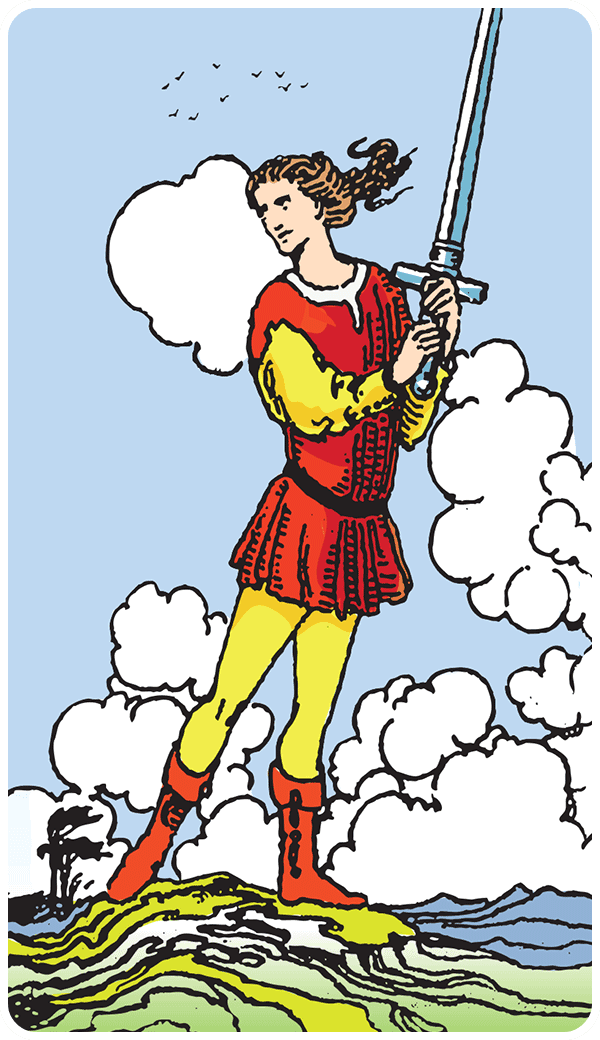
Page of Swords · plate page
What the card is actually doing
The Page of Swords shows up in a money reading and most people read it as a warning. Someone is lying. A contract has hidden clauses. The investment is too good to be true. They brace for betrayal or loss, and then they either freeze or they walk away from something that might have been fine. That is not what the card is doing. The Page of Swords is not naming danger. It is naming the stage you are in — the part where you are gathering information but do not yet have a position.
Reading Page of Swords in money
What the suit, the rank, and the image are each doing
Swords is the suit of thought, strategy, and the part of the psyche that cuts through fog to name what is true. In a finance reading, Swords cards describe how you are thinking about money — the analysis you are running, the argument you are making to yourself, the decision framework you are using. When Swords dominates a money spread, the question is almost always about whether you trust your own reasoning.
Pages in tarot are students. They are not masters. They are not fools. A Page is someone who has learned the alphabet of a thing but has not yet written a sentence. The Page of Pentacles is learning how material systems work. The Page of Cups is learning how feeling moves between people. The Page of Swords is learning how to think clearly under pressure. Pages describe a developmental stage, not a personality type.
Now look at the image. A young figure stands alone on a hill, holding a sword upright with both hands. The wind blows. The ground is uneven. The sky is turbulent. The figure is alert, scanning. The sword is raised, but it is not being swung. This is reconnaissance, not combat. The Page is gathering data. The question the card is asking is: what are you going to do with what you are learning?
How the card reads for two different financial situations
If you are early in a financial decision — researching a purchase, comparing loan terms, reading the fine print on an offer — the Page of Swords is describing exactly where you are. You are in information-gathering mode. You are asking questions. You are noticing details. The card is not telling you the decision is bad. It is telling you that you do not yet have enough to make the decision, and you know it. The mistake here is rushing to a conclusion because you are tired of not knowing. The Page of Swords says: you are not done reading yet.
If you are months into a financial situation — a job, a business partnership, a long-term investment — and the Page of Swords shows up, the card is naming something different. You are still gathering information about something you thought you already understood. New details are arriving. The deal is not what you thought it was, or your role in it has shifted, or the terms have quietly changed. The Page of Swords here is not a warning. It is a description of the fact that you are back in student mode, re-learning the landscape. What you do with that fact is up to you.
The tell that you are misreading the card on yourself
You are misreading the Page of Swords if you are using it as permission to stay in research mode forever. If you have read twelve articles, talked to five people, and built a spreadsheet with conditional formatting, and you are still telling yourself you need one more data point before you can decide — you are not gathering information anymore. You are avoiding the decision. The Page of Swords describes the learning phase. It does not describe the decision phase. If the card keeps showing up in the same money question across multiple readings, the problem is not that you do not know enough. The problem is that knowing more will not resolve the thing you are actually afraid of.
From the practice
“A card never tells you what to do. It tells you what you're already deciding — and gives you the words to name it.”
A grounded observation
Go back through your calendar and look for the last time you said 'I just need to do a little more research' about money. Check whether you ever actually made the decision, or whether the decision made itself while you were still reading.
Key themes to watch for
- № 01Theme
Non-material wealth
- № 02Theme
Generosity
- № 03Theme
Values check
What to do with this reading
Read the upright meaning first, even if you pulled the card reversed. The reversal is a commentary on the upright — not a separate card.
Notice what your body did when you saw Page of Swords. That reaction is usually closer to the truth than the interpretation.
Write down one sentence: What is this card asking me to stop avoiding? Let the answer be smaller than you expect.
Come back to this card in 48 hours. Most money readings sharpen with a little distance.
Questions answered
Frequently asked
In finances, the Page of Swords brings an inquisitive mindset. It's a time to explore new ideas for managing your money, like researching investments or learning about budgeting. Picture yourself diving into financial topics with enthusiasm, ready to ask questions and seek advice. This card encourages curiosity, not reckless decisions. What financial concepts have piqued your interest, and how might they align with your goals?
Reversed, the Page of Swords warns of potential misunderstandings or overlooked details in financial matters. Perhaps you're dealing with unclear information or hasty decisions. Imagine trying to read fine print without your glasses; something might be escaping your notice. How can you ensure you're fully informed before making any commitments?
Page of Swords colors the cards around it. Pay attention to where its themes — mental clarity, the truth being named, what the mind needs to release — show up in the next card. That is usually where the story is.
Tarot is observational, not predictive. Page of Swords describes the conditions in front of you right now and where they tend to lead if nothing changes — not a guarantee of timing.
Repeat cards are the deck underlining a theme. With Page of Swords, that usually means the question you are asking is the right one — but you have not yet acted on what the card is showing you.
Read next
Related readings
More Swords · Money
- Ace of Swords — MoneyHow Ace of Swords reads in a money context.
- Two of Swords — MoneyHow Two of Swords reads in a money context.
- Three of Swords — MoneyHow Three of Swords reads in a money context.
- Four of Swords — MoneyHow Four of Swords reads in a money context.
- Five of Swords — MoneyHow Five of Swords reads in a money context.
- Six of Swords — MoneyHow Six of Swords reads in a money context.
Other Page of Swords readings
- General MeaningPage of Swords read for general meaning.
- Love & RelationshipsPage of Swords read for love & relationships.
- Career & WorkPage of Swords read for career & work.
- Health & WellbeingPage of Swords read for health & wellbeing.
- SpiritualityPage of Swords read for spirituality.
- Yes / No AnswerPage of Swords read for yes / no answer.