Nine of Swords in Money
The Nine of Swords in money readings names the worry loop, not the actual problem. Here's what the card is doing when it shows up in a financial spread.
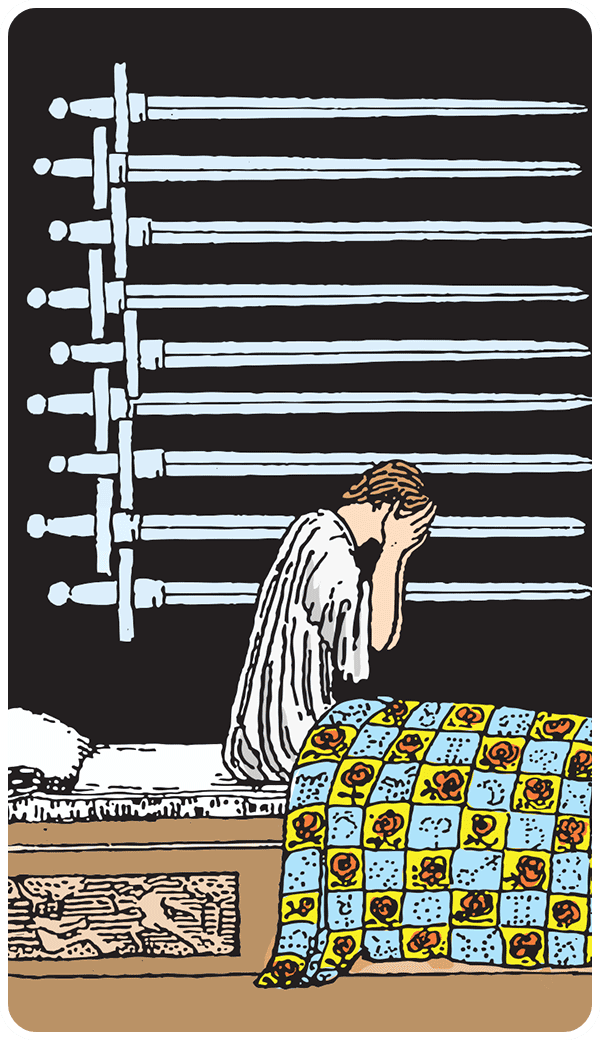
Nine of Swords · plate 9
What the card is actually doing
The Nine of Swords shows up in a finance reading and the querent assumes they're about to lose everything. They think the card is confirming their worst fear — bankruptcy, foreclosure, the savings account zeroing out. That is not what the card is doing. The Nine of Swords does not predict financial collapse. It names the part of your brain that is running disaster scenarios at 3am while the actual bank balance sits unchanged.
Reading Nine of Swords in money
What the suit, the rank, and the image are doing
Swords is the suit of thought, not circumstance. It governs how your mind constructs a story about what is happening, how you frame a problem, and what mental loop you get stuck in when uncertainty arrives. When Swords cards dominate a financial reading, the question is not whether you have enough money — it is whether you can think clearly about the money you have.
Nines in tarot are the penultimate card of the suit. They describe the moment before resolution, when the pattern has run its full course but has not yet turned over into the Ten. The Nine of Swords is the peak of the mental spiral. You have been thinking about this problem for so long that the thinking has become the problem.
Now look at the image. A figure sits upright in bed, head in hands. Nine swords hang on the wall behind them. The bed is untouched. The room is dark. They are not being attacked. No one is coming through the door. The swords are mounted, static, decorative. The figure is alone with their own mind, running the same scenario on repeat. This is the mechanical answer. The Nine of Swords is the worry loop, not the disaster.
How the card reads for two different financial situations
For someone who is actually in financial trouble — behind on rent, carrying debt, facing a real shortfall — the Nine of Swords says the catastrophizing is now louder than the problem itself. You have been so busy imagining worst-case scenarios that you have not opened the bank statement in two weeks. You have not called the creditor. You have not asked the friend who offered help. The mental spiral is preventing you from taking the one concrete action that would reduce the actual risk.
For someone whose finances are stable but who feels chronically unsafe about money, the Nine of Swords is the tell that the fear is not data-driven. You check the balance compulsively. You run hypothetical disaster budgets. You delay purchases you can afford because the number in the account never feels like enough. The card is not warning you that something bad is coming. It is naming the fact that no amount of money will fix the part of your brain that is convinced scarcity is always one month away.
The tell that someone is misreading the card on themselves
The tell is when the querent treats the Nine of Swords as confirmation that their fear is justified. They say, "See, the cards know something bad is going to happen." What the card actually knows is that you have been awake for three hours running scenarios. The card does not validate the content of the worry. It points to the fact that you are worrying instead of acting, or worrying instead of sleeping, or worrying because the mind has nothing else to do with the uncertainty. If you pull the Nine of Swords and your next move is to catastrophize harder, you have misread it. The card is the mirror, not the prophecy.
From the practice
“A card never tells you what to do. It tells you what you're already deciding — and gives you the words to name it.”
A grounded observation
Go back through your calendar and count how many of the financial disasters you stayed awake worrying about actually happened. The Nine of Swords is the gap between that number and the hours you spent bracing for it.
Key themes to watch for
- № 01Theme
Non-material wealth
- № 02Theme
Generosity
- № 03Theme
Values check
What to do with this reading
Read the upright meaning first, even if you pulled the card reversed. The reversal is a commentary on the upright — not a separate card.
Notice what your body did when you saw Nine of Swords. That reaction is usually closer to the truth than the interpretation.
Write down one sentence: What is this card asking me to stop avoiding? Let the answer be smaller than you expect.
Come back to this card in 48 hours. Most money readings sharpen with a little distance.
Questions answered
Frequently asked
Financially, the Nine of Swords denotes stress and worry. Perhaps you find yourself troubled by bills or future expenses. This card suggests these fears may be amplified by uncertainty rather than facts. It's worth examining your financial situation closely to separate real concerns from imagined ones. The card invites you to find clarity by seeking advice or setting up a plan, turning anxiety into action.
Reversed, the Nine of Swords in finances indicates relief from monetary worries. You might be seeing the results of budgeting or paying off a debt. This card suggests a chance to learn from past financial stresses. Reflect on what helped you move past these concerns and how you can maintain this stability.
Nine of Swords colors the cards around it. Pay attention to where its themes — mental clarity, the truth being named, what the mind needs to release — show up in the next card. That is usually where the story is.
Tarot is observational, not predictive. Nine of Swords describes the conditions in front of you right now and where they tend to lead if nothing changes — not a guarantee of timing.
Repeat cards are the deck underlining a theme. With Nine of Swords, that usually means the question you are asking is the right one — but you have not yet acted on what the card is showing you.
Read next
Related readings
More Swords · Money
- Ace of Swords — MoneyHow Ace of Swords reads in a money context.
- Two of Swords — MoneyHow Two of Swords reads in a money context.
- Three of Swords — MoneyHow Three of Swords reads in a money context.
- Four of Swords — MoneyHow Four of Swords reads in a money context.
- Five of Swords — MoneyHow Five of Swords reads in a money context.
- Six of Swords — MoneyHow Six of Swords reads in a money context.
Other Nine of Swords readings
- General MeaningNine of Swords read for general meaning.
- Love & RelationshipsNine of Swords read for love & relationships.
- Career & WorkNine of Swords read for career & work.
- Health & WellbeingNine of Swords read for health & wellbeing.
- SpiritualityNine of Swords read for spirituality.
- Yes / No AnswerNine of Swords read for yes / no answer.