King of Swords in Money
The King of Swords in money readings is not about winning. It's about the decision structure you're bringing to the table and whether it can hold what comes next.
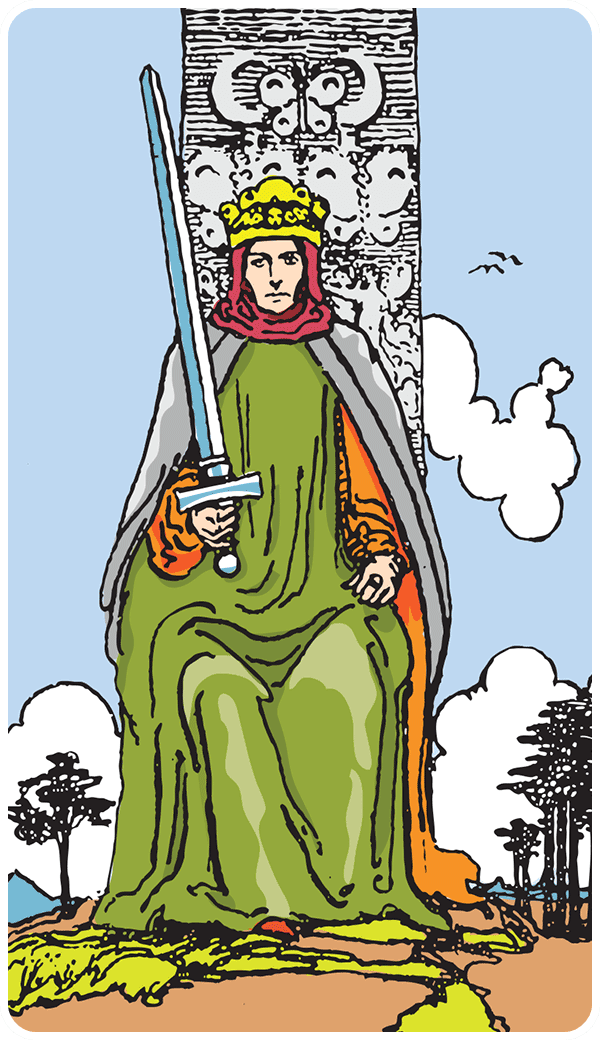
King of Swords · plate king
What the card is actually doing
The King of Swords shows up in a finance reading and people assume it means they're about to make a smart move. That they'll negotiate well, cut a good deal, see through the noise and act decisively. The card gets read as competence arriving. But that's not what's on the card. The King of Swords doesn't describe a future outcome. It describes the decision-making apparatus you're currently using — and whether that apparatus is actually serving the question you're asking.
Reading King of Swords in money
What the suit, the rank, and the image are doing
Swords is the suit of thought structure. It governs how you frame problems, what logic you apply, what gets weighted in your internal arguments. When Swords cards dominate a money reading, the financial question is being solved — or avoided — at the level of reasoning, not at the level of emotion or material reality. You are thinking your way through it, and the cards are naming what that thinking is actually doing.
Kings in tarot are established positions. They are not beginnings. A King is someone who has built a kingdom, set its laws, and now governs from that seat. The King of Swords specifically is the seat of pure rationality. The figure sits upright, sword vertical, no ornament. The posture is judicial. This is the part of you that cuts away sentiment, applies principle, makes decisions from a place of detachment. The image is cold on purpose. Detachment is the technology.
The most common misreading in finance contexts is to read the King of Swords as "I will make the right call." But the card is not promising correctness. It is describing the type of decision-making you are locked into right now. You are solving this money problem by applying logic, by cutting away the emotional data, by trying to out-think the situation. The card is asking: is that the right tool for this specific problem? Because sometimes it is. And sometimes it is the exact wrong tool, and you are using it anyway because it feels like control.
How the card reads for two different querent situations
If you are deciding whether to take a job offer, and the King of Swords appears, the card is naming that you are weighing this decision purely on paper. Salary, title, growth trajectory, the logic of the move. You have successfully removed how you feel about the work itself, how you feel about the people, whether the day-to-day will make you want to be alive. The King of Swords is correct if those emotional variables are noise. It is wrong if they are signal. The card does not tell you which. It tells you that you have made a choice about what counts as data.
If you are trying to recover from a financial loss, and the King of Swords appears, the card is naming that you are trying to logic your way out of grief. You are building spreadsheets. You are making plans. You are applying discipline and cutting away the part of you that is scared or ashamed or furious. The King of Swords works if the loss was purely mechanical and the solution is mechanical. It fails if the loss has an emotional weight that will sabotage every rational plan you build until you let yourself feel it.
The tell that you are misreading the card on yourself
The tell is this: you keep making smart decisions and they keep not working. You can explain every choice. You can defend every move. The logic is airtight. And yet the outcome keeps being wrong, or the outcome is technically correct but feels hollow, or you execute the plan perfectly and then sabotage it three weeks later for reasons you can't articulate. That is the King of Swords running past its jurisdiction. You are trying to think your way through a problem that requires a different organ.
From the practice
“A card never tells you what to do. It tells you what you're already deciding — and gives you the words to name it.”
A grounded observation
Go back through your last three financial decisions and notice whether you let yourself feel anything before you acted. If the answer is no every time, the King of Swords is naming the cost of that.
Key themes to watch for
- № 01Theme
Non-material wealth
- № 02Theme
Generosity
- № 03Theme
Values check
What to do with this reading
Read the upright meaning first, even if you pulled the card reversed. The reversal is a commentary on the upright — not a separate card.
Notice what your body did when you saw King of Swords. That reaction is usually closer to the truth than the interpretation.
Write down one sentence: What is this card asking me to stop avoiding? Let the answer be smaller than you expect.
Come back to this card in 48 hours. Most money readings sharpen with a little distance.
Questions answered
Frequently asked
Financially, the King of Swords suggests a rational approach to money matters. It's a good time to review your financial strategies, focusing on clear goals and logical planning. This card implies that through careful analysis, you can make informed decisions that enhance your financial stability. Are there investments or savings plans you need to reassess? The invitation here is to let your intellect guide your monetary choices.
Reversed, the King of Swords warns against impulsive financial decisions or being swayed by others' opinions. There may be a sense of confusion or frustration with your financial situation. This card suggests taking a step back to gain perspective. Are there areas where you're overcomplicating things? Consider simplifying your approach and seeking advice if needed.
King of Swords colors the cards around it. Pay attention to where its themes — mental clarity, the truth being named, what the mind needs to release — show up in the next card. That is usually where the story is.
Tarot is observational, not predictive. King of Swords describes the conditions in front of you right now and where they tend to lead if nothing changes — not a guarantee of timing.
Repeat cards are the deck underlining a theme. With King of Swords, that usually means the question you are asking is the right one — but you have not yet acted on what the card is showing you.
Read next
Related readings
More Swords · Money
- Ace of Swords — MoneyHow Ace of Swords reads in a money context.
- Two of Swords — MoneyHow Two of Swords reads in a money context.
- Three of Swords — MoneyHow Three of Swords reads in a money context.
- Four of Swords — MoneyHow Four of Swords reads in a money context.
- Five of Swords — MoneyHow Five of Swords reads in a money context.
- Six of Swords — MoneyHow Six of Swords reads in a money context.
Other King of Swords readings
- General MeaningKing of Swords read for general meaning.
- Love & RelationshipsKing of Swords read for love & relationships.
- Career & WorkKing of Swords read for career & work.
- Health & WellbeingKing of Swords read for health & wellbeing.
- SpiritualityKing of Swords read for spirituality.
- Yes / No AnswerKing of Swords read for yes / no answer.