Eight of Swords in Money
The Eight of Swords in finance reads as 'I'm stuck' — but the card isn't describing external constraint. It's naming the mental loop that keeps you from looking at the actual numbers.
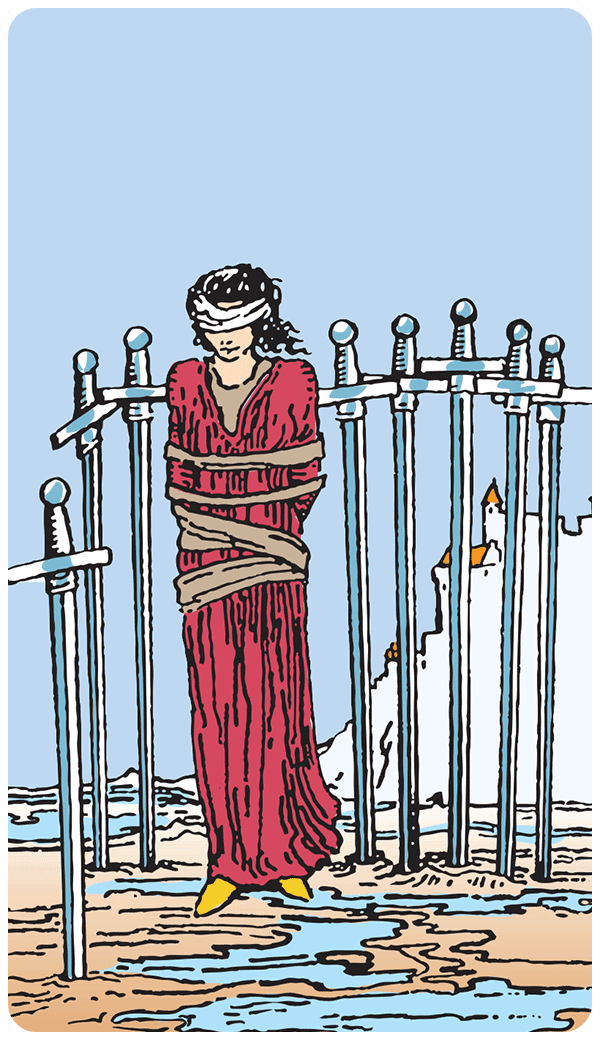
Eight of Swords · plate 8
What the card is actually doing
The Eight of Swords shows up in a finance reading and the querent exhales in recognition. Finally, a card that gets it. They are stuck. They can't leave the job. They can't negotiate the salary. They can't ask for the raise, start the business, open the account, look at the statement. The money situation is impossible and the card confirms it.
That is not what the card is doing. The Eight of Swords does not describe external constraint. It describes the moment you stop testing whether the constraint is still real.
Reading Eight of Swords in money
What the suit, the rank, and the image are actually showing
Swords governs thought, narrative, and the stories you tell yourself about what is true. It is the suit of mental models — the frameworks you use to interpret what is happening and what is possible. When Swords cards dominate a finance reading, the question is almost never about the money itself. It is about the belief structure around the money.
Eights in tarot describe restriction, but not the kind that comes from outside. An Eight is the moment a system closes in on itself. The structure has tightened to the point where movement feels impossible, but the tightness is often self-generated. The Eight of Pentacles is restriction through repetition; the Eight of Cups is restriction through emotional exhaustion. The Eight of Swords is restriction through thought.
Now look at the image. A figure stands blindfolded, surrounded by eight swords planted in the ground. Their hands appear bound. But the swords are not a cage — there are gaps. The bindings are loose. The blindfold could be removed. The figure is not trapped. They are standing still because they believe they are trapped. That is the entire card.
The most common misreading in a finance context is to treat the Eight of Swords as confirmation that the external situation is genuinely impossible. The querent takes it as validation: yes, I really am stuck in this job; yes, I really can't afford to leave; yes, the market really is against me. They leave the reading feeling seen, but they also leave without testing a single assumption.
How the card reads for two different situations
For someone early in financial constraint — recently unemployed, newly in debt, just hit with an unexpected expense — the Eight of Swords describes the panic spiral. The mind generates ten reasons why every option is closed before the person has looked at a single real number. They 'know' they can't ask family, can't sell the thing, can't take the lower offer, can't renegotiate. The card is naming the speed at which the narrative outpaces the reality check.
For someone who has been in the same financial position for years — same salary, same debt level, same 'I can't afford to' script — the Eight of Swords describes habituation. The constraint was real once. It may not be real now. But the story is so embedded that the person no longer checks. They have stopped looking at the swords. They have stopped testing the gaps. The card is naming the moment belief became infrastructure.
The tell that someone is misreading the card on themselves: they cite the Eight of Swords as proof they were right to not act. If the card is being used as permission to stay put, the reading has inverted. The card is not a diagnosis of external reality. It is a flag that you are standing still inside a story.
From the practice
“A card never tells you what to do. It tells you what you're already deciding — and gives you the words to name it.”
A grounded observation
Go back through your last three months of 'I can't afford that' moments. Write down what you didn't check. Not what you decided against — what you didn't even look up the price of, didn't ask about, didn't run the numbers on. That list is the Eight of Swords.
Key themes to watch for
- № 01Theme
Non-material wealth
- № 02Theme
Generosity
- № 03Theme
Values check
What to do with this reading
Read the upright meaning first, even if you pulled the card reversed. The reversal is a commentary on the upright — not a separate card.
Notice what your body did when you saw Eight of Swords. That reaction is usually closer to the truth than the interpretation.
Write down one sentence: What is this card asking me to stop avoiding? Let the answer be smaller than you expect.
Come back to this card in 48 hours. Most money readings sharpen with a little distance.
Questions answered
Frequently asked
Financially, the Eight of Swords indicates a feeling of being trapped by debt or financial obligations. It may seem like there's no way out of your current situation, but this card suggests that some of these barriers are self-imposed. Are there creative solutions or resources that you've overlooked? Consider how re-evaluating your priorities might change your financial outlook. The invitation is to take a step back and rethink your approach, allowing room for fresh ideas.
Reversed, the Eight of Swords hints at a financial situation that's beginning to improve. Constraints you once felt might be easing, allowing for better management of your resources. Perhaps you're finding new ways to stretch your budget or discovering unexpected sources of income. Acknowledge these positive shifts and consider how they might influence your financial strategies moving forward.
Eight of Swords colors the cards around it. Pay attention to where its themes — mental clarity, the truth being named, what the mind needs to release — show up in the next card. That is usually where the story is.
Tarot is observational, not predictive. Eight of Swords describes the conditions in front of you right now and where they tend to lead if nothing changes — not a guarantee of timing.
Repeat cards are the deck underlining a theme. With Eight of Swords, that usually means the question you are asking is the right one — but you have not yet acted on what the card is showing you.
Read next
Related readings
More Swords · Money
- Ace of Swords — MoneyHow Ace of Swords reads in a money context.
- Two of Swords — MoneyHow Two of Swords reads in a money context.
- Three of Swords — MoneyHow Three of Swords reads in a money context.
- Four of Swords — MoneyHow Four of Swords reads in a money context.
- Five of Swords — MoneyHow Five of Swords reads in a money context.
- Six of Swords — MoneyHow Six of Swords reads in a money context.
Other Eight of Swords readings
- General MeaningEight of Swords read for general meaning.
- Love & RelationshipsEight of Swords read for love & relationships.
- Career & WorkEight of Swords read for career & work.
- Health & WellbeingEight of Swords read for health & wellbeing.
- SpiritualityEight of Swords read for spirituality.
- Yes / No AnswerEight of Swords read for yes / no answer.