Death in Yes / No
Death in a yes/no reading usually means no to continuation, yes to completion. The card names what's already ending, not what might end if you're unlucky.
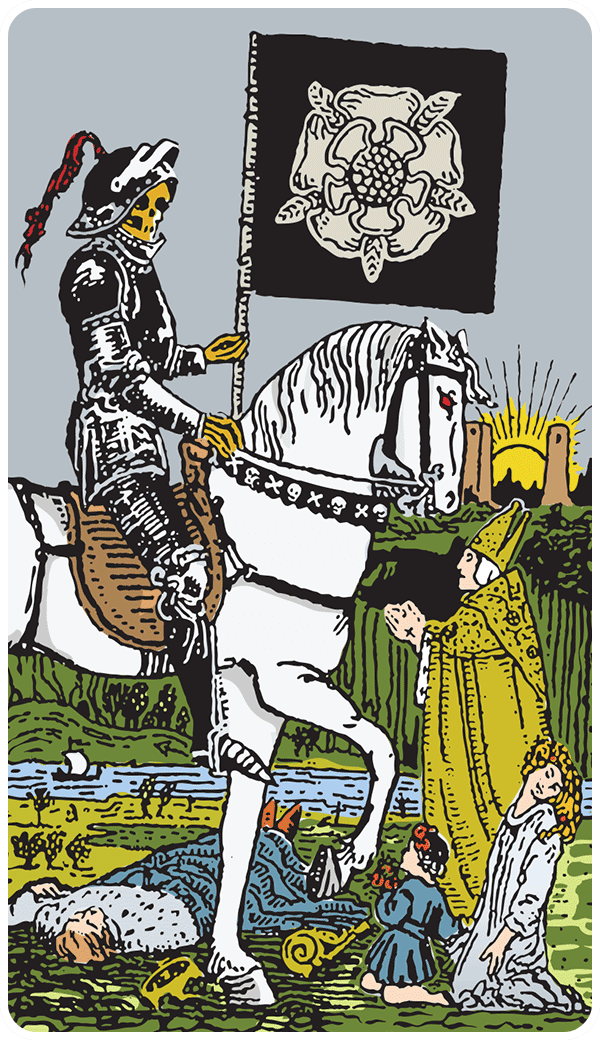
Death · plate 13
NO
Death in a yes/no reading leans no — but only if the question is asking whether something will continue, survive, or stay the same. If the question is asking whether something will end, transform, or complete, the answer is yes. The card does not predict disaster. It names the structure that is already in its final phase. Most people read Death as a warning about what might happen. That is the misread. Death describes what is already happening, whether you have admitted it yet or not.
Why Death reads this way
What the card is actually describing
Death is a Major Arcana card, which means it governs a structural shift in the querent's life, not a single event or feeling. The image shows a skeleton in armor on a white horse, carrying a black flag with a white rose. A king lies dead in the foreground. A child, a bishop, and a maiden stand in various postures of surrender or pleading. The sun rises between two towers in the background. The skeleton is not choosing who dies — everyone in the image is already in the process. The card is not a threat. It is a report.
The most common misreading in a yes/no context is treating Death as a veto from the universe. The querent asks, "Will this job work out?" Death appears. They read it as: the universe is saying no, something bad is coming, I should be afraid. That is not what the card is doing. Death is naming the part of the situation that is already decomposing. If the job requires you to keep performing a version of yourself that no longer fits, Death is the card that says that performance is ending. Whether the job works out depends on whether the job can survive that ending. Most of the time, it cannot. That is why the answer reads as no.
How the card reads differently depending on what is being asked
If the question is, "Should I stay in this relationship?" and Death appears, the answer is no — not because the relationship is doomed, but because the version of the relationship you have been trying to preserve is already over. Staying means entering a new relationship with the same person, and most people are not prepared to do that work. They want the old thing back. Death says the old thing is gone.
If the question is, "Will this divorce finalize?" and Death appears, the answer is yes. The card confirms the ending that is already in motion. If the question is, "Will I finally be able to let this person go?" the answer is also yes, but with a condition: the letting go is not a decision you make once. It is a structure you stop feeding. Death does not arrive because you decided to let go. Death arrives because you already stopped feeding the structure, whether you noticed or not.
Reversed, Death usually means the ending is stalled. The structure is rotting in place because the querent is refusing to admit it is dead. The yes/no answer does not flip — it becomes maybe, contingent on whether the querent is willing to stop performing life support on something that is already gone.
The tell that someone is misreading the card on themselves
The querent says, "I know it means something has to end, but I don't know what." That is the tell. If you do not know what is ending, you are not looking at the thing you have been trying to hold in place against its natural decomposition. Go back through the last six months and look for the moment you started saying, "I just need to get through this" or "I just need them to go back to how they were." That is the thing that is ending. Death is not a mystery. It is the name for the ending you have been negotiating with in private.
A grounded observation
If Death shows up in a yes/no reading and your first response is fear, the question you asked was not actually a yes/no question. It was a request for permission to keep something alive that you already know is finished.
Key themes to watch for
- № 01Theme
Affirmative current
- № 02Theme
Open door
- № 03Theme
Forward motion
What to do with this reading
Read the upright meaning first, even if you pulled the card reversed. The reversal is a commentary on the upright — not a separate card.
Notice what your body did when you saw Death. That reaction is usually closer to the truth than the interpretation.
Write down one sentence: What is this card asking me to stop avoiding? Let the answer be smaller than you expect.
Come back to this card in 48 hours. Most yes / no readings sharpen with a little distance.
Questions answered
Frequently asked
Death in a yes/no reading leans no — but only if the question is asking whether something will continue, survive, or stay the same. If the question is asking whether something will end, transform, or complete, the answer is yes. The card does not predict disaster. It names the structure that is already in its final phase. Most people read Death as a warning about what might happen. That is the misread. Death describes what is already happening, whether you have admitted it yet or not.
Reversed cards are rarely "bad." Death reversed asks you to look at where the same theme is blocked, postponed, or being avoided — usually with more compassion than the upright version.
Death colors the cards around it. Pay attention to where its themes — archetype, pattern, invitation — show up in the next card. That is usually where the story is.
Tarot is observational, not predictive. Death describes the conditions in front of you right now and where they tend to lead if nothing changes — not a guarantee of timing.
Repeat cards are the deck underlining a theme. With Death, that usually means the question you are asking is the right one — but you have not yet acted on what the card is showing you.
Read next
Related readings
Other Death readings