Death in General
Death shows up and querents brace for loss. The card isn't warning you something is ending—it's naming the thing that already ended and you're still carrying.
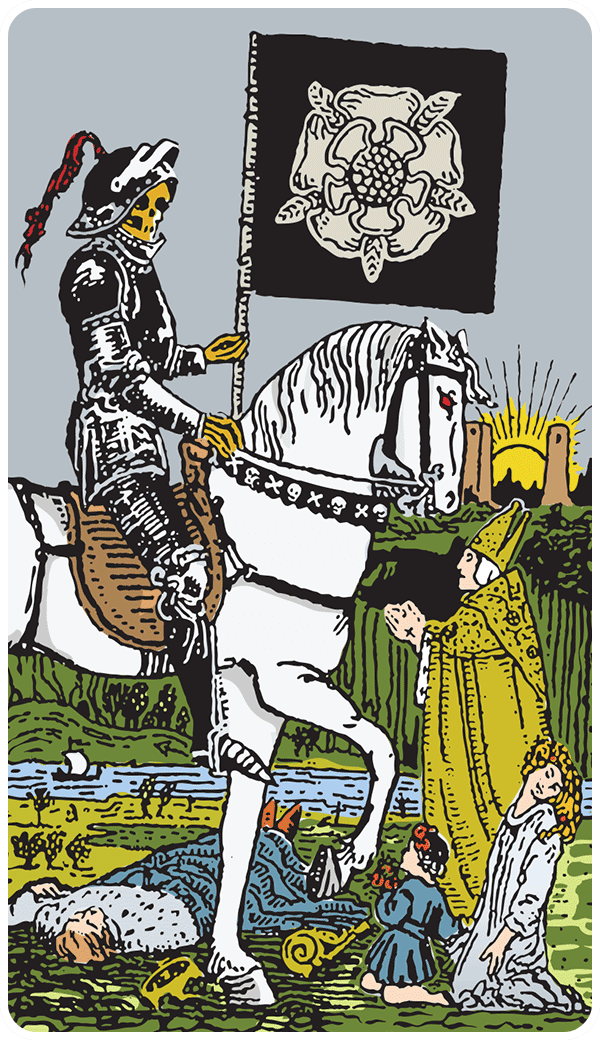
Death · plate 13
What the card is actually doing
Death shows up in a general reading and the querent stops breathing for a second. They want to know if someone is going to die, if they're going to lose their job, if the relationship is over. The card feels like a threat. Like the deck is warning them to brace for impact.
That is not what the card does. Death does not predict disaster. It names the structure, identity, or attachment that has already completed its cycle and is now decomposing in your hands while you pretend it's still alive.
Reading Death in general
What the card is doing and why everyone reads it wrong
Death is a Major Arcana card, which means it describes a psychological threshold—a developmental shift that reorganizes how you see yourself or move through the world. It is not a minor transit. It is not a mood. It is the moment a previous version of you becomes unsustainable and the structure that held that version collapses.
The image shows a skeleton in armor on a white horse, carrying a black flag with a white rose. A king lies dead at the horse's feet. A child, a maiden, and a bishop stand in its path. The sun rises between two towers in the distance. The skeleton is not attacking anyone. It is moving forward. The king is already down. The others are simply next in line.
People read Death as a warning because they mistake the card for the event. But the event already happened. The king is already on the ground. What the card is naming is the fact that you are still standing in the path, still negotiating with the horse, still trying to bargain your way out of what has already been set in motion. The misreading is thinking the card arrives before the ending. It doesn't. It arrives when you are refusing to see that the ending already occurred.
How the card reads for two different situations
For someone in the middle of a breakup, job loss, or relocation—something they can name as a clear ending—Death reads as confirmation. The card is not telling them anything new. It is reflecting back what they already know and giving them permission to stop performing continuity. The version of their life that included that person, that role, that city is over. The card says: correct. Stop pretending otherwise.
For someone who pulls Death and insists nothing is ending, the card reads differently. They are usually mid-argument with themselves about an identity they have outgrown, a belief system that no longer fits, or a relational pattern they keep choosing despite knowing it doesn't work. The ending here is internal. The card is naming the part of them that is trying to die and they are the ones holding the ventilator tube in place.
The tell that you are misreading Death on yourself
You pulled Death three months ago and you are still waiting for the bad thing to happen. You keep scanning the perimeter for what you are about to lose. You are braced, vigilant, tense.
That is the tell. If the card feels like a future threat, you are reading it backward. Death does not announce what is coming. It names what already left and you are still trying to resurrect. Go back through the last six months and look for the moment you started performing a role that no longer felt true, or the week you stopped arguing for something you used to defend, or the day you looked at someone you loved and felt nothing. That was Death. The card is just the receipt.
From the practice
“A card never tells you what to do. It tells you what you're already deciding — and gives you the words to name it.”
A grounded observation
The sun is rising between the towers in the background of the card. The image is not describing an end. It is describing what becomes visible once you stop propping up the structure that was blocking the light.
Key themes to watch for
- № 01Theme
Beginnings
- № 02Theme
Inner movement
- № 03Theme
Receptivity
What to do with this reading
Read the upright meaning first, even if you pulled the card reversed. The reversal is a commentary on the upright — not a separate card.
Notice what your body did when you saw Death. That reaction is usually closer to the truth than the interpretation.
Write down one sentence: What is this card asking me to stop avoiding? Let the answer be smaller than you expect.
Come back to this card in 48 hours. Most general readings sharpen with a little distance.
Questions answered
Frequently asked
The Death card, often misunderstood, signals a time of transformation. While it's easy to fixate on its grim iconography, the essence here is about letting go. Just as leaves fall in autumn to make way for spring growth, something in your life is ready to be released. This might be a belief, a habit, or a situation that no longer serves you. It's a moment to embrace change, however uncomfortable it might feel. Consider what chapter is closing and what new story is waiting to be written.
When Death appears reversed, there's a hint of resistance to change. Perhaps you're holding onto something past its due, fearing the uncertainty of what's next. It's not about forcing a change but noticing where you're stuck. Sometimes, the need for closure or acceptance can be subtle. Ask yourself what needs to be acknowledged or what fear might be holding you back. This could be a gentle nudge to explore how you're adapting to life's inevitable shifts.
Death colors the cards around it. Pay attention to where its themes — archetype, pattern, invitation — show up in the next card. That is usually where the story is.
Tarot is observational, not predictive. Death describes the conditions in front of you right now and where they tend to lead if nothing changes — not a guarantee of timing.
Repeat cards are the deck underlining a theme. With Death, that usually means the question you are asking is the right one — but you have not yet acted on what the card is showing you.
Read next
Related readings
Other Death readings