Death in Career
Death in a career reading does not predict job loss. It names the part of your professional identity that has already stopped working and asks what you're still performing.
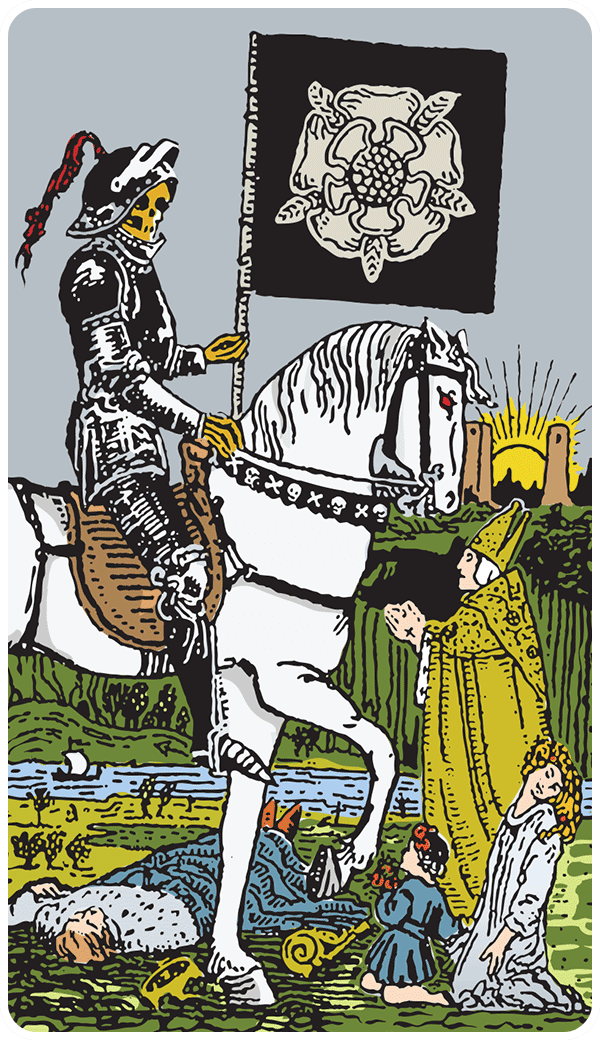
Death · plate 13
What the card is actually doing
Death shows up in a career reading and the querent goes silent. They think the card is warning them about layoffs, about being fired, about the business collapsing. They want me to tell them it doesn't mean what they think it means. I can't do that, because what they think it means is wrong from the start. The card is not predicting an external event. It is naming an internal one that has already happened.
Death in a work context describes the moment a professional identity stops generating meaning. The role still exists. You still show up. But the part of you that was animated by the work — the part that felt like it mattered, that wanted the problems, that cared about the outcome — has gone quiet. The card is not telling you to quit. It is telling you that something has already ended, and you are still performing it.
Reading Death in career
What the Major Arcana rank and the image are doing
Death is Major Arcana, which means it describes a structural shift in identity, not a circumstantial event. Major cards govern how you understand yourself, what you believe your life is for, and what roles you occupy in the world. When a Major shows up in a career reading, the question is not about the job. It is about who you have been inside the job, and whether that person still exists.
Look at the image. A skeleton in armor rides a white horse. A king lies dead on the ground. A bishop pleads. A child watches. The sun rises between two towers in the distance. The skeleton is not killing anyone. The king is already dead. The card depicts aftermath, not attack. What Death names is the moment you look at the role you have been playing and realize the role has outlived the person who needed it. The misreading is thinking the card is about what will happen. The card is about what has already stopped happening inside you.
Most querents read Death as a threat to external stability. They think it means they are about to lose the job, the title, the income. That is almost never what the card is doing. What it is doing is naming the gap between the professional identity you are still performing and the part of you that has moved on. The grief is not about what you might lose. The grief is about what you have already lost and have not yet admitted.
How the card reads for two different situations
For someone mid-career who built their identity around a specific role — the litigator, the creative director, the attending physician — Death reads as the end of the fantasy that the role will ever feel like it felt in year three. You are still competent. You are still respected. But the part of you that was fed by the work has gone quiet, and no amount of competence brings it back. The card is not telling you to leave. It is telling you that you are mourning something while still inhabiting it, and that the mourning is the honest response.
For someone early in a career who took a job because it seemed like the right move — the startup that was supposed to be meaningful, the nonprofit that was supposed to matter — Death reads as the moment you realize the work is not building toward the person you thought you were becoming. You are learning skills. You are performing well. But nothing you are doing feels like it is accumulating into a self you recognize. The card names the end of the story you told yourself about what this job would make you into.
The tell that someone is misreading the card on themselves
The tell is when someone reads Death and immediately starts planning the next move. They start networking. They update the resume. They research pivot options. They treat the card as a productivity prompt. That is avoidance. What the card is asking you to do is sit with the fact that a version of your professional self has ended, and that you do not yet know what comes after. The action is not the point. The recognition is the point. Most people skip the recognition because it feels unbearable. Then they take the next job and realize six months in that they brought the same problem with them.
From the practice
“A card never tells you what to do. It tells you what you're already deciding — and gives you the words to name it.”
A grounded observation
Go back through the last six months of your calendar and look for the meetings where you performed engagement you did not feel. That is the gap the card is naming.
Key themes to watch for
- № 01Theme
Creative purpose
- № 02Theme
Heart-led work
- № 03Theme
Right alignment
What to do with this reading
Read the upright meaning first, even if you pulled the card reversed. The reversal is a commentary on the upright — not a separate card.
Notice what your body did when you saw Death. That reaction is usually closer to the truth than the interpretation.
Write down one sentence: What is this card asking me to stop avoiding? Let the answer be smaller than you expect.
Come back to this card in 48 hours. Most career readings sharpen with a little distance.
Questions answered
Frequently asked
In career matters, Death indicates a significant shift. This could be the end of a job or a dramatic change in your professional path. While endings can seem daunting, they often clear the way for more aligned opportunities. Perhaps a role is no longer fulfilling, or you're being nudged toward a different direction. It's a time to consider what truly engages you and where your professional life might be reinvigorated. What possibilities open up when you embrace this transition?
Reversed, Death in your career hints at reluctance to leave a role or situation behind. You might feel stuck in a job that doesn't satisfy you, yet fear the unknown of change. This can lead to a sense of restlessness or frustration. Consider what you're holding onto and why. Is it security, familiarity, or something else? It's worth exploring what small steps might help you move toward a more fulfilling professional life without rushing the process.
Death colors the cards around it. Pay attention to where its themes — archetype, pattern, invitation — show up in the next card. That is usually where the story is.
Tarot is observational, not predictive. Death describes the conditions in front of you right now and where they tend to lead if nothing changes — not a guarantee of timing.
Repeat cards are the deck underlining a theme. With Death, that usually means the question you are asking is the right one — but you have not yet acted on what the card is showing you.
Read next
Related readings
Other Death readings