Death in Health
Death in a health reading doesn't predict illness. It names the moment your body forces a change you've been resisting. Here's what the card is doing.
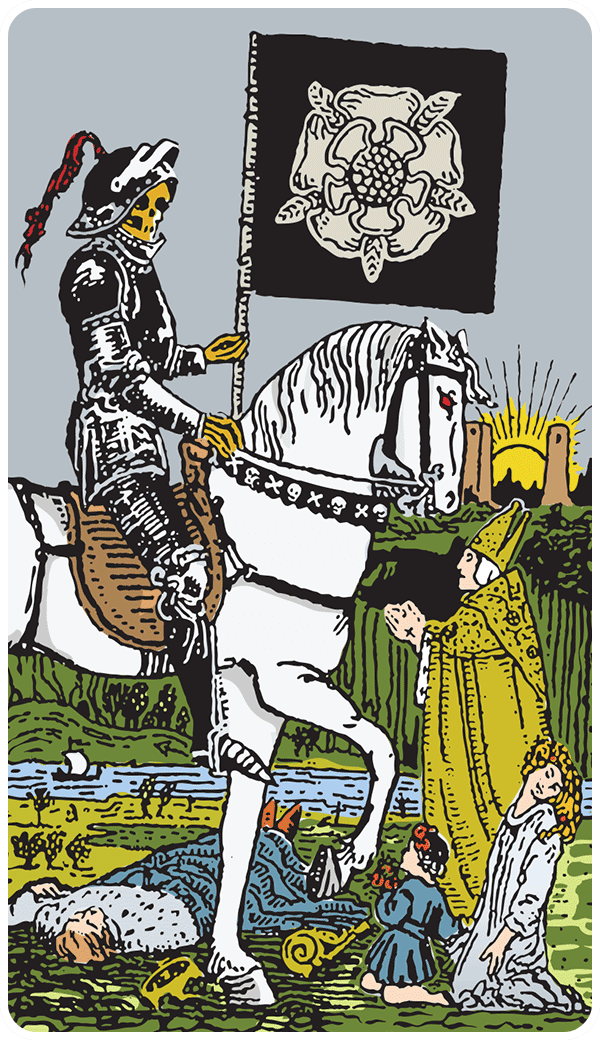
Death · plate 13
What the card is actually doing
Death shows up in a health reading and the querent goes pale. They want me to tell them it doesn't mean what they think it means. I can't do that, because what they think it means—literal death, terminal diagnosis, the body shutting down—is not what the card is saying. The card is almost never literal. But the panic response tells me something useful: the querent already knows their body is trying to end something, and they've been fighting it.
Reading Death in health
What the Major Arcana rank and the image are doing
Death is Major Arcana XIII. The Majors govern large psychological shifts—the moments when the operating system changes, not when a single file gets corrupted. When a Major shows up in a health reading, the body is not the isolated subject. The body is the site where a bigger transformation is being forced into visibility.
Look at the image. A skeleton in armor rides a white horse. A king lies dead. A child watches. A bishop pleads. The sun rises between two towers in the distance. What the card shows is a process that does not negotiate. It moves through everyone—status doesn't exempt you, pleading doesn't stop it, innocence doesn't delay it. The sun rising in the background is the tell: something is ending so something else can begin. The card is named Death because it describes the mechanism of death—irreversible transformation, the point past which you cannot go back to what you were.
The most common misreading in a health context is to treat Death as diagnostic. The querent sees the card and thinks: my body is failing, something is seriously wrong, I'm sicker than I thought. That is almost never what is happening. What is happening is that the body has been sending signals for months or years, and the querent has been overriding them, and the card is naming the moment the override stops working. The body is forcing a end to a pattern. The panic comes from the fact that the querent knows exactly which pattern, and they do not want to stop it.
How the card reads for two different situations
For someone in active burnout, Death reads as the moment the body pulls the brake. You can't sleep four hours and function anymore. You can't skip meals and stay sharp. The chronic tension in your shoulders isn't releasing with a massage. This version of Death says: the way you have been running your body is over. You do not get to vote on this. The transformation is that you now have a body with limits that enforce themselves.
For someone managing a chronic condition, Death reads differently. It's the moment you stop trying to return to the before-version of your body. You've been treating every flare as temporary, every accommodation as provisional, every limitation as something you'll overcome if you try hard enough. Death is the card that says: that version of you is dead. You are someone else now. The body you are in is the body you are in. The transformation is acceptance, and acceptance feels like loss until it doesn't.
The tell that someone is misreading the card on themselves
The tell is when someone sees Death in a health reading and immediately starts negotiating. They want to know what they can do to stop it, reverse it, prove it wrong. They start listing all the things they've already tried. They want the card to be a warning they can heed, a problem they can solve, a future they can avoid if they just work hard enough. That response means they are reading Death as threat instead of reading it as description. The card is not telling you what might happen. It is naming what is already over. The question is not how to prevent the ending. The question is what you do now that the ending has happened.
From the practice
“A card never tells you what to do. It tells you what you're already deciding — and gives you the words to name it.”
A grounded observation
Go back through your calendar and look for the moment you first noticed the thing you've been ignoring. That is when the transformation started. The card is just naming it.
Key themes to watch for
- № 01Theme
Emotional renewal
- № 02Theme
Mind-body link
- № 03Theme
Soft restoration
What to do with this reading
Read the upright meaning first, even if you pulled the card reversed. The reversal is a commentary on the upright — not a separate card.
Notice what your body did when you saw Death. That reaction is usually closer to the truth than the interpretation.
Write down one sentence: What is this card asking me to stop avoiding? Let the answer be smaller than you expect.
Come back to this card in 48 hours. Most health readings sharpen with a little distance.
Questions answered
Frequently asked
In health, Death signifies a pivotal change. This may relate to letting go of unhealthy habits or embracing a new wellness routine. It's an invitation to assess what in your lifestyle needs to shift for better health. This could be a dietary change, a new exercise regime, or even a mental health focus. Reflect on what aspect of your health feels ready for renewal, and what habits need to be released for a fresher approach.
Reversed, Death can indicate reluctance to change health habits. You might know a change is needed but struggle to make it happen. This stagnation can affect your well-being. Consider what fears are holding you back from embracing healthier choices. It's not about making huge changes overnight but recognizing small shifts that can lead to improved health over time. What gentle step could you take today?
Death colors the cards around it. Pay attention to where its themes — archetype, pattern, invitation — show up in the next card. That is usually where the story is.
Tarot is observational, not predictive. Death describes the conditions in front of you right now and where they tend to lead if nothing changes — not a guarantee of timing.
Repeat cards are the deck underlining a theme. With Death, that usually means the question you are asking is the right one — but you have not yet acted on what the card is showing you.
Read next