Death in Money
Death in a finance reading doesn't predict loss. It names the structure that already stopped working. Here's what the card is actually pointing to.
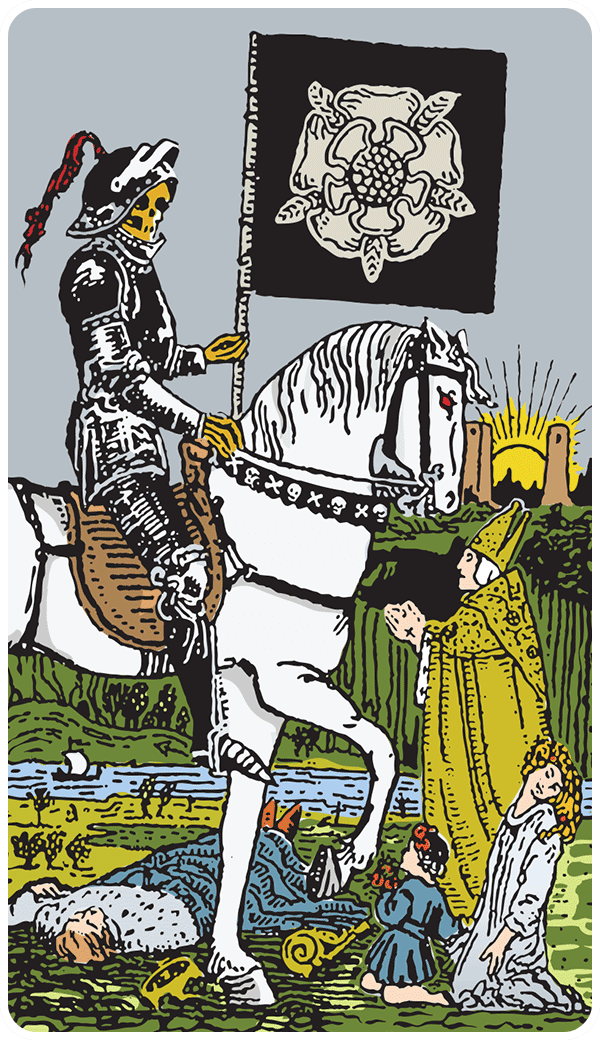
Death · plate 13
What the card is actually doing
Death shows up in a finance reading and the querent's first move is damage control. They want to know what they're about to lose, how bad it will be, when it will happen. They are already bracing. But the card is not a forecast. It is not warning you about something that hasn't happened yet. Death names the thing that has already ended — the income stream that dried up three months ago, the business model you've been resuscitating, the financial plan built on assumptions that no longer hold. The card is diagnostic. The panic comes from mistaking diagnosis for prophecy.
Reading Death in money
What the Major Arcana rank and the image are doing
Death is Major Arcana XIII, which means it describes a structural shift, not a transactional event. Major Arcana cards point to the framework — the paradigm you're operating inside, the identity or belief system that governs how you move. When a Major shows up in a finance reading, the question is not about this month's budget. It is about the financial story you are living inside and whether that story still functions.
Look at the image. A skeleton in armor rides a white horse. A king lies dead on the ground. A child, a maiden, and a bishop stand in its path. The sun rises between two towers in the distance. The skeleton is not killing anyone. The king is already dead. The others are not being threatened; they are standing in front of a process that does not stop for negotiation. The sun rising in the background is the tell — something is beginning, but only after the old structure has been cleared.
The most common misreading in a finance context is to treat Death as a loss card. It is not. Loss is Ten of Swords, Five of Pentacles, Three of Swords. Those cards describe the emotional and material experience of something being taken. Death describes the moment you stop pretending the old thing still works. The loss already happened. The card is naming your recognition of it.
How the card reads for two different financial situations
For someone clinging to a failing business or income model, Death reads as the end of the denial phase. The card says: the version of this that used to work is not coming back. The clients who used to call, the market that used to exist, the skill set that used to be enough — that chapter closed. The querent usually knows this already. They have been watching the numbers decline for months. Death is the card that says you are now allowed to admit it out loud and start building the next thing.
For someone in stable financial circumstances asking about a career pivot or major purchase, Death reads differently. It points to the identity or financial belief system that will not survive the transition. The card might be naming the self-concept of "I am someone who stays in one field," or "I am someone who does not take risks with money." The structure being cleared is internal. The question the card is asking is: are you willing to let the old financial self-image die so the new chapter can start, or will you keep trying to make the new plan fit the old identity?
The tell that someone is misreading the card on themselves
The tell is when the querent starts asking what they can do to prevent it. "If I cut expenses, will this still happen?" "If I take the second job, can I avoid this?" Death does not describe something you prevent. It describes something you stop resisting. If you are asking how to avoid Death, you are misreading the card as a threat instead of a clearance. The correct question is: what am I still pretending is viable, and what becomes possible when I stop pretending?
From the practice
“A card never tells you what to do. It tells you what you're already deciding — and gives you the words to name it.”
A grounded observation
Go back through your financial records for the last six months. Find the line item you kept funding even though the return stopped showing up. That is what Death is naming.
Key themes to watch for
- № 01Theme
Non-material wealth
- № 02Theme
Generosity
- № 03Theme
Values check
What to do with this reading
Read the upright meaning first, even if you pulled the card reversed. The reversal is a commentary on the upright — not a separate card.
Notice what your body did when you saw Death. That reaction is usually closer to the truth than the interpretation.
Write down one sentence: What is this card asking me to stop avoiding? Let the answer be smaller than you expect.
Come back to this card in 48 hours. Most money readings sharpen with a little distance.
Questions answered
Frequently asked
Death in finances suggests a transformation in how you manage money. This could mean letting go of old spending habits or rethinking your financial goals. It's a time to clear out financial clutter and make way for new strategies. The focus is on creating a sustainable plan that aligns with your current life stage. Consider what financial patterns are no longer useful and what fresh approaches might bring greater security.
Reversed, Death in finances points to resistance in changing financial habits. You might be sticking to outdated strategies or avoiding necessary adjustments. This could lead to financial stagnation. Reflect on what fears might be preventing you from updating your financial practices. Is there a reluctance to embrace a new budget or investment plan? Understanding this can be the first step toward healthier financial management.
Death colors the cards around it. Pay attention to where its themes — archetype, pattern, invitation — show up in the next card. That is usually where the story is.
Tarot is observational, not predictive. Death describes the conditions in front of you right now and where they tend to lead if nothing changes — not a guarantee of timing.
Repeat cards are the deck underlining a theme. With Death, that usually means the question you are asking is the right one — but you have not yet acted on what the card is showing you.
Read next
Related readings
Other Death readings