Two of Swords in General
The Two of Swords doesn't tell you to make a decision. It names the mechanism you're using to avoid making one — and why that mechanism is costing you.
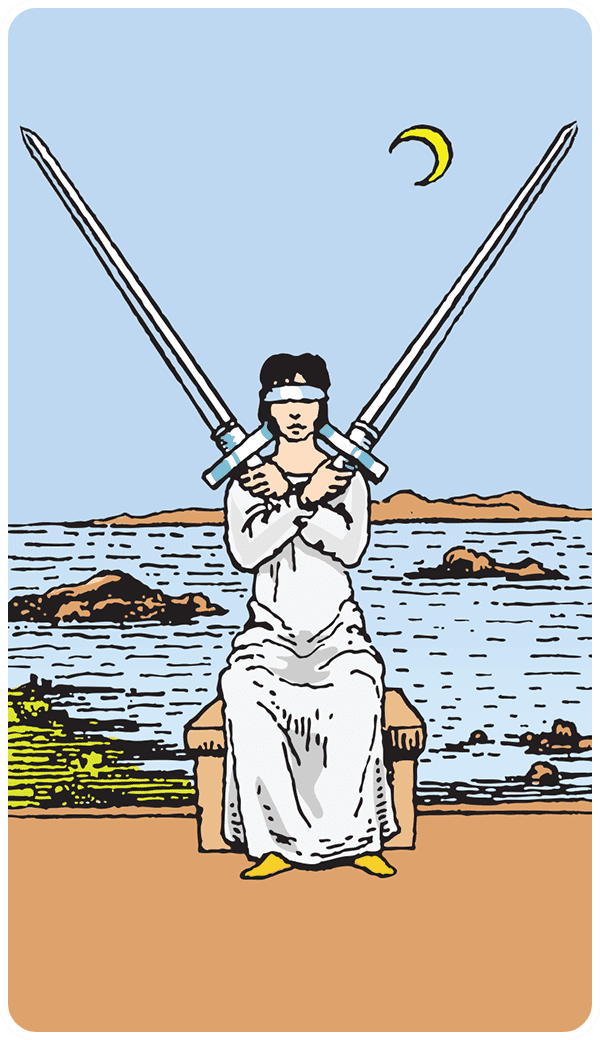
Two of Swords · plate 2
What the card is actually doing
The Two of Swords shows up and people immediately start talking about difficult choices. Two options, equal weight, impossible to decide between. The card gets read as a snapshot of indecision, which means the querent leaves the reading waiting for clarity to arrive so they can finally choose. That is not what the card is describing. The Two of Swords is not about a choice being hard. It is about a choice being actively refused — and the specific psychological architecture that refusal requires.
Reading Two of Swords in general
What the suit, the rank, and the image are each doing
Swords governs thought, discernment, and the part of the psyche that cuts through ambiguity to name what is true. When Swords cards dominate a reading, the question is almost always about what the querent knows but has not yet said out loud, even to themselves. The suit operates in the realm of clarity, which means it also operates in the realm of what clarity costs.
Twos in tarot describe a held tension between two forces. They are not about choosing between the forces. They are about the equilibrium that emerges when both forces are given equal weight and neither is allowed to win. The Two of Pentacles is active juggling. The Two of Cups is mutual recognition. The Two of Swords is the deliberate suspension of knowing.
Now look at the image. A figure sits blindfolded, holding two swords crossed over their chest. The posture is defensive. The blindfold is not something that happened to them — it is something they are wearing. The swords are not pointing at two external options. They are pointed away, holding something at bay. The card describes someone who has decided not to decide, and who is using a enormous amount of energy to maintain that state.
How the card reads when the querent is lying to themselves versus when they are buying time
The Two of Swords has two distinct mechanical readings depending on what the querent is actually doing. In the first version, the person already knows what the answer is. They know which job to take, which relationship to leave, which conversation to have. The Two of Swords names the moment they talk themselves out of knowing. They list pros and cons. They ask for more information. They say they need to think about it. The blindfold is self-imposed, and the longer it stays on, the more the decision calcifies into dread.
In the second version, the person genuinely does not have enough information yet, and they are correctly refusing to act prematurely. The stalemate is strategic. They are waiting for a contract to finalize, a test result to come back, another person to show their hand. Here, the Two of Swords reads as discipline. The blindfold is not avoidance — it is a refusal to be rushed into a choice that is not yet ripe. The card affirms the pause.
Most querents cannot tell which version they are in. That is the problem the card is naming.
The tell that someone is misreading the card on themselves
The tell is this: if you have been "waiting for clarity" for longer than two weeks and no new information has arrived, you are not waiting for clarity. You are waiting for permission to know what you already know. Go back through your journal or your text threads and look for the moment you first named the thing you are now calling unclear. That moment is usually much earlier than you want it to be. The Two of Swords does not arrive to help you decide. It arrives to show you that the decision has already been made, and you are spending your days pretending it hasn't.
From the practice
“A card never tells you what to do. It tells you what you're already deciding — and gives you the words to name it.”
A grounded observation
The next time someone asks you what you think, notice how long it takes you to answer. If the pause is longer than three seconds, you are not thinking. You are deciding whether to say it.
Key themes to watch for
- № 01Theme
Beginnings
- № 02Theme
Inner movement
- № 03Theme
Receptivity
What to do with this reading
Read the upright meaning first, even if you pulled the card reversed. The reversal is a commentary on the upright — not a separate card.
Notice what your body did when you saw Two of Swords. That reaction is usually closer to the truth than the interpretation.
Write down one sentence: What is this card asking me to stop avoiding? Let the answer be smaller than you expect.
Come back to this card in 48 hours. Most general readings sharpen with a little distance.
Questions answered
Frequently asked
The Two of Swords suggests a moment of stalemate or indecision. You might feel caught between two equally compelling choices, each with its own set of consequences. This is a time for reflection, not hasty action. Are you protecting yourself from the discomfort of making a decision, or is there truly more information you need? Take a pause, but don't let inaction become your default state. Consider what fears or desires are driving your hesitation. Sometimes, the act of choosing itself is more important than the choice made.
The reversed Two of Swords indicates that confusion or avoidance is now dissolving. Perhaps you've been sitting on a decision for too long, and the pressure has become unavoidable. It's time to face the music, whether that means embracing discomfort or acknowledging the truth. The path may be clearer now, even if it's not the one you hoped for. Notice how it feels to finally move forward, and what that might say about the value of clarity over comfort.
Two of Swords colors the cards around it. Pay attention to where its themes — mental clarity, the truth being named, what the mind needs to release — show up in the next card. That is usually where the story is.
Tarot is observational, not predictive. Two of Swords describes the conditions in front of you right now and where they tend to lead if nothing changes — not a guarantee of timing.
Repeat cards are the deck underlining a theme. With Two of Swords, that usually means the question you are asking is the right one — but you have not yet acted on what the card is showing you.
Read next
Related readings
More Swords · General
- Ace of Swords — GeneralHow Ace of Swords reads in a general context.
- Three of Swords — GeneralHow Three of Swords reads in a general context.
- Four of Swords — GeneralHow Four of Swords reads in a general context.
- Five of Swords — GeneralHow Five of Swords reads in a general context.
- Six of Swords — GeneralHow Six of Swords reads in a general context.
- Seven of Swords — GeneralHow Seven of Swords reads in a general context.
Other Two of Swords readings
- Love & RelationshipsTwo of Swords read for love & relationships.
- Career & WorkTwo of Swords read for career & work.
- Money & FinanceTwo of Swords read for money & finance.
- Health & WellbeingTwo of Swords read for health & wellbeing.
- SpiritualityTwo of Swords read for spirituality.
- Yes / No AnswerTwo of Swords read for yes / no answer.