Five of Swords in General
The Five of Swords doesn't mean you lost or someone else won. It names the moment you realize the argument was never worth having in the first place.
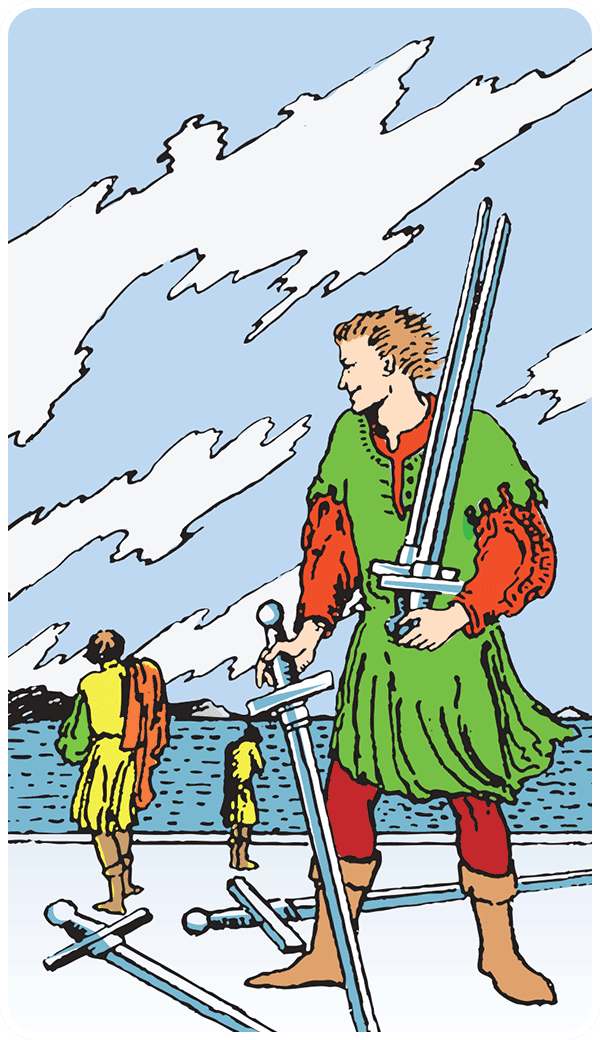
Five of Swords · plate 5
What the card is actually doing
The Five of Swords shows up and people read it as defeat. Someone else won. You lost. The card feels like humiliation, like walking away from a fight you should have stayed in. That reading misses what the card is actually doing. The Five of Swords doesn't describe who won. It describes the moment you notice that winning this particular fight would have cost you something you can't afford to lose.
Reading Five of Swords in general
What the suit, rank, and image are doing
Swords is the suit of thought, language, and the conflicts that happen when two people's mental frameworks collide. It governs arguments, boundaries named out loud, the part of you that needs to be right or needs the other person to admit they were wrong. When Swords cards cluster in a reading, the querent is almost always mid-conflict or post-conflict, still replaying what was said.
Fives in tarot are friction points. They describe the place where a system that was working stops working. The Five of Pentacles is material instability. The Five of Cups is emotional loss that hasn't been processed yet. The Five of Swords is the breakdown of a shared agreement about what the fight was even about. Someone moved the goalposts. Someone decided winning mattered more than resolution.
The image: a figure holds three swords and looks at two figures walking away. Two more swords lie on the ground. The sky is turbulent. The figure in the foreground looks smug or satisfied, but the people leaving are not looking back. The card is often read as "the smug figure won," but that misses the structural fact: the other two left. They stopped playing. The figure holding the swords is alone with the victory, and victories that leave you alone are not victories.
How it reads for two different situations
If you are the one holding the swords — if you won the argument, if you got the last word, if you proved your point and the other person walked away — the card is naming the cost. You were right, and being right mattered more than the relationship. The card asks: what did you actually win? Look at who is still in the room with you. The honest version is that most Five of Swords moments feel like relief in the first hour and regret by the end of the week.
If you are one of the figures walking away, the card is naming the decision to stop engaging. You realized mid-fight that this person was never going to hear you, or that the fight had turned into a game about dominance instead of resolution. The card reads as loss because walking away feels like losing, but the alternative was staying in a fight that was eating you. The Five of Swords is the exit. It does not feel good. It is still the correct move.
The tell that you are misreading it
You are misreading the Five of Swords if you are using it to justify staying in the fight. If the card shows up and you think "I need to go back and win this properly," you are reading it backward. The card does not say "try harder." It says "this fight is not worth what it is costing you." The other tell: if you read the card and immediately start building the case for why you were right, you are still in the argument. The card is not asking you to prove anything. It is asking you to notice that proving it will not give you what you actually need.
From the practice
“A card never tells you what to do. It tells you what you're already deciding — and gives you the words to name it.”
A grounded observation
Go back through your calendar and find the last argument you won. Check whether the person you won it against is still someone you talk to.
Key themes to watch for
- № 01Theme
Beginnings
- № 02Theme
Inner movement
- № 03Theme
Receptivity
What to do with this reading
Read the upright meaning first, even if you pulled the card reversed. The reversal is a commentary on the upright — not a separate card.
Notice what your body did when you saw Five of Swords. That reaction is usually closer to the truth than the interpretation.
Write down one sentence: What is this card asking me to stop avoiding? Let the answer be smaller than you expect.
Come back to this card in 48 hours. Most general readings sharpen with a little distance.
Questions answered
Frequently asked
The Five of Swords signals a moment where conflict seems unavoidable. You might feel like you're caught in a whirlwind of disagreements or misunderstandings, where winning appears more important than the cost. The air is charged with tension, and the aftermath leaves a residue of bitterness. It's a time to consider the true worth of victory and whether it's a prize you wish to hold. Reflect on how these conflicts shape your relationships and your sense of self. Sometimes, acknowledging the impact is the first step toward a more peaceful path.
When reversed, the Five of Swords hints at a potential for reconciliation or moving past a recent conflict. The sharp edges of previous arguments begin to dull, allowing room for understanding or at least a truce. It’s a moment where the ego steps aside, providing space for healing. Observe how this shift affects your interactions and emotions. Could this be an opportunity to rebuild trust or redefine boundaries? The choice lies in how you wish to engage with those around you.
Five of Swords colors the cards around it. Pay attention to where its themes — mental clarity, the truth being named, what the mind needs to release — show up in the next card. That is usually where the story is.
Tarot is observational, not predictive. Five of Swords describes the conditions in front of you right now and where they tend to lead if nothing changes — not a guarantee of timing.
Repeat cards are the deck underlining a theme. With Five of Swords, that usually means the question you are asking is the right one — but you have not yet acted on what the card is showing you.
Read next
Related readings
More Swords · General
- Ace of Swords — GeneralHow Ace of Swords reads in a general context.
- Two of Swords — GeneralHow Two of Swords reads in a general context.
- Three of Swords — GeneralHow Three of Swords reads in a general context.
- Four of Swords — GeneralHow Four of Swords reads in a general context.
- Six of Swords — GeneralHow Six of Swords reads in a general context.
- Seven of Swords — GeneralHow Seven of Swords reads in a general context.
Other Five of Swords readings
- Love & RelationshipsFive of Swords read for love & relationships.
- Career & WorkFive of Swords read for career & work.
- Money & FinanceFive of Swords read for money & finance.
- Health & WellbeingFive of Swords read for health & wellbeing.
- SpiritualityFive of Swords read for spirituality.
- Yes / No AnswerFive of Swords read for yes / no answer.