Ace of Swords in General
The Ace of Swords isn't good news. It's the moment a thought cuts through — sharp, clarifying, and often unwelcome. Here's what the card is doing.
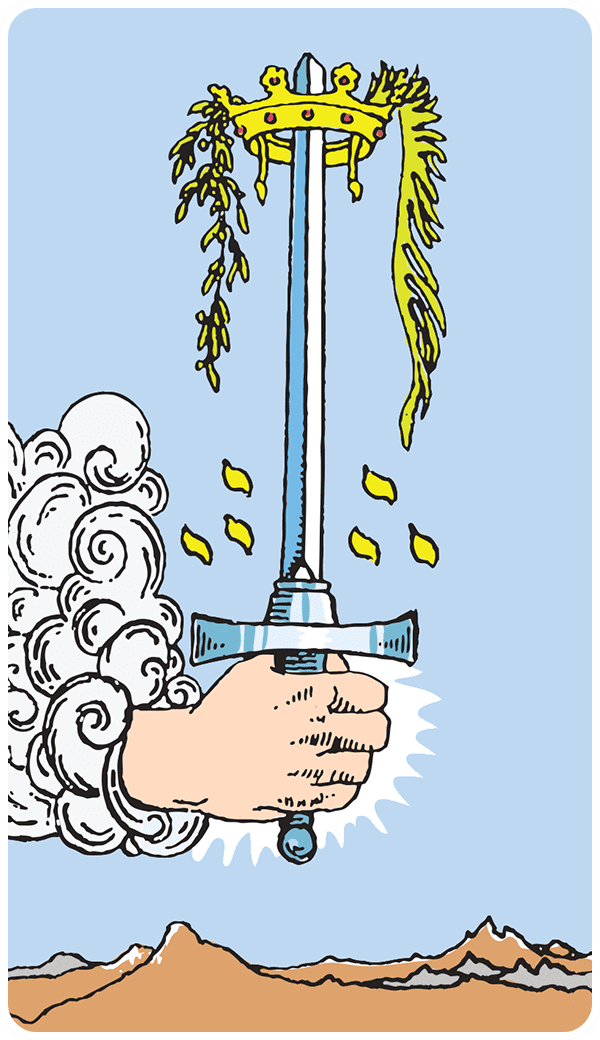
Ace of Swords · plate 1
What the card is actually doing
The Ace of Swords shows up and most readers treat it like a gift. Clarity! Breakthrough! Mental power! The querent smiles. They think the card is telling them they're about to understand something they've been confused about, that the fog is lifting, that insight is arriving like a reward for all the hard thinking they've been doing.
That is not what the card says. The Ace of Swords is not gentle. It is not a reward. It is a cut — and the cut is the point.
Reading Ace of Swords in general
What the suit, the rank, and the image are each doing
Swords is the suit of thought, discernment, and the part of the mind that separates one thing from another. It governs how you think, what you decide is true, and the process of cutting away what doesn't hold up under scrutiny. When Swords cards dominate a reading, the querent is almost always in their head — analyzing, arguing with themselves, or trying to think their way out of something that requires a different tool.
Aces are thresholds. They describe the moment a new channel opens, not what happens after you walk through it. The Ace of Swords is not clarity achieved. It is the arrival of the thought that changes everything — the realization you can't unfeel, the question you can't unask, the sentence someone said that you will still be turning over in six months.
Look at the image. A hand emerges from a cloud, holding a sword upright. The blade is sharp. A crown sits at the tip, surrounded by laurel and palm branches. The sword has not been swung. It has not been used. It is being offered, point-up, waiting. This is the mechanical answer: the Ace of Swords is the moment the blade arrives in your hand. What you do with it is a different card.
How the card reads for someone resisting versus someone seeking
For someone who has been avoiding a hard truth, the Ace of Swords reads as the end of avoidance. The thought they have been not-thinking finally lands. It is often unwelcome. It is often the thing they already knew but were not letting themselves say out loud. The card does not produce the thought; it names the moment the thought can no longer be ignored.
For someone actively seeking an answer, the Ace of Swords reads as the cut that separates signal from noise. They have been turning over ten possibilities, weighing pros and cons, asking everyone they know. The card is the moment one option becomes obviously wrong and falls away. It does not tell you which option is right. It tells you the blade is now in your hand and you can finally make the cut you've been circling.
Reversed, the Ace of Swords often shows up when the thought has arrived but the querent is refusing to pick up the sword. They see the realization. They know what it means. They are choosing not to act on it, or not to say it, or to keep pretending the old story still works. The card reversed is not confusion — it is the active suppression of clarity.
The tell that someone is misreading the card on themselves
The tell is relief. If the querent reads the Ace of Swords and feels comforted, they are misreading it. This card does not comfort. It clarifies, and clarification is often the opposite of comfort. If someone sees this card and thinks "good, now I'll finally understand what to do," they are skipping past what the card actually describes: the arrival of a thought sharp enough to require a decision they have been avoiding.
The honest version is this. The Ace of Swords is not the answer. It is the question you can no longer pretend you're not asking.
From the practice
“A card never tells you what to do. It tells you what you're already deciding — and gives you the words to name it.”
A grounded observation
Go back through your calendar and look for the moment a single sentence changed the shape of the next six months. That sentence arriving — not what you did with it, just the fact that it landed — is what the Ace of Swords describes.
Key themes to watch for
- № 01Theme
Beginnings
- № 02Theme
Inner movement
- № 03Theme
Receptivity
What to do with this reading
Read the upright meaning first, even if you pulled the card reversed. The reversal is a commentary on the upright — not a separate card.
Notice what your body did when you saw Ace of Swords. That reaction is usually closer to the truth than the interpretation.
Write down one sentence: What is this card asking me to stop avoiding? Let the answer be smaller than you expect.
Come back to this card in 48 hours. Most general readings sharpen with a little distance.
Questions answered
Frequently asked
The Ace of Swords slices through confusion, delivering clarity like a fresh breeze. This card often signals a breakthrough, a moment when the fog lifts and you see things as they truly are. It's about mental clarity, the genesis of an idea, or the start of a new intellectual journey. If something has been puzzling you, expect a sudden insight or a new perspective that changes everything. Consider what this new understanding might prompt you to explore further, and remember, clarity can be a powerful first step toward meaningful action.
When the Ace of Swords appears reversed, it suggests a clouding of judgment or muddled thoughts. You might be grappling with confusion or miscommunication, leading to frustration or indecision. It's as if the blade meant to cut through uncertainty is dulled, leaving you feeling stuck. This card invites you to reflect on the sources of this mental clutter. Are there assumptions you need to challenge or information you need to clarify? Consider how you might create space for clearer thinking and communication.
Ace of Swords colors the cards around it. Pay attention to where its themes — mental clarity, the truth being named, what the mind needs to release — show up in the next card. That is usually where the story is.
Tarot is observational, not predictive. Ace of Swords describes the conditions in front of you right now and where they tend to lead if nothing changes — not a guarantee of timing.
Repeat cards are the deck underlining a theme. With Ace of Swords, that usually means the question you are asking is the right one — but you have not yet acted on what the card is showing you.
Read next
Related readings
More Swords · General
- Two of Swords — GeneralHow Two of Swords reads in a general context.
- Three of Swords — GeneralHow Three of Swords reads in a general context.
- Four of Swords — GeneralHow Four of Swords reads in a general context.
- Five of Swords — GeneralHow Five of Swords reads in a general context.
- Six of Swords — GeneralHow Six of Swords reads in a general context.
- Seven of Swords — GeneralHow Seven of Swords reads in a general context.
Other Ace of Swords readings
- Love & RelationshipsAce of Swords read for love & relationships.
- Career & WorkAce of Swords read for career & work.
- Money & FinanceAce of Swords read for money & finance.
- Health & WellbeingAce of Swords read for health & wellbeing.
- SpiritualityAce of Swords read for spirituality.
- Yes / No AnswerAce of Swords read for yes / no answer.