Six of Swords in General
The Six of Swords gets read as relief or escape. What it actually describes is the mechanical act of leaving — and the specific kind of quiet that follows.
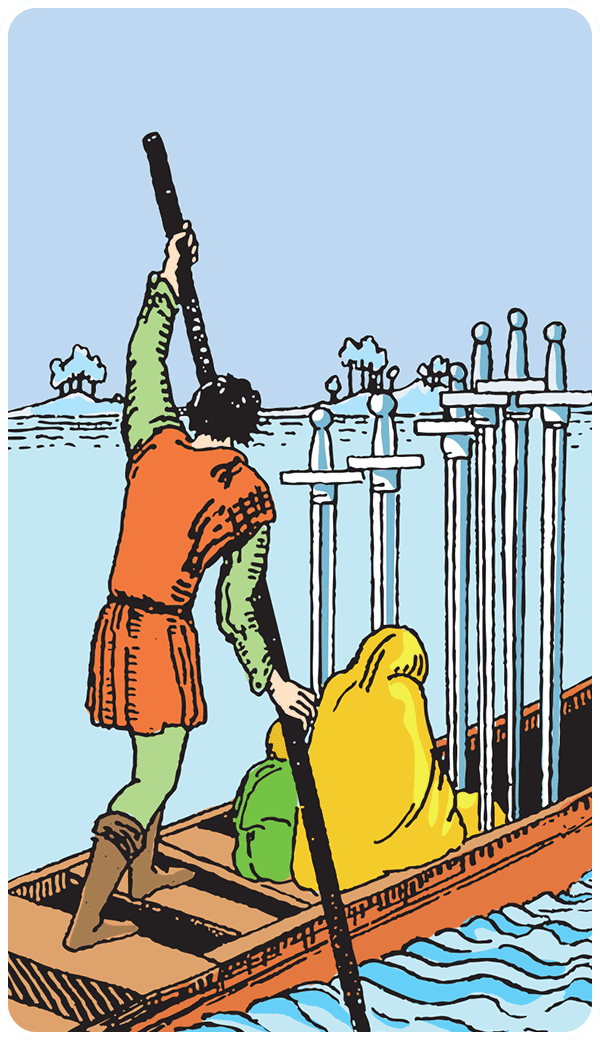
Six of Swords · plate 6
What the card is actually doing
The Six of Swords shows up and people read it as good news. They've been stuck, they've been suffering, and here comes the card that says they're finally moving toward something better. The boat is headed to calmer water. The swords are laid down. It's over. Except that's not what the card describes. The Six of Swords names the act of leaving, not the arrival. And the difference between those two things is where most of the misreading happens.
Reading Six of Swords in general
What the suit, the rank, and the image are each doing
Swords is the suit of thought, pattern, and the stories you tell yourself about what happened. It governs how you process conflict, how you hold onto old arguments, and how you cut through or get cut by the narratives you're living inside. When Swords cards show up, the question is almost always about what you're thinking, not what you're feeling — even when the querent phrases it as an emotional question.
Sixes in tarot describe a point of temporary stability after the destabilization of the Five. They are not resolutions. They are breathing rooms. The Six of Pentacles is not wealth secured; it's the moment resources start moving again after scarcity. The Six of Cups is not childhood healed; it's the memory surfacing so you can look at it differently. Sixes describe a provisional order, not a permanent one.
Now look at the image. A figure in a boat, often with a child, is being ferried across water by a hooded guide. Six swords stand upright in the boat. The water on one side is choppy; the water ahead looks calmer. The figure is turned away from where they came from. They are in transit. They have not arrived. The boat is still moving. This is the mechanical answer: the Six of Swords is the moment you are in the act of leaving, carrying what you carry, not yet anywhere else.
How the card reads for two different situations
For someone who just ended a relationship or quit a job, the Six of Swords describes the first week after. The decision is made. The logistics are in motion. The hard conversation is over. What the card names is the specific quiet that follows — not peace, but the absence of the thing that was taking up all the room. The relief is real, but it's not the same as being somewhere new. You're still holding the swords. You're still in the boat.
For someone who hasn't left yet but knows they need to, the Six of Swords shows up as the card they're arguing with. They want it to mean they'll feel better soon, that the transition will be smooth, that someone will help them. What it actually says is: you will have to get in the boat. You will have to turn your back on the shore. The card does not promise easy. It promises movement, and movement requires you to stop waiting for conditions to improve before you act.
The tell that someone is misreading the card on themselves
The tell is when someone reads the Six of Swords and immediately starts talking about what's coming next — the new job, the better relationship, the healed version of themselves. If the card were describing arrival, you'd see land. You'd see a dock. You'd see the figure stepping out of the boat. You don't. The card describes the middle part, the part where you're no longer where you were but not yet where you're going. If you're reading it as "I'm almost there," you're skipping the part the card is actually naming: you're still in motion, and the motion itself is the work.
From the practice
“A card never tells you what to do. It tells you what you're already deciding — and gives you the words to name it.”
A grounded observation
Go back through your last six months and look for the moment you stopped fighting about whether to leave and started packing. That's the Six of Swords. The rest came later.
Key themes to watch for
- № 01Theme
Beginnings
- № 02Theme
Inner movement
- № 03Theme
Receptivity
What to do with this reading
Read the upright meaning first, even if you pulled the card reversed. The reversal is a commentary on the upright — not a separate card.
Notice what your body did when you saw Six of Swords. That reaction is usually closer to the truth than the interpretation.
Write down one sentence: What is this card asking me to stop avoiding? Let the answer be smaller than you expect.
Come back to this card in 48 hours. Most general readings sharpen with a little distance.
Questions answered
Frequently asked
The Six of Swords often suggests a transition, a movement away from difficulty towards calmer waters. It's the sense of leaving something behind—perhaps a situation or mindset—that no longer serves you. This card doesn't promise instant relief, but hints at gradual improvement and a shift in perspective. It's about finding a sliver of peace amidst chaos and letting that guide you forward. Consider what you're moving away from and what you're moving towards. What small steps can you take to keep the momentum going?
When the Six of Swords appears reversed, it might indicate feeling stuck or unable to move on from a challenging situation. Instead of progress, there seems to be a hesitation or an inability to find closure. This card can signal emotional baggage that's hard to shake off, or perhaps a reluctance to leave something familiar behind. Notice where you feel anchored unnecessarily. Is there a story or belief that keeps you rooted in place?
Six of Swords colors the cards around it. Pay attention to where its themes — mental clarity, the truth being named, what the mind needs to release — show up in the next card. That is usually where the story is.
Tarot is observational, not predictive. Six of Swords describes the conditions in front of you right now and where they tend to lead if nothing changes — not a guarantee of timing.
Repeat cards are the deck underlining a theme. With Six of Swords, that usually means the question you are asking is the right one — but you have not yet acted on what the card is showing you.
Read next
Related readings
More Swords · General
- Ace of Swords — GeneralHow Ace of Swords reads in a general context.
- Two of Swords — GeneralHow Two of Swords reads in a general context.
- Three of Swords — GeneralHow Three of Swords reads in a general context.
- Four of Swords — GeneralHow Four of Swords reads in a general context.
- Five of Swords — GeneralHow Five of Swords reads in a general context.
- Seven of Swords — GeneralHow Seven of Swords reads in a general context.
Other Six of Swords readings
- Love & RelationshipsSix of Swords read for love & relationships.
- Career & WorkSix of Swords read for career & work.
- Money & FinanceSix of Swords read for money & finance.
- Health & WellbeingSix of Swords read for health & wellbeing.
- SpiritualitySix of Swords read for spirituality.
- Yes / No AnswerSix of Swords read for yes / no answer.