Seven of Swords in General
The Seven of Swords gets read as betrayal or theft. What it actually describes is the moment you convince yourself a partial solution is the whole answer.
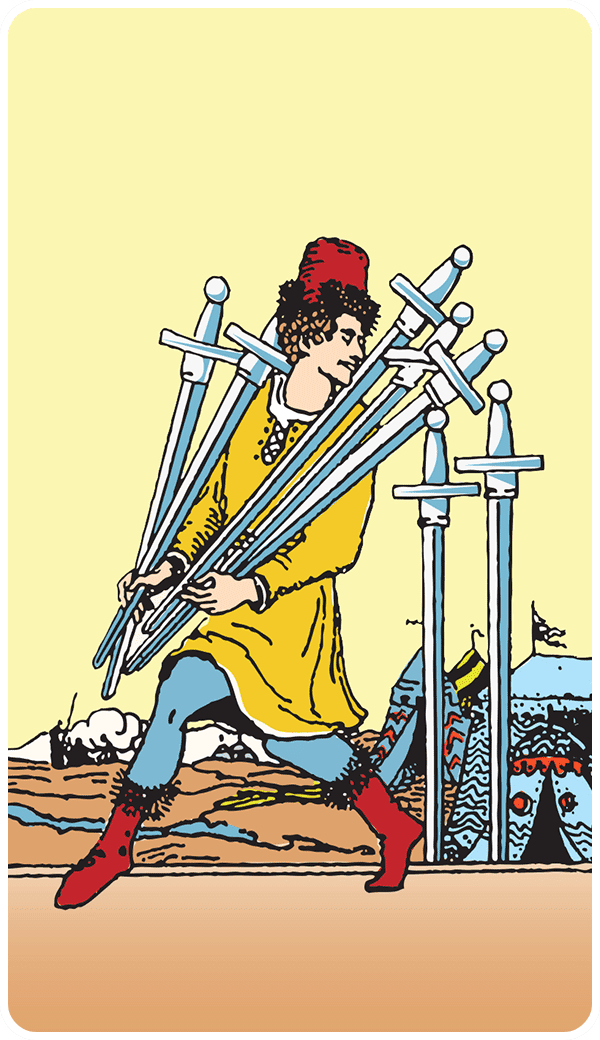
Seven of Swords · plate 7
What the card is actually doing
The Seven of Swords shows up in a general reading and the querent immediately asks who is lying to them. They want to know who the thief is, who is sneaking around, who cannot be trusted. The card has a reputation problem. It gets flattened into "someone is being dishonest" and the querent spends the session trying to figure out who.
That is not what the card is doing. The Seven of Swords describes a specific cognitive move: taking what you can carry and leaving the rest behind because you have decided the rest does not matter. Sometimes that move is correct. Sometimes it is the beginning of a larger problem. The card does not tell you which one you are looking at. It names the move itself.
Reading Seven of Swords in general
What the suit, the rank, and the image are each doing
Swords is the suit of thought, strategy, and the stories you tell yourself about what is happening. It governs how you frame a situation, what you decide counts as evidence, and the internal arguments you run to justify a choice. When Swords cards dominate a reading, the question is almost always about perception — not what is true, but what the querent has decided is true and whether that decision is load-bearing.
Sevens in tarot describe a moment of assessment mid-process. You are far enough in to see what is working and what is not. You have enough information to make a strategic choice. The Seven of Pentacles is the gardener pausing to evaluate the crop. The Seven of Cups is the moment of sorting real options from fantasy. Sevens ask: what are you keeping, and what are you walking away from?
Now look at the image. A figure tiptoes away from a camp, carrying five swords. Two swords remain planted in the ground behind him. His posture reads as sneaking — shoulders forward, glancing back. The sky is dawn or dusk; the light is ambiguous. He has made a choice about what to take. He has left something behind on purpose. The card does not show you whether he is stealing or escaping. It shows you the act of selective retention.
How the card reads when the querent is the one holding the swords
Most of the time, the querent is the figure in the card. They are the one deciding what counts and what does not. They have taken the arguments that support the story they want to believe and left the contradictory evidence behind. The Seven of Swords is the moment you tell yourself you have thought it through, when what you have actually done is think around the parts that would require you to change course.
This shows up as: the job candidate who takes the salary number and ignores the job description. The person who holds onto the two good months and dismisses the eight difficult ones. The querent who says "I've considered everything" and then lists four things. The card is not calling this malicious. It is naming it as a move. You are building a case with selected evidence. The question the card asks is whether the evidence you left behind will matter later.
The tell that someone is misreading the card on themselves
The querent who misreads the Seven of Swords on themselves will spend the reading looking outward. They will ask who is lying, who is hiding something, who cannot be trusted. They will treat the card as a warning about someone else's behavior. The actual tell is simpler: they are describing a situation where they have already made up their mind, and they are here to have that decision validated, not examined. The Seven of Swords does not arrive to warn you about a thief. It arrives when you are the one deciding what gets counted.
From the practice
“A card never tells you what to do. It tells you what you're already deciding — and gives you the words to name it.”
A grounded observation
Go back through the last month and look for the moment you said "I've thought about this" and then listed reasons that all pointed the same direction. That was the card.
Key themes to watch for
- № 01Theme
Beginnings
- № 02Theme
Inner movement
- № 03Theme
Receptivity
What to do with this reading
Read the upright meaning first, even if you pulled the card reversed. The reversal is a commentary on the upright — not a separate card.
Notice what your body did when you saw Seven of Swords. That reaction is usually closer to the truth than the interpretation.
Write down one sentence: What is this card asking me to stop avoiding? Let the answer be smaller than you expect.
Come back to this card in 48 hours. Most general readings sharpen with a little distance.
Questions answered
Frequently asked
In the realm of the general, the Seven of Swords suggests an air of stealth and cunning. There's a sense of moving quietly, perhaps out of necessity, as if navigating a tightrope in the dead of night. It might mean you're handling a situation on your own terms, or choosing discretion over confrontation. This card invites you to consider where you're using strategy in your life and whether you're being honest with yourself. Are you avoiding a direct approach? This could be a time to reflect on the balance between tact and transparency.
Reversed, the Seven of Swords hints at the consequences of past actions catching up to you. It suggests secrets coming to light or plans going awry. You may feel as if you've been caught in a web of your own making. Here, the card nudges you to think about accountability and the value of honesty. Is there something that needs to be addressed openly? It could be an opportunity to clear the air and regain trust, both with others and within yourself.
Seven of Swords colors the cards around it. Pay attention to where its themes — mental clarity, the truth being named, what the mind needs to release — show up in the next card. That is usually where the story is.
Tarot is observational, not predictive. Seven of Swords describes the conditions in front of you right now and where they tend to lead if nothing changes — not a guarantee of timing.
Repeat cards are the deck underlining a theme. With Seven of Swords, that usually means the question you are asking is the right one — but you have not yet acted on what the card is showing you.
Read next
Related readings
More Swords · General
- Ace of Swords — GeneralHow Ace of Swords reads in a general context.
- Two of Swords — GeneralHow Two of Swords reads in a general context.
- Three of Swords — GeneralHow Three of Swords reads in a general context.
- Four of Swords — GeneralHow Four of Swords reads in a general context.
- Five of Swords — GeneralHow Five of Swords reads in a general context.
- Six of Swords — GeneralHow Six of Swords reads in a general context.
Other Seven of Swords readings
- Love & RelationshipsSeven of Swords read for love & relationships.
- Career & WorkSeven of Swords read for career & work.
- Money & FinanceSeven of Swords read for money & finance.
- Health & WellbeingSeven of Swords read for health & wellbeing.
- SpiritualitySeven of Swords read for spirituality.
- Yes / No AnswerSeven of Swords read for yes / no answer.