Three of Wands in Yes / No
The Three of Wands leans yes in yes/no readings, but only if you've already done the setup work. Here's what the card is actually measuring.
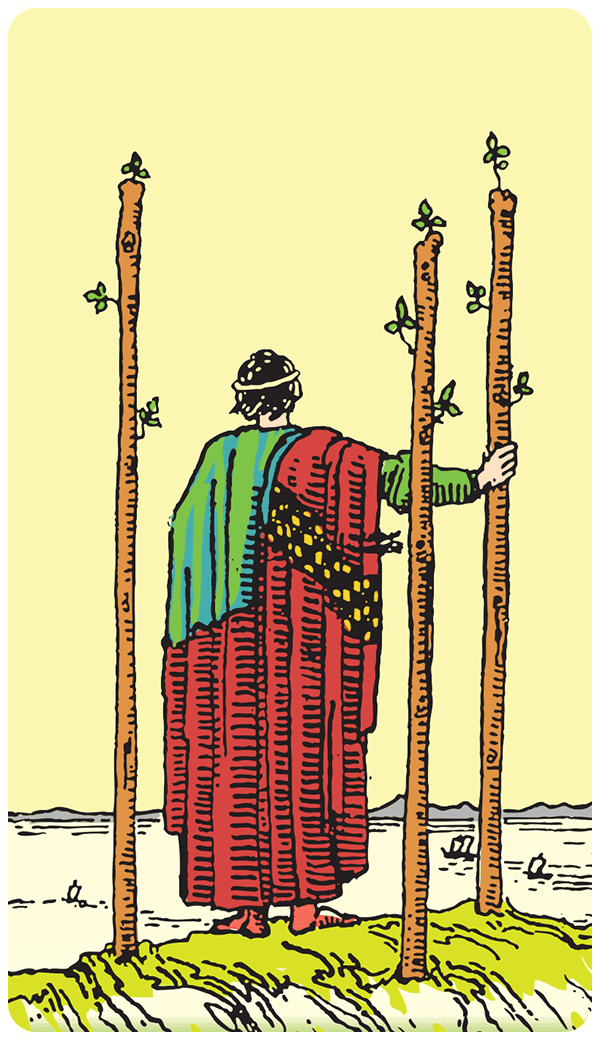
Three of Wands · plate 3
YES
The Three of Wands leans yes, but it's a conditional yes — the answer depends on whether you've already put the structure in place. Most querents read this card as confirmation that their plan will work. What it actually describes is the moment after you've committed resources and before results arrive. If you're asking yes/no and you haven't started yet, the card is answering a different question than the one you asked.
Why Three of Wands reads this way
What the suit, the rank, and the image are doing
Wands is the suit of will, initiative, and forward motion. It governs the part of you that decides to act, that commits energy toward an outcome, that holds momentum through uncertainty. When Wands cards show up, the question being asked is almost always about whether something will happen — whether the thing you want will materialize, whether your effort will pay off.
Threes in tarot describe the first stable form after initial pairing. The Ace is spark, the Two is decision, the Three is structure. It's the moment a thing becomes real enough to observe from a distance. In Wands, that structure is your plan in motion. You've launched. You've allocated resources. You're watching to see what returns.
The image shows a figure standing on a cliff, back to the viewer, looking out at three ships on the horizon. The wands are planted in the ground behind them. They are not rowing the ships. They are not on the ships. They are waiting for the ships to come in. This is the mechanical answer: the Three of Wands describes the interval between action and outcome. You have done the part you can do. Now you are waiting to see if the world responds.
Why the card reads differently depending on what you've already done
If you ask "Will this work?" and you have already started — you've sent the pitch, you've had the conversation, you've made the move — the Three of Wands leans yes. The card is describing the state you are already in. You are in the waiting phase because there is something to wait for. The ships are out there because you sent them.
If you ask "Should I do this?" and you haven't started yet, the card is not answering that question. It's describing what happens after you start. The yes/no framing breaks down here. The card is saying: if you do this, you will enter a waiting period, and that waiting period will require you to hold your position without immediate feedback. That is not the same as "yes, do it." It's a description of what doing it will feel like.
The tell that someone is misreading the card on themselves: they pull the Three of Wands, decide it means their plan is blessed, and then never actually execute the plan. They stay in the visioning phase. They refine the idea. They wait for a sign to start. The card was describing the state after commitment, and they read it as permission to keep preparing.
What the reversed version measures
Reversed, the Three of Wands describes the same waiting period but without the underlying structure. You are looking at the horizon, but you didn't send the ships. You want the outcome, but you skipped the setup work. The reversed card in a yes/no reading leans no — not because the thing is impossible, but because the preconditions are missing. The question you are asking assumes a foundation that isn't there yet.
The other reversed read: you sent the ships, but you're not actually watching for them. You committed and then got distracted. You started three things and finished none of them. The card reversed is naming the gap between your intention and your follow-through.
A grounded observation
Go back through your calendar and look at what you actually did in the two weeks before you asked the question. If you took action, the card is answering yes. If you didn't, it's answering a question you haven't earned yet.
Key themes to watch for
- № 01Theme
Affirmative current
- № 02Theme
Open door
- № 03Theme
Forward motion
What to do with this reading
Read the upright meaning first, even if you pulled the card reversed. The reversal is a commentary on the upright — not a separate card.
Notice what your body did when you saw Three of Wands. That reaction is usually closer to the truth than the interpretation.
Write down one sentence: What is this card asking me to stop avoiding? Let the answer be smaller than you expect.
Come back to this card in 48 hours. Most yes / no readings sharpen with a little distance.
Questions answered
Frequently asked
The Three of Wands leans yes, but it's a conditional yes — the answer depends on whether you've already put the structure in place. Most querents read this card as confirmation that their plan will work. What it actually describes is the moment after you've committed resources and before results arrive. If you're asking yes/no and you haven't started yet, the card is answering a different question than the one you asked.
Reversed cards are rarely "bad." Three of Wands reversed asks you to look at where the same theme is blocked, postponed, or being avoided — usually with more compassion than the upright version.
Three of Wands colors the cards around it. Pay attention to where its themes — creative momentum, will and appetite, the spark that wants to be tended — show up in the next card. That is usually where the story is.
Tarot is observational, not predictive. Three of Wands describes the conditions in front of you right now and where they tend to lead if nothing changes — not a guarantee of timing.
Repeat cards are the deck underlining a theme. With Three of Wands, that usually means the question you are asking is the right one — but you have not yet acted on what the card is showing you.
Read next
Related readings
More Wands · Yes / No
- Ace of Wands — Yes / NoHow Ace of Wands reads in a yes / no context.
- Two of Wands — Yes / NoHow Two of Wands reads in a yes / no context.
- Four of Wands — Yes / NoHow Four of Wands reads in a yes / no context.
- Five of Wands — Yes / NoHow Five of Wands reads in a yes / no context.
- Six of Wands — Yes / NoHow Six of Wands reads in a yes / no context.
- Seven of Wands — Yes / NoHow Seven of Wands reads in a yes / no context.
Other Three of Wands readings
- General MeaningThree of Wands read for general meaning.
- Love & RelationshipsThree of Wands read for love & relationships.
- Career & WorkThree of Wands read for career & work.
- Money & FinanceThree of Wands read for money & finance.
- Health & WellbeingThree of Wands read for health & wellbeing.
- SpiritualityThree of Wands read for spirituality.