Ace of Wands in Yes / No
The Ace of Wands reads as yes — but only if you're asking about starting, not finishing. Here's what the card is actually doing in a binary question.
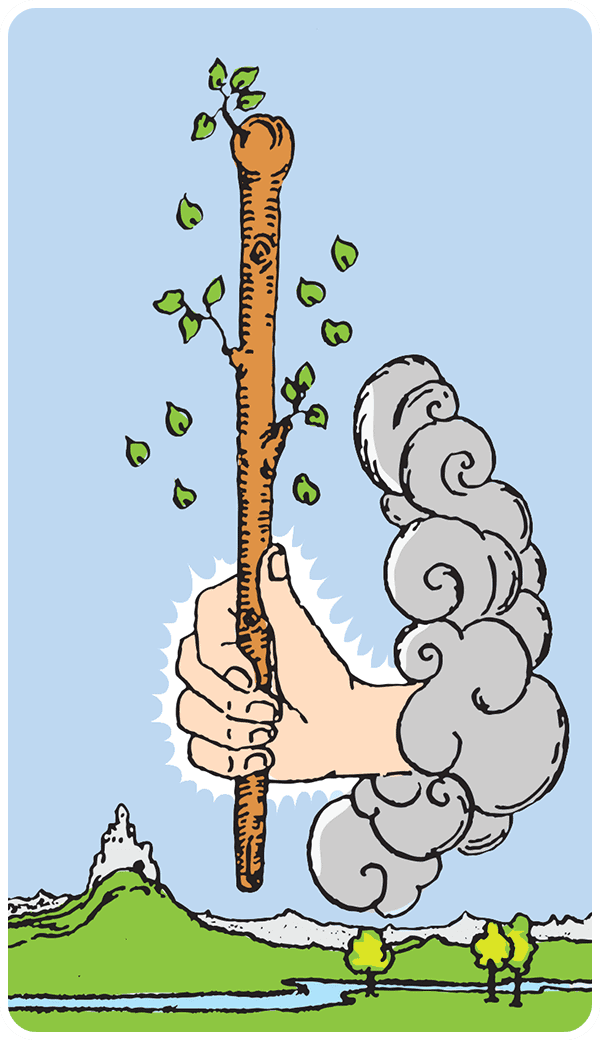
Ace of Wands · plate 1
YES
The Ace of Wands is a yes. But it is a yes to beginning, not a yes to completion. Most people miss this. They pull the card, see fire and momentum, and read it as confirmation that the thing they want will happen. What the card is actually saying is that the conditions to start are present. Whether you finish is a separate question the card is not answering.
Why Ace of Wands reads this way
What the suit, the rank, and the image are doing
Wands is the suit of will and initiation. It governs the part of you that decides to act, that moves toward a thing because you want it, that converts thought into momentum. When Wands cards dominate a reading, the question is almost always about whether to start something, not whether the something will work.
Aces are thresholds. They describe the moment a door opens — the precondition for action, not the action's outcome. The Ace of Wands is not the fire burning; it is the spark catching. It is the instant you feel the pull to move and the path clears enough to take the first step.
Look at the image. A hand emerges from a cloud, holding a wooden staff. The staff is alive — leaves are sprouting from it. The landscape behind it is open, fertile, waiting. The hand is offering the staff to you. It has not been grasped yet. The card describes potential energy at the moment it becomes kinetic. The yes is to the spark, not to what the spark will eventually consume.
The most common misreading in a yes/no context is treating the Ace of Wands as a promise of success. Someone asks, "Will this job work out?" or "Should I move cities?" and they pull the Ace of Wands and read it as the universe saying, "Yes, do it, it will be great." That is not what the card says. The card says the ignition is there. What happens after ignition depends on fuel, on follow-through, on whether the conditions three months from now still support the fire. The Ace of Wands does not see that far.
How the card reads for two different situations
If you are asking, "Should I start this?" — a new project, a new relationship, a new direction — the Ace of Wands is an unambiguous yes. The card is describing exactly that moment: the threshold where starting becomes possible. The energy is present, the path is clear enough, and waiting longer will not improve the conditions. Start now.
If you are asking, "Will this work out?" — will the relationship last, will the business succeed, will the move be worth it — the Ace of Wands is a maybe leaning toward irrelevant. The card is not reading outcome. It is reading readiness. You can start. Whether you sustain is a question for the middle of the deck, not the beginning. If this is your question and the Ace of Wands is your answer, the reading is telling you that you are asking the wrong question. You do not need to know if it will work out. You need to know if you are willing to begin.
The tell that someone is misreading the card
The tell is when someone pulls the Ace of Wands, takes it as a green light, starts the thing, and then three months later feels betrayed because the thing got hard. They say, "But the card said yes." The card said yes to the start. It did not say the start would be easy, or that momentum would carry itself, or that external conditions would stay favorable. The Ace of Wands describes the moment the match strikes. It does not describe whether you keep feeding the fire.
A grounded observation
Go back through your last six months and find the thing you started on impulse, the thing that felt obvious in the moment. That was an Ace of Wands threshold. Whether you are still doing it now is a different card.
Key themes to watch for
- № 01Theme
Affirmative current
- № 02Theme
Open door
- № 03Theme
Forward motion
What to do with this reading
Read the upright meaning first, even if you pulled the card reversed. The reversal is a commentary on the upright — not a separate card.
Notice what your body did when you saw Ace of Wands. That reaction is usually closer to the truth than the interpretation.
Write down one sentence: What is this card asking me to stop avoiding? Let the answer be smaller than you expect.
Come back to this card in 48 hours. Most yes / no readings sharpen with a little distance.
Questions answered
Frequently asked
The Ace of Wands is a yes. But it is a yes to beginning, not a yes to completion. Most people miss this. They pull the card, see fire and momentum, and read it as confirmation that the thing they want will happen. What the card is actually saying is that the conditions to start are present. Whether you finish is a separate question the card is not answering.
Reversed cards are rarely "bad." Ace of Wands reversed asks you to look at where the same theme is blocked, postponed, or being avoided — usually with more compassion than the upright version.
Ace of Wands colors the cards around it. Pay attention to where its themes — creative momentum, will and appetite, the spark that wants to be tended — show up in the next card. That is usually where the story is.
Tarot is observational, not predictive. Ace of Wands describes the conditions in front of you right now and where they tend to lead if nothing changes — not a guarantee of timing.
Repeat cards are the deck underlining a theme. With Ace of Wands, that usually means the question you are asking is the right one — but you have not yet acted on what the card is showing you.
Read next
Related readings
More Wands · Yes / No
- Two of Wands — Yes / NoHow Two of Wands reads in a yes / no context.
- Three of Wands — Yes / NoHow Three of Wands reads in a yes / no context.
- Four of Wands — Yes / NoHow Four of Wands reads in a yes / no context.
- Five of Wands — Yes / NoHow Five of Wands reads in a yes / no context.
- Six of Wands — Yes / NoHow Six of Wands reads in a yes / no context.
- Seven of Wands — Yes / NoHow Seven of Wands reads in a yes / no context.
Other Ace of Wands readings
- General MeaningAce of Wands read for general meaning.
- Love & RelationshipsAce of Wands read for love & relationships.
- Career & WorkAce of Wands read for career & work.
- Money & FinanceAce of Wands read for money & finance.
- Health & WellbeingAce of Wands read for health & wellbeing.
- SpiritualityAce of Wands read for spirituality.