Five of Wands in Yes / No
The Five of Wands in a yes/no reading means maybe — not because the outcome is unclear, but because five competing agendas are still playing out.
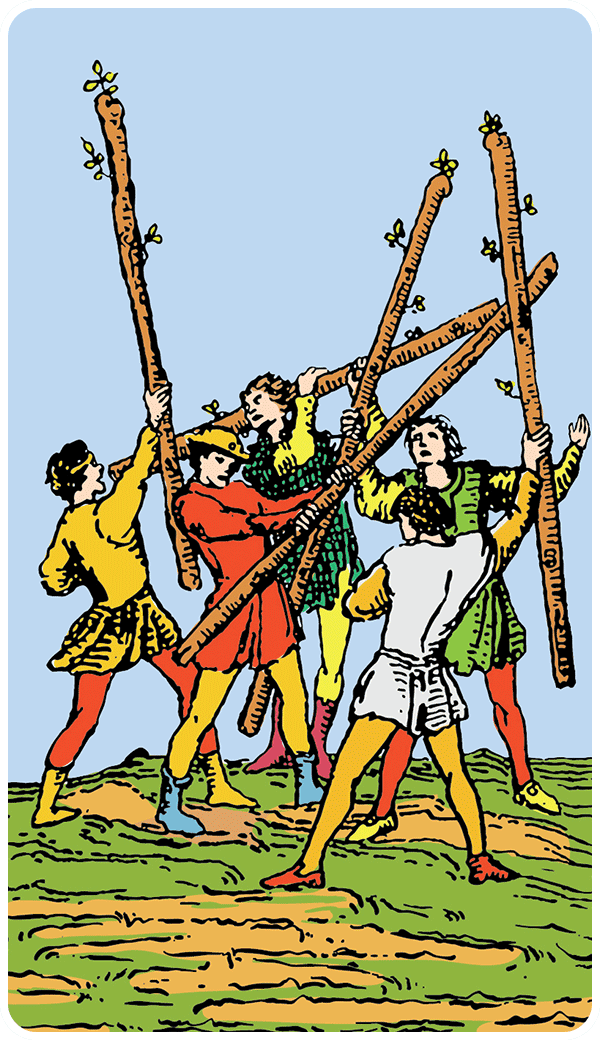
Five of Wands · plate 5
MAYBE
The Five of Wands in a yes/no reading is maybe. Not because the card is indecisive, but because the situation it describes is still actively contested. Five figures are mid-swing with their wands raised, each angling for position, none of them clearly winning or losing yet. The outcome depends on whether you can stay in the scrum long enough to see who tires first.
Most people read this card as a hard no — they see conflict and assume failure. That misreading costs them. The Five of Wands doesn't describe defeat. It describes the phase where the thing you want is still being fought over, and walking away now means you forfeit by default.
Why Five of Wands reads this way
What the suit, rank, and image are doing
Wands governs will, initiative, and the forward motion of a project or desire. It is the suit of action, ambition, and the part of you that says I want this and moves toward it. When Wands cards show up, the question is almost always about momentum — whether you have it, whether you can sustain it, whether the environment will let you keep it.
Fives in tarot describe instability and competition. They are the number of conflict, but not the kind that resolves cleanly. A Five is the moment multiple forces are pulling in different directions and no single force has won yet. The Five of Pentacles is material insecurity. The Five of Cups is emotional loss that hasn't been processed. The Five of Wands is the scrum — five people with five agendas, all trying to move the same object in five different directions.
Look at the image. Five figures hold wands and appear to be fighting, but no one is injured. No one has dropped their wand. No one is walking away. This is not war. This is jockeying. The question the card asks is whether you have the stamina to stay in the jockeying long enough for the field to thin.
How the card reads for two different querent situations
If the querent is asking a yes/no question about something they are actively pursuing — a job, a deal, a relationship they are trying to start — the Five of Wands leans toward yes, but only if they can outlast the competition. The card is saying: you are not the only person who wants this. The outcome is not yet decided. If you stay in and keep swinging, you have a real chance. If you interpret the presence of competition as a sign to quit, you lose by default.
If the querent is asking about something they want to happen to them — whether someone will reach out, whether an opportunity will arrive without their effort — the Five of Wands leans toward no. The card describes a situation where five agendas are in motion and none of them are aligned with yours yet. Waiting for resolution without participating in the scrum means you are not in the game. The answer becomes yes only if you insert yourself into the conflict and make your case.
The tell that someone is misreading the card
The tell is when someone sees the Five of Wands and immediately interprets it as "too much drama, not worth it." They decide the presence of competition or friction means the thing they want is cursed, or that the universe is telling them to let it go. That is not what the card is saying. The Five of Wands is neutral on whether the thing is worth it. It is only describing what is currently true: multiple people want the same thing, and the outcome is still being determined.
The card becomes a hard no only when the querent has no willingness to compete, no stamina for the back-and-forth, or no skin in the game. If you are asking "will this happen?" and you are not willing to be one of the five people with a wand raised, the answer is no. If you are willing to stay in the scrum, the answer is maybe, and maybe is enough to keep moving.
A grounded observation
Go back through your calendar and look for the last time you walked away from something because other people wanted it too. Check whether the thing you wanted actually went to someone else, or whether everyone else also walked away and the opportunity sat there unclaimed.
Key themes to watch for
- № 01Theme
Affirmative current
- № 02Theme
Open door
- № 03Theme
Forward motion
What to do with this reading
Read the upright meaning first, even if you pulled the card reversed. The reversal is a commentary on the upright — not a separate card.
Notice what your body did when you saw Five of Wands. That reaction is usually closer to the truth than the interpretation.
Write down one sentence: What is this card asking me to stop avoiding? Let the answer be smaller than you expect.
Come back to this card in 48 hours. Most yes / no readings sharpen with a little distance.
Questions answered
Frequently asked
The Five of Wands in a yes/no reading is maybe. Not because the card is indecisive, but because the situation it describes is still actively contested. Five figures are mid-swing with their wands raised, each angling for position, none of them clearly winning or losing yet. The outcome depends on whether you can stay in the scrum long enough to see who tires first.
Reversed cards are rarely "bad." Five of Wands reversed asks you to look at where the same theme is blocked, postponed, or being avoided — usually with more compassion than the upright version.
Five of Wands colors the cards around it. Pay attention to where its themes — creative momentum, will and appetite, the spark that wants to be tended — show up in the next card. That is usually where the story is.
Tarot is observational, not predictive. Five of Wands describes the conditions in front of you right now and where they tend to lead if nothing changes — not a guarantee of timing.
Repeat cards are the deck underlining a theme. With Five of Wands, that usually means the question you are asking is the right one — but you have not yet acted on what the card is showing you.
Read next
Related readings
More Wands · Yes / No
- Ace of Wands — Yes / NoHow Ace of Wands reads in a yes / no context.
- Two of Wands — Yes / NoHow Two of Wands reads in a yes / no context.
- Three of Wands — Yes / NoHow Three of Wands reads in a yes / no context.
- Four of Wands — Yes / NoHow Four of Wands reads in a yes / no context.
- Six of Wands — Yes / NoHow Six of Wands reads in a yes / no context.
- Seven of Wands — Yes / NoHow Seven of Wands reads in a yes / no context.
Other Five of Wands readings
- General MeaningFive of Wands read for general meaning.
- Love & RelationshipsFive of Wands read for love & relationships.
- Career & WorkFive of Wands read for career & work.
- Money & FinanceFive of Wands read for money & finance.
- Health & WellbeingFive of Wands read for health & wellbeing.
- SpiritualityFive of Wands read for spirituality.