Seven of Wands in Yes / No
The Seven of Wands leans yes in a yes/no reading, but only if you're already in the fight. Here's what the card is actually describing and when the answer flips.
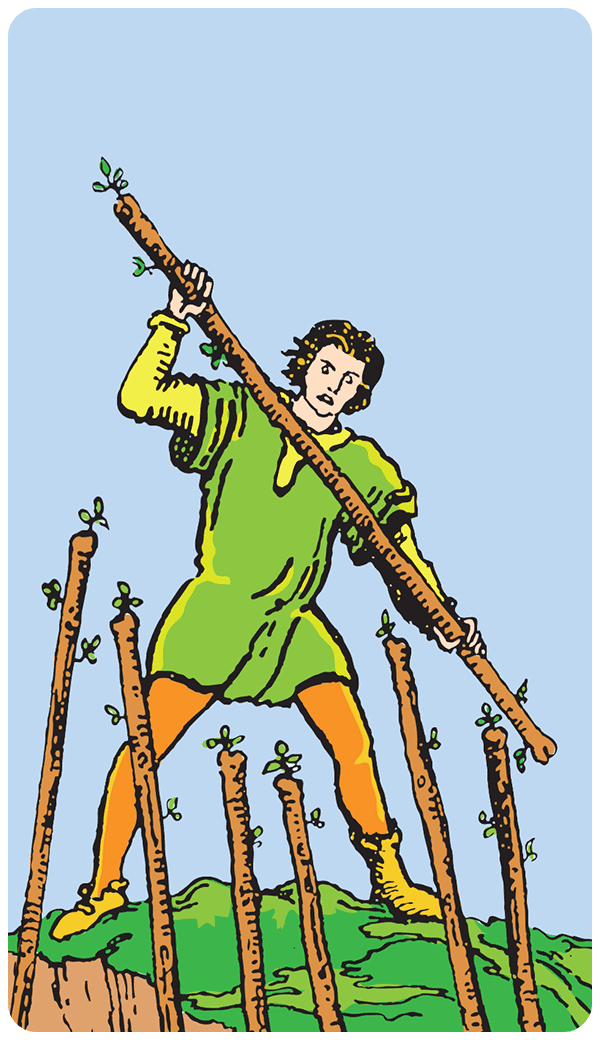
Seven of Wands · plate 7
YES
The Seven of Wands leans yes in a yes/no reading, but it is a qualified yes — the kind that requires you to stay in the arena. Most people read the card as pure conflict and assume it means no, stop, don't proceed. That misses what the image is showing. The figure on the card is already on the hill. They already have the high ground. The question is not whether to engage; the question is whether they can hold the position they've claimed.
Why Seven of Wands reads this way
What the suit, rank, and image are doing
Wands is the suit of will, momentum, and directed energy. It governs action taken because you decided to take it, not because circumstances forced your hand. When Wands cards dominate a reading, the querent is almost always asking about something they are actively pushing forward — a project, a pursuit, a claim they are making on their own life. The suit does not describe passivity.
Seven is the rank of test and persistence. Sevens across all suits describe a moment where the initial momentum has carried you to a threshold, and now you have to prove you can sustain what you started. The Seven of Pentacles is the gardener mid-season, deciding whether to keep tending. The Seven of Cups is the dreamer sorting real options from distraction. The Seven of Wands is the person who has taken a visible position and now has to defend it against pushback.
Look at the image. A figure stands on elevated ground, holding a wand, facing six other wands rising from below. The figure is not retreating. They are not surrounded. They have the advantage of position. The other wands are coming at them one by one, not all at once. The card describes active defense of something already claimed. The question is whether the figure can hold their ground, not whether they should have climbed the hill in the first place.
When the answer is yes versus when it flips
The Seven of Wands reads as yes when the querent is already in motion on the thing they are asking about. If they have already started the business, already made the pitch, already told the person how they feel, already claimed the role — the card says yes, keep going, the resistance you are meeting is normal and does not mean you are wrong. The opposition is the cost of being visible. The card is describing the middle of the process, not the beginning.
The answer flips to no when the querent has not yet started and is asking whether to begin. If the question is "should I apply for this job" or "should I tell them how I feel" and the querent has taken no prior action, the Seven of Wands is describing a fight they are not yet in and may not need to pick. The card does not greenlight a new conflict. It describes how to stay in one you have already chosen.
Reversed, the card often describes exhaustion — the moment the querent realizes they no longer want to hold the hill badly enough to keep defending it. The answer in that case is not no, proceed differently; it is no, let this one go. The fight was real, but the goal stopped mattering.
The tell that someone is misreading the card
The clearest tell is when someone reads the Seven of Wands and immediately pulls back from something they were previously committed to, citing the card as evidence that the path is blocked. If the querent was moving forward with confidence two days ago and now wants to quit because the card "showed conflict," they have misread it. The card does not warn you away from conflict. It describes conflict as the condition of holding your ground. If you were not prepared to meet resistance, you were not prepared for the thing you were asking about.
A grounded observation
Go back through your calendar and look for the moments you stayed in something past the point where it got uncomfortable. The Seven of Wands describes those moments. Whether you held or let go is the answer the card was pointing toward.
Key themes to watch for
- № 01Theme
Affirmative current
- № 02Theme
Open door
- № 03Theme
Forward motion
What to do with this reading
Read the upright meaning first, even if you pulled the card reversed. The reversal is a commentary on the upright — not a separate card.
Notice what your body did when you saw Seven of Wands. That reaction is usually closer to the truth than the interpretation.
Write down one sentence: What is this card asking me to stop avoiding? Let the answer be smaller than you expect.
Come back to this card in 48 hours. Most yes / no readings sharpen with a little distance.
Questions answered
Frequently asked
The Seven of Wands leans yes in a yes/no reading, but it is a qualified yes — the kind that requires you to stay in the arena. Most people read the card as pure conflict and assume it means no, stop, don't proceed. That misses what the image is showing. The figure on the card is already on the hill. They already have the high ground. The question is not whether to engage; the question is whether they can hold the position they've claimed.
Reversed cards are rarely "bad." Seven of Wands reversed asks you to look at where the same theme is blocked, postponed, or being avoided — usually with more compassion than the upright version.
Seven of Wands colors the cards around it. Pay attention to where its themes — creative momentum, will and appetite, the spark that wants to be tended — show up in the next card. That is usually where the story is.
Tarot is observational, not predictive. Seven of Wands describes the conditions in front of you right now and where they tend to lead if nothing changes — not a guarantee of timing.
Repeat cards are the deck underlining a theme. With Seven of Wands, that usually means the question you are asking is the right one — but you have not yet acted on what the card is showing you.
Read next
Related readings
More Wands · Yes / No
- Ace of Wands — Yes / NoHow Ace of Wands reads in a yes / no context.
- Two of Wands — Yes / NoHow Two of Wands reads in a yes / no context.
- Three of Wands — Yes / NoHow Three of Wands reads in a yes / no context.
- Four of Wands — Yes / NoHow Four of Wands reads in a yes / no context.
- Five of Wands — Yes / NoHow Five of Wands reads in a yes / no context.
- Six of Wands — Yes / NoHow Six of Wands reads in a yes / no context.
Other Seven of Wands readings
- General MeaningSeven of Wands read for general meaning.
- Love & RelationshipsSeven of Wands read for love & relationships.
- Career & WorkSeven of Wands read for career & work.
- Money & FinanceSeven of Wands read for money & finance.
- Health & WellbeingSeven of Wands read for health & wellbeing.
- SpiritualitySeven of Wands read for spirituality.