Six of Wands in Yes / No
The Six of Wands in a yes/no reading leans yes — but only if the work is already done. Here's what the card is actually measuring.
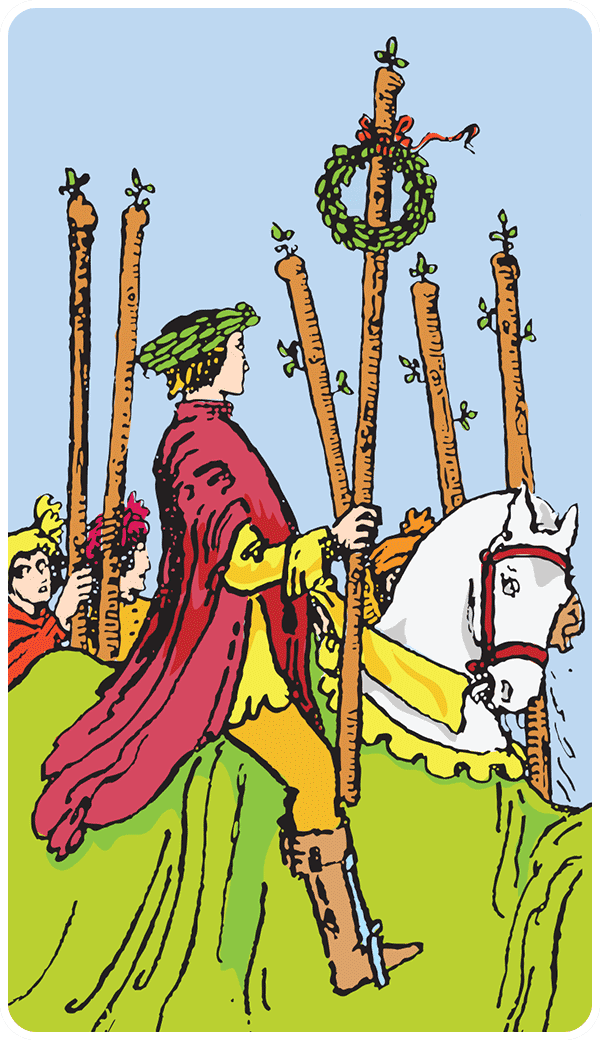
Six of Wands · plate 6
YES
The Six of Wands in a yes/no reading is a yes. But it's a yes with a condition most people miss: the card doesn't predict victory, it names recognition for something you've already accomplished. If you're asking whether something will work out and the work hasn't been done yet, the card isn't answering your question — it's telling you you're asking too early.
Why Six of Wands reads this way
What the suit, rank, and image are doing
Wands is the suit of will, initiative, and forward motion. It governs what you're building, what you're driving toward, and whether the momentum is real or imagined. When Wands cards show up, the question being asked is almost always about action — whether to start, whether to push, whether the thing you're doing is going to land.
Sixes in tarot are cards of outcome and equilibrium. They describe a temporary stability after effort. The Two through Five of any suit are the scramble — the learning, the conflict, the adjustment. The Six is the moment you catch your breath and see what you've produced. It's not permanent. The Seven is already forming. But for now, the thing has resolved.
The image shows a rider on a horse, holding a wand wrapped in a victory wreath, moving through a crowd. People are watching. Some are holding their own wands up in acknowledgment. The rider's posture is upright. This is public recognition. The card is not describing the private moment of finishing the work — it's describing the moment other people see that you finished it and respond accordingly.
The misreading: treating recognition as permission
The most common misreading in a yes/no context is this: the querent pulls the Six of Wands and reads it as cosmic permission to proceed. They think the card is saying "yes, go ahead, it will work." Then they move forward on something half-formed, and it doesn't land, and they blame the card.
What the card was actually saying: if the work is done, the answer is yes — people will see it, it will be received, you will get the acknowledgment you're hoping for. If the work is not done, the card is naming a future state that depends entirely on whether you finish what you started. The Six of Wands does not arrive before effort. It arrives after.
Here's the behavioral tell: if you pull this card and immediately feel relief, like you've been let off the hook, you're misreading it. The Six of Wands does not relieve pressure. It confirms that the pressure you already handled produced something real.
When the answer flips to no or maybe
The answer shifts if the question is about something private or internal. The Six of Wands is a card of external validation. If you're asking "should I leave this job" and what you actually need is rest, not applause, the card reads as a no — you're solving for the wrong variable. If you're asking "will this relationship work" and the relationship has no witnesses, no shared public context, no one rooting for it, the card reads as maybe at best. It wants an audience. If there isn't one, the card has nothing to measure.
Reversed, the Six of Wands is not defeat — it's recognition withheld or delayed. The work is done, but no one is clapping yet. In a yes/no reading, reversed usually means "yes, but not on the timeline you want" or "yes, but you'll have to ask for the acknowledgment instead of waiting for it to arrive."
A grounded observation
Go back through your calendar and look for the moment you actually finished the thing you're asking about. If that moment hasn't happened yet, the Six of Wands isn't answering — it's describing what happens after you do.
Key themes to watch for
- № 01Theme
Affirmative current
- № 02Theme
Open door
- № 03Theme
Forward motion
What to do with this reading
Read the upright meaning first, even if you pulled the card reversed. The reversal is a commentary on the upright — not a separate card.
Notice what your body did when you saw Six of Wands. That reaction is usually closer to the truth than the interpretation.
Write down one sentence: What is this card asking me to stop avoiding? Let the answer be smaller than you expect.
Come back to this card in 48 hours. Most yes / no readings sharpen with a little distance.
Questions answered
Frequently asked
The Six of Wands in a yes/no reading is a yes. But it's a yes with a condition most people miss: the card doesn't predict victory, it names recognition for something you've already accomplished. If you're asking whether something will work out and the work hasn't been done yet, the card isn't answering your question — it's telling you you're asking too early.
Reversed cards are rarely "bad." Six of Wands reversed asks you to look at where the same theme is blocked, postponed, or being avoided — usually with more compassion than the upright version.
Six of Wands colors the cards around it. Pay attention to where its themes — creative momentum, will and appetite, the spark that wants to be tended — show up in the next card. That is usually where the story is.
Tarot is observational, not predictive. Six of Wands describes the conditions in front of you right now and where they tend to lead if nothing changes — not a guarantee of timing.
Repeat cards are the deck underlining a theme. With Six of Wands, that usually means the question you are asking is the right one — but you have not yet acted on what the card is showing you.
Read next
Related readings
More Wands · Yes / No
- Ace of Wands — Yes / NoHow Ace of Wands reads in a yes / no context.
- Two of Wands — Yes / NoHow Two of Wands reads in a yes / no context.
- Three of Wands — Yes / NoHow Three of Wands reads in a yes / no context.
- Four of Wands — Yes / NoHow Four of Wands reads in a yes / no context.
- Five of Wands — Yes / NoHow Five of Wands reads in a yes / no context.
- Seven of Wands — Yes / NoHow Seven of Wands reads in a yes / no context.
Other Six of Wands readings
- General MeaningSix of Wands read for general meaning.
- Love & RelationshipsSix of Wands read for love & relationships.
- Career & WorkSix of Wands read for career & work.
- Money & FinanceSix of Wands read for money & finance.
- Health & WellbeingSix of Wands read for health & wellbeing.
- SpiritualitySix of Wands read for spirituality.