Ten of Swords in General
The Ten of Swords doesn't predict disaster. It names the moment you stop fighting what already happened. Here's what the card is doing when it shows up.
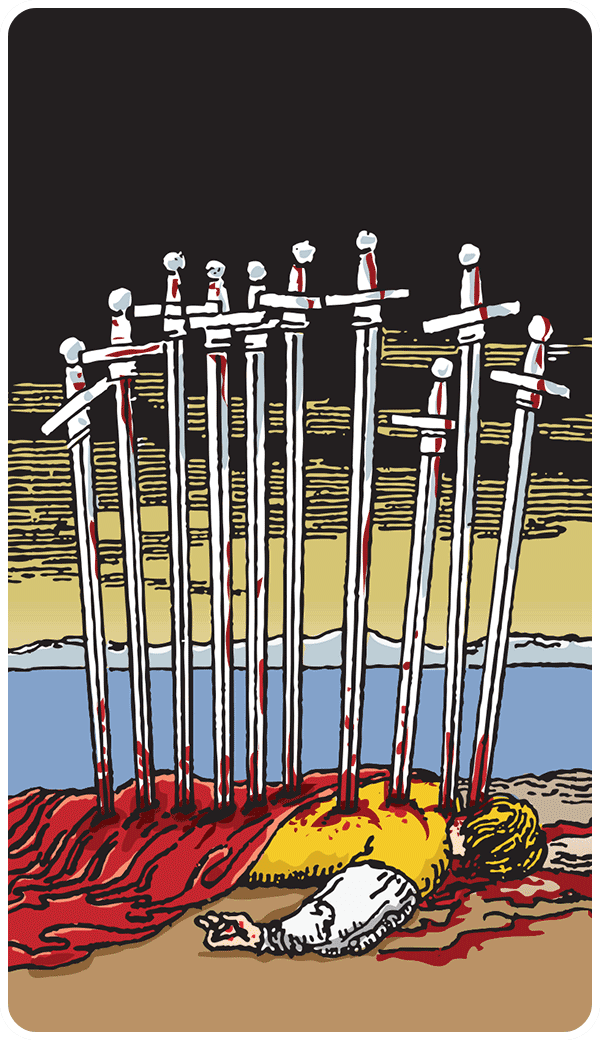
Ten of Swords · plate 10
What the card is actually doing
The Ten of Swords lands and the querent recoils. They see the figure face-down with ten swords in the back and read it as catastrophe incoming, betrayal waiting, the worst possible outcome about to arrive. That is not what the card is doing. The Ten of Swords does not describe something that is about to happen. It describes something that has already finished happening — and the specific moment when you finally stop pretending it hasn't.
Reading Ten of Swords in general
What the suit, the rank, and the image are each doing
Swords governs thought, narrative, and the stories you tell yourself about what is happening to you. It is the suit of how you frame events, how you argue with reality, how you decide what something means. When Swords cards dominate a reading, the pain in the question is almost always cognitive — not that the situation is unbearable, but that the mind will not stop running the same loop.
Tens in tarot mark completion. They are the end of a cycle, the point where a suit's energy has run its full course and cannot continue in its current form. The Ten of Pentacles is material stability that has fully arrived. The Ten of Cups is relational contentment that has settled. Tens do not predict; they describe a state that has been reached.
Now look at the image. A figure lies face-down on the ground. Ten swords pierce the back. The sky is dark, but the horizon shows yellow — dawn is coming. The figure is still. The swords are already in place. There is no struggle happening. This is the mechanical answer: the Ten of Swords is the moment the fight ends because there is nothing left to fight. The thing you were resisting has fully landed. The narrative you were holding against the evidence has collapsed. What the card names is not the disaster — it is the exhaustion that follows the disaster, and the stillness that arrives when you finally stop.
How it reads for two different querent situations
For someone in the middle of a breakup they are still arguing against, the Ten of Swords is the morning they wake up and do not immediately check their ex's location. The swords are the ten rounds of "maybe if I just" that have all failed. The card is not saying the relationship is over — the relationship was already over. The card is naming the moment the nervous system stops running the same search.
For someone in a job they have been trying to save for two years, the Ten of Swords is the day they stop rewriting the email to their manager. The performance improvement plan has been in place. The raises have not come. The project they built their identity around got reassigned. The card describes the point where the story you were telling yourself about what this job could become finally dies, and you are left on the ground with it.
The tell that someone is misreading the card on themselves
The misreading sounds like this: "So something terrible is going to happen." No. Something terrible already happened, or something you wanted very badly has already not happened, and you have been in cleanup mode for longer than you realize. If the Ten of Swords shows up and you cannot name what it is describing, go back six months. Look for the moment you started saying "I just need to get through this" and never stopped saying it. The card is not a warning. It is a timestamp.
From the practice
“A card never tells you what to do. It tells you what you're already deciding — and gives you the words to name it.”
A grounded observation
The Ten of Swords does not arrive to tell you that you are defeated. It arrives to tell you that you are done being defeated, whether you have noticed yet or not.
Key themes to watch for
- № 01Theme
Beginnings
- № 02Theme
Inner movement
- № 03Theme
Receptivity
What to do with this reading
Read the upright meaning first, even if you pulled the card reversed. The reversal is a commentary on the upright — not a separate card.
Notice what your body did when you saw Ten of Swords. That reaction is usually closer to the truth than the interpretation.
Write down one sentence: What is this card asking me to stop avoiding? Let the answer be smaller than you expect.
Come back to this card in 48 hours. Most general readings sharpen with a little distance.
Questions answered
Frequently asked
The Ten of Swords presents a moment that feels like rock bottom, a culmination of stress or a painful ending. It's a card that acknowledges the weight of finality, perhaps when something important concludes in a less-than-ideal way. Yet, in this low point, there's a small glimmer—the night before dawn, the pause before renewal. This card invites you to recognize that endings, though hard, are often the compost for new beginnings. Reflect on what’s been lost and consider how you might gather the strength to rise again.
Reversed, the Ten of Swords suggests a slow climb back from despair. The worst may be behind you, but recovery takes time. There's a sense of release, where the swords start to loosen their grip, hinting at regeneration. It’s like seeing the first hint of green after a harsh winter. Consider what healing looks like for you, and how you might embrace the chance to rebuild with resilience. What small steps can you take towards feeling whole again?
Ten of Swords colors the cards around it. Pay attention to where its themes — mental clarity, the truth being named, what the mind needs to release — show up in the next card. That is usually where the story is.
Tarot is observational, not predictive. Ten of Swords describes the conditions in front of you right now and where they tend to lead if nothing changes — not a guarantee of timing.
Repeat cards are the deck underlining a theme. With Ten of Swords, that usually means the question you are asking is the right one — but you have not yet acted on what the card is showing you.
Read next
Related readings
More Swords · General
- Ace of Swords — GeneralHow Ace of Swords reads in a general context.
- Two of Swords — GeneralHow Two of Swords reads in a general context.
- Three of Swords — GeneralHow Three of Swords reads in a general context.
- Four of Swords — GeneralHow Four of Swords reads in a general context.
- Five of Swords — GeneralHow Five of Swords reads in a general context.
- Six of Swords — GeneralHow Six of Swords reads in a general context.
Other Ten of Swords readings
- Love & RelationshipsTen of Swords read for love & relationships.
- Career & WorkTen of Swords read for career & work.
- Money & FinanceTen of Swords read for money & finance.
- Health & WellbeingTen of Swords read for health & wellbeing.
- SpiritualityTen of Swords read for spirituality.
- Yes / No AnswerTen of Swords read for yes / no answer.