Temperance in Spirit
Temperance gets read as 'balance' or 'moderation' in spiritual practice. What it actually names is the alchemical process of integrating opposites over time.
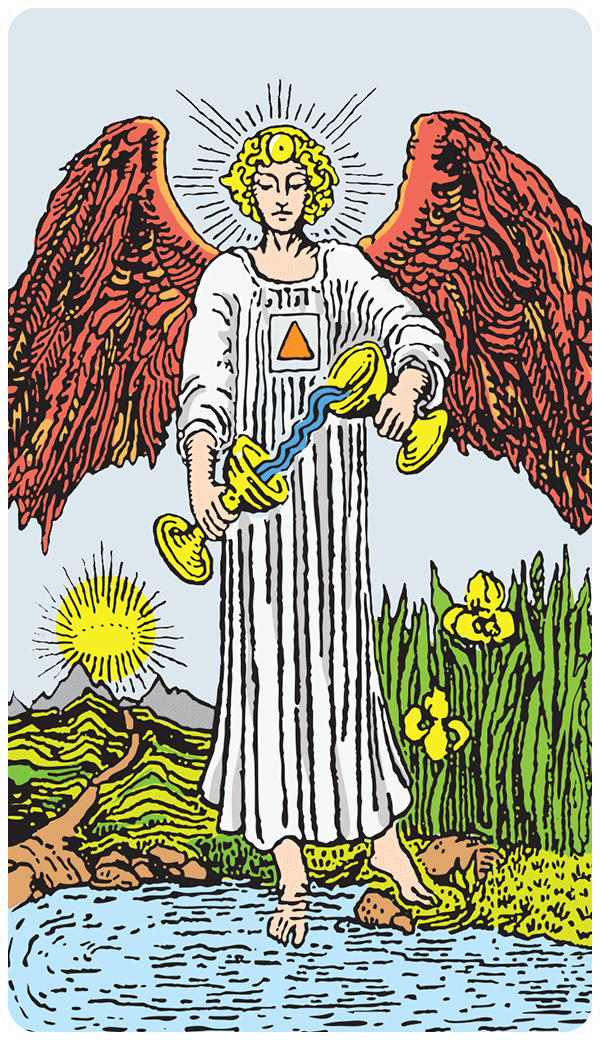
Temperance · plate 14
What the card is actually doing
Temperance shows up in a spirituality reading and the querent hears 'balance.' They think the card is telling them to meditate more, eat cleaner, find equilibrium between work and rest. They treat it as a prescription for lifestyle management.
That is not what the card is doing. Temperance is not about adding moderation to your routine. It is about the specific psychological work of holding two incompatible truths at the same time until something new emerges from the friction.
Reading Temperance in spirit
What the Major Arcana rank, the angel figure, and the water transfer are each doing
Temperance is Major Arcana fourteen. The Majors describe structural psychological shifts, not day-to-day adjustments. When a Major shows up in a spirituality reading, the question is not 'what should I do this week' — it is 'what part of my inner architecture is being rebuilt right now.'
The figure on the card is an angel pouring water between two cups. One foot is on land, one foot is in water. The angel is not choosing between land and water. It is standing in both at once. This is the mechanical image: holding two states simultaneously without collapsing into either one. The water does not spill. The transfer is controlled. The angel is not rushing.
The alchemical symbol on the angel's chest is the sign for the philosophical process of tempering — heating and cooling a material repeatedly until it becomes something it was not before. Not balanced. Transformed. The card is named for the process, not the outcome. Most readers skip this and go straight to 'moderation,' which flattens the entire mechanism.
How the card reads differently depending on what the querent is actually integrating
If the querent is someone who has spent years in spiritual bypassing — using practice to avoid anger, grief, or confrontation — Temperance names the moment they stop trying to transcend the difficult feeling and start letting it live next to the calm. They sit in meditation and the rage is there and they do not try to breathe it away. They hold both. That is the water moving between cups.
If the querent is someone who has been in a deconstructive phase — tearing down old religious frameworks, rejecting the language they grew up with — Temperance shows up when they start finding pieces of the old system they actually want to keep. They realize they can hold 'that institution harmed me' and 'this prayer still works' in the same hand. The card is not saying 'forgive and move on.' It is saying the integration has started and it will take time.
Reversed, Temperance describes impatience with the process. The querent wants the synthesis now. They try to force the two cups to merge by sheer will. They oscillate instead of integrate — swinging between extremes, calling it balance. The water spills.
The tell that someone is misreading the card on themselves
The querent says 'I need to be more moderate' and starts a new routine. More yoga. Less caffeine. Boundaries with family. They treat Temperance as a to-do list. Six weeks later they are frustrated because they do not feel transformed.
What they missed: Temperance does not describe what you do. It describes what is happening inside you while you are doing nothing visible at all. It is the card of psychological digestion. If you are not currently holding two incompatible truths and letting them erode each other slowly, the card is not about you yet.
From the practice
“A card never tells you what to do. It tells you what you're already deciding — and gives you the words to name it.”
A grounded observation
Go back through your last three months and look for the moment you stopped needing one side of an argument to be wrong. That is when Temperance was actually operating.
Key themes to watch for
- № 01Theme
Heart-opening
- № 02Theme
Divine flow
- № 03Theme
Soul refresh
What to do with this reading
Read the upright meaning first, even if you pulled the card reversed. The reversal is a commentary on the upright — not a separate card.
Notice what your body did when you saw Temperance. That reaction is usually closer to the truth than the interpretation.
Write down one sentence: What is this card asking me to stop avoiding? Let the answer be smaller than you expect.
Come back to this card in 48 hours. Most spirit readings sharpen with a little distance.
Questions answered
Frequently asked
In spirituality, Temperance represents the blending of different beliefs or practices into a harmonious spiritual path. You might be finding peace in a personal ritual or philosophy that resonates deeply. This card invites you to explore how different aspects of your spiritual journey complement one another. Is there a new practice or perspective that could enrich your spiritual tapestry, adding depth and harmony?
Temperance reversed in spirituality points to a possible disconnection or imbalance in your spiritual practices. Perhaps different beliefs are clashing, or you're struggling to find a cohesive path. This card suggests a time to reflect on what truly resonates with you. Consider small adjustments that might help you find a more aligned and peaceful spiritual journey.
Temperance colors the cards around it. Pay attention to where its themes — archetype, pattern, invitation — show up in the next card. That is usually where the story is.
Tarot is observational, not predictive. Temperance describes the conditions in front of you right now and where they tend to lead if nothing changes — not a guarantee of timing.
Repeat cards are the deck underlining a theme. With Temperance, that usually means the question you are asking is the right one — but you have not yet acted on what the card is showing you.
Read next
Related readings
Other Temperance readings
- General MeaningTemperance read for general meaning.
- Love & RelationshipsTemperance read for love & relationships.
- Career & WorkTemperance read for career & work.
- Money & FinanceTemperance read for money & finance.
- Health & WellbeingTemperance read for health & wellbeing.
- Yes / No AnswerTemperance read for yes / no answer.